
Laboratory equipment · Polymer research
Which high pressure reactor is best for lab scale polymerization?
The best high pressure reactor for lab scale polymerization is the one that matches the reaction’s working batch, pressure and temperature requirements, mixing demands, and heat-removal needs. A larger vessel or a higher listed setting does not automatically make an instrument more suitable for a particular polymer formulation.
Practical starting point: The CJF High Pressure Reactor series offers listed vessel capacities from 0.05 L to 30 L. For small formulation studies, the CJF-0.05, CJF-0.1, and CJF-0.5 are worth evaluating; for experiments requiring more material, the CJF-1 and larger models provide additional capacity. Final selection should follow the process requirements rather than the model number alone.
How a high pressure reactor supports polymerization
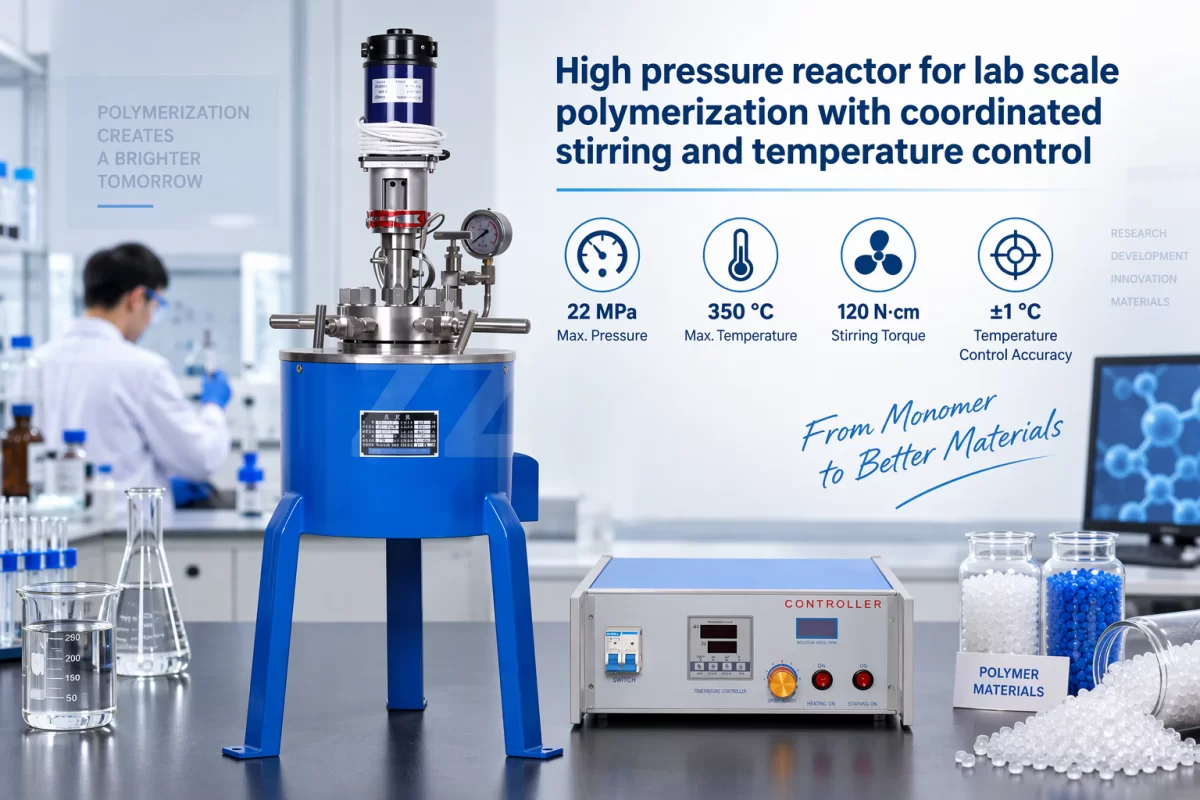
A High Pressure Reactor provides a contained reaction environment for experiments that require elevated pressure. In stirred polymerization, agitation helps distribute reactants and heat, while heating and temperature control establish the intended reaction conditions. Pressure can arise from introduced gases, volatile components, or the reaction itself, depending on the chemistry.
These functions matter when studying pressure-dependent reactions, gas-involving polymerization, or formulations that need controlled conditions above atmospheric pressure. They do not establish compatibility with every monomer, solvent, catalyst, or polymer. Wetted materials, seals, feed arrangements, and the safety system must be selected for the actual process.
The CJF controller provides real-time display and adjustment of speed, temperature, and time, with a standard PID automatic temperature adjustment meter. PID control adjusts heating in response to temperature feedback. It supports temperature regulation, but polymerization heat release still requires a separate assessment of cooling capacity and reaction risk. For an overview of the equipment category, explore this guide to lab scale high pressure reactors.
Choose the CJF capacity around the experiment
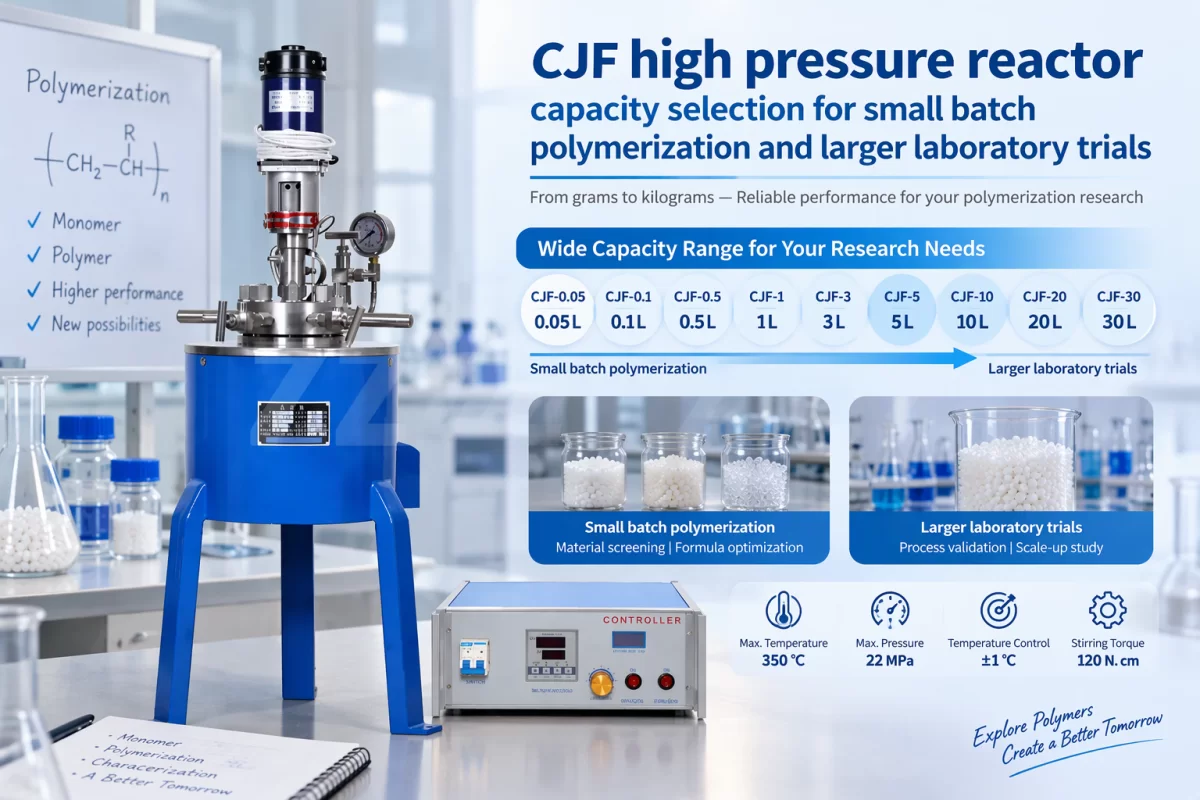
The CJF range includes the following model and capacity combinations. Vessel capacity is not the same as an approved working charge: the intended fill level must account for headspace, gas requirements, thermal expansion, foaming, and the applicable operating procedure.
| Model | Listed capacity (L) |
|---|---|
| CJF-0.05 | 0.05 |
| CJF-0.1 | 0.1 |
| CJF-0.5 | 0.5 |
| CJF-1 | 1 |
| CJF-3 | 3 |
| CJF-5 | 5 |
| CJF-10 | 10 |
| CJF-20 | 20 |
| CJF-30 | 30 |
Small vessels can be useful when screening formulations or conserving costly reagents. Larger vessels may be appropriate when enough polymer is needed for downstream characterization, processing trials, or repeat testing. Moving between sizes, however, changes heat-transfer and mixing behavior; a successful small-batch recipe should not be transferred simply by multiplying ingredient quantities.
Which CJF size is a practical starting point for formulation screening?
My recommendation is to begin with the smallest vessel that accommodates the planned working charge and required headspace. I would shortlist the CJF-0.05, CJF-0.1, or CJF-0.5 for small-volume studies, then compare the sample requirement with the permitted filling conditions. A CJF-1 becomes a more relevant candidate when the experiment needs additional material.
Key CJF specifications for the selection shortlist
The following series specifications describe the listed settings, controls, and installation conditions. Their meaning is important: setting values are not, by themselves, a complete pressure–temperature operating envelope for a particular reaction.
| Parameter | Listed specification |
|---|---|
| Setting pressure | 22 MPa |
| Setting temperature | 350 °C |
| Temperature control accuracy | ±1 °C |
| Stirring torque | 120 N·cm |
| General heating method | Electric heating |
| Other listed heating methods | Far-infrared, thermal oil, steam, and circulating water |
| Temperature controller | Real-time display and adjustment of speed, temperature, and time; standard PID automatic temperature adjustment meter |
| Ambient temperature | 0–50 °C |
| Relative humidity | 30–80% |
| Electrical supply | 220 V, 50/60 Hz |
Selection perspective: Temperature control accuracy is not a promise of identical temperature throughout a reacting polymer mixture. Likewise, a torque figure alone does not establish suitability for every viscosity. Reaction behavior, impeller design, sensor placement, and heat transfer all influence the result.
Does a higher pressure setting make a reactor better for polymerization?
I would not rank reactors on pressure setting alone. I would first examine the required reaction conditions, the permitted pressure–temperature envelope, chemical compatibility, and safety arrangements. Additional pressure capability has purchasing value only when it serves the planned experiments; it cannot compensate for inadequate mixing or heat removal.
What matters most in a lab scale polymerization setup?
Mixing as viscosity develops
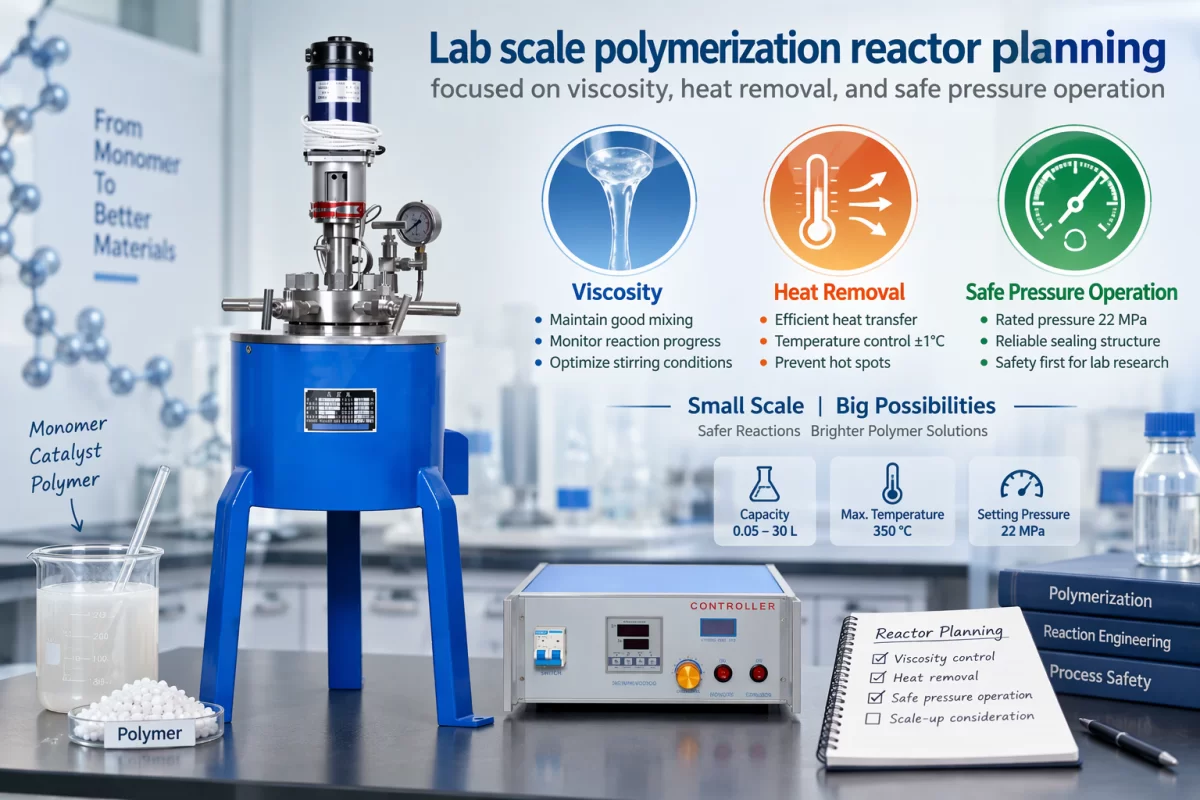
Polymer formation can increase viscosity and change how readily the contents circulate. Selection should therefore consider both the initial liquid mixture and the expected material near the end of the batch. Describe anticipated viscosity, solids, and gas–liquid contact needs when discussing agitation. Do not treat the listed torque as a substitute for an application-specific mixing assessment.
Heat input and heat removal
Heating helps establish reaction conditions, but exothermic polymerization may require active cooling and a controlled feed strategy. The selected thermal arrangement should address startup, reaction heat release, and cooldown. Where a compatible circulating thermal system is part of the proposed setup, a recirculating chiller heater is relevant to the discussion. Its connection and thermal duty must match the reactor configuration and process.
Compatibility, access, and safe operation
Evaluate vessel and seal materials against the full formulation, including cleaning agents. Consider how reactants enter, how samples are collected, and how the polymer is removed afterward. Pressure relief, gas handling, ventilation, and emergency procedures should be addressed before operation. Never open a vessel while it remains pressurized.
Purchasing value: specify the experiment before requesting a quote
The CJF series is worth evaluating when a laboratory needs stirred, pressure-containing equipment with defined capacity choices and adjustable process controls. Its purchasing value depends on how well the selected configuration supports the laboratory’s actual workload—not on an unsupported claim that one model is best for all polymerizations.
For a focused quotation, provide the following information:
- Formulation: monomers, solvents, catalysts, gases, and expected chemical compatibility requirements.
- Batch plan: working charge, headspace needs, desired sample quantity, and anticipated test frequency.
- Process conditions: target pressure, temperature profile, reaction duration, and expected heat release.
- Configuration needs: agitation, heating and cooling, feed and sampling connections, cleaning access, and laboratory utilities.
What makes a reactor quotation useful for comparing purchase options?
I look for a quotation tied to a defined model and a clear configuration scope. It should identify the vessel size, materials, agitation arrangement, thermal equipment, controls, and included accessories. That approach makes the investment easier to evaluate against the planned experiments rather than comparing equipment names alone.
The best high pressure reactor is the best process match
For lab scale polymerization, start with the working batch and reaction requirements, then select the CJF capacity and configuration that fit. Small-capacity models are sensible candidates for formulation screening; larger options become relevant when sample demand increases. Across the shortlist, mixing performance, heat management, chemical compatibility, and safe operation deserve as much attention as pressure and temperature settings.
Explore the High Pressure Stirred Reactor product page and submit the material, batch, and process requirements for a corresponding proposal and quotation. A well-defined specification is the most practical route to choosing a reactor that supports meaningful polymerization research.