
Industrial equipment selection guide
How to choose an industrial solvent recovery system?
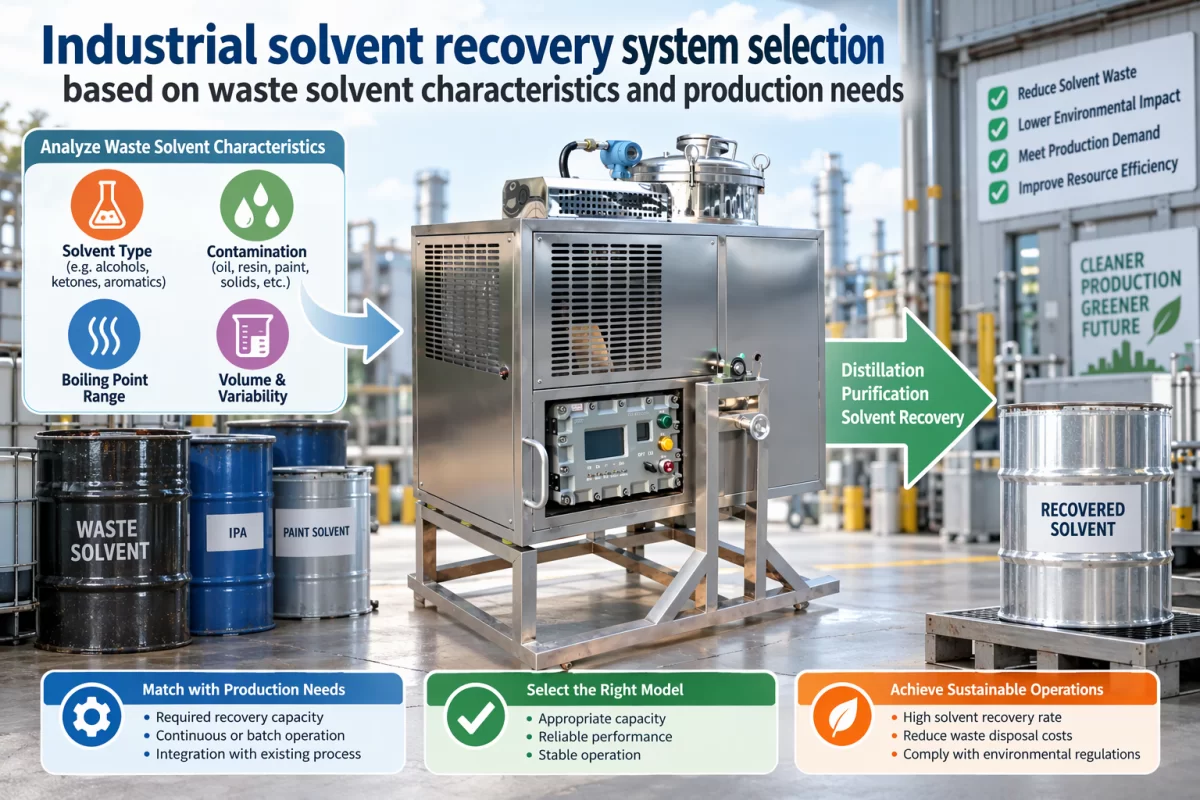
Choosing an industrial solvent recovery system starts with the waste solvent—not simply the largest machine or the lowest purchase price. Solvent composition, contamination, working batch size, available utilities, and the intended reuse standard all affect whether a recovery installation will fit a production process.
A Solvent Recovery Machine is used to reclaim reusable solvent from suitable contaminated liquid streams. For printing, industrial cleaning, and other solvent-consuming operations, recovery can help reduce fresh-solvent purchases and the volume of liquid waste requiring disposal. The right choice connects the equipment’s specifications with a clearly defined operating task.
Understand how a solvent recovery machine works
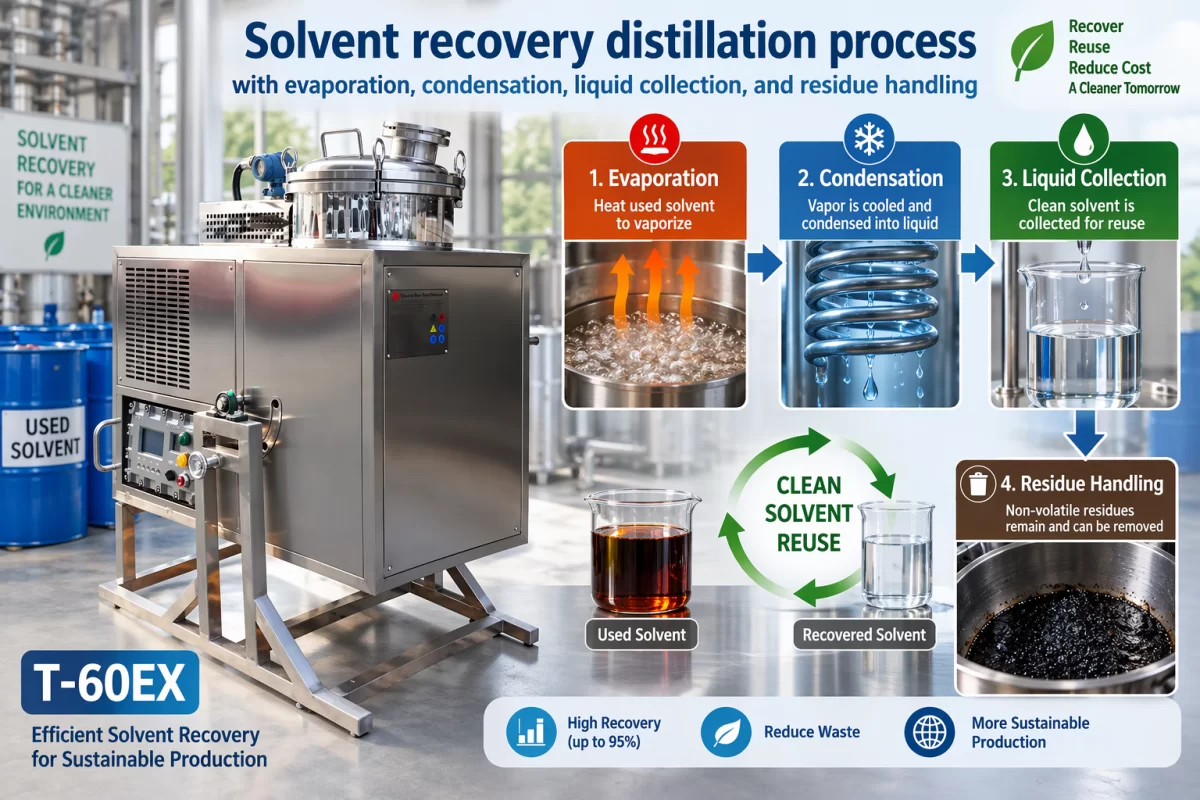
Distillation-based solvent recovery separates components through differences in volatility. Contaminated solvent is heated so that recoverable volatile components evaporate. The vapor is then cooled and condensed into a liquid collection stream, while less-volatile contamination remains in the distillation vessel.
This principle is useful for separating solvent from many nonvolatile residues, but it does not mean that every waste mixture produces solvent suitable for immediate reuse. Water, multiple solvents, dissolved contaminants, and heat-sensitive substances can change the separation behavior. The recovered liquid should be assessed against the requirements of its next application.
For additional process context, explore how solvent recovery distillation units support industrial processes. Understanding the separation task helps prevent an equipment purchase based on capacity alone.
Does a high recovery percentage guarantee reusable solvent purity?
Alice: I distinguish recovery yield from product quality. A recovery percentage describes how much material is reclaimed; it does not establish the purity or composition of the collected solvent. I recommend testing the recovered liquid against the cleaning, formulation, or processing requirements of the intended reuse.
Compare model-specific capacity and key parameters
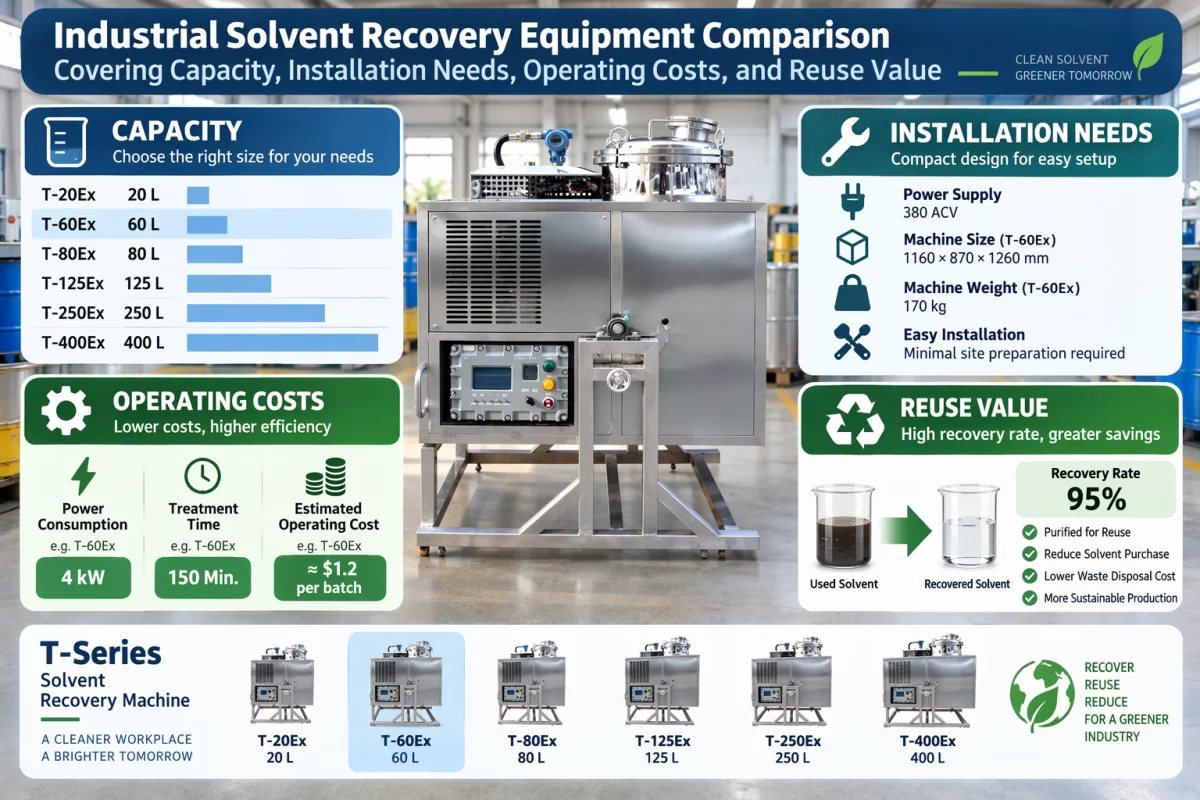
The T-series specifications below provide a practical starting point for comparing feed capacity, electrical supply, heating power, treatment time, and installation dimensions. Keep each specification attached to its model. A larger feed capacity also changes the heating requirement, machine weight, and space needed for installation.
| Model | Feed capacity (L) |
Power supply (AC V) |
Heating power (kW) |
Temperature range (°C) |
Treatment time (min) |
Listed recovery (%) |
Machine weight (kg) |
Machine size (mm) |
|---|---|---|---|---|---|---|---|---|
| T-20Ex | 20 | 380 | 2 | RT–200 | 120 | 95 | 153 | 860 × 760 × 1190 |
| T-60Ex | 60 | 380 | 4 | RT–200 | 150 | 95 | 170 | 1160 × 870 × 1260 |
| T-80Ex | 80 | 380 | 5 | RT–200 | 180 | 95 | 200 | 1180 × 850 × 1290 |
| T-125Ex | 125 | 380 | 6 | RT–200 | 210 | 95 | 280 | 1250 × 920 × 1450 |
| T-250Ex | 250 | 380 | 16 | RT–200 | 240 | 95 | 520 | 2600 × 1200 × 1950 |
| T-400Ex | 400 | 380 | 32 | RT–200 | 270 | 95 | 1200 | 1990 × 1850 × 2090 |
RT means room temperature. Listed treatment times and recovery percentages are specification values, not guarantees for every waste composition. Recovery percentage is not a solvent-purity specification, and feed capacity is not an hourly throughput rating.
For example, the T-60Ex lists a 60 L feed capacity and 4 kW heating power, whereas the T-250Ex lists a 250 L feed capacity and 16 kW heating power. These differences matter for batch planning and electrical installation. Heating power alone should not be treated as the complete system’s energy consumption.
Similarly, machine dimensions describe the equipment envelope, not the full operating area. Allow additional space for loading, collection containers, residue removal, maintenance access, and safe movement around the unit.
How to choose the right industrial solvent recovery system
- Define the feed. Record solvent identities, approximate mixture composition, water content, and the type of contamination. Include information about solids, oils, inks, or other residues and any known thermal hazards.
- Identify the normal working batch. Measure how much waste solvent accumulates during a typical production period. Select a feed capacity that fits the operating schedule rather than assuming the entire daily volume must be processed in one charge.
- Plan the complete operating cycle. Account for charging, heating, distillation, cooling, unloading, and cleaning. A listed treatment time should not automatically be interpreted as the complete turnaround time between batches.
- Check utilities and installation. The listed T-series models use a 380 V AC supply. Assess available electrical capacity, cooling arrangements, ventilation, access routes, and the installation area before selecting a model.
- Evaluate safety for the actual site. Flammable-solvent service requires appropriate equipment protection, grounding, ventilation, and operating procedures. Assess the proposed configuration’s documentation against the site’s hazardous-area and regulatory requirements.
- Set a reuse acceptance standard. Define the tests needed for the recovered solvent and a practical method for handling residual waste. Successful recovery includes both usable output and manageable residue.
Is the largest feed capacity always the best industrial choice?
Alice: I would choose capacity around the actual waste-generation pattern and available operating hours. A larger unit may accommodate bigger charges, but it also introduces different power, space, and handling requirements. The most suitable model is the one that fits production without creating unnecessary installation or operating burdens.
Match solvent recycling equipment to the application
The product range includes listings for printing-industry recovery, ethyl acetate recovery, xylene and toluene distillation, hydrocarbon cleaning solvent recovery, and IPA recovery for electronics cleaning. These application categories are useful starting points, but solvent identity alone is not enough to select a configuration.
In printing operations, assess the solvent mixture together with ink-related contamination and residue behavior. For industrial cleaning, consider the oils, dissolved material, or other contaminants introduced during use. Electronics-cleaning applications require particular attention to the recovered solvent’s acceptance criteria before returning it to the cleaning process.
Mixed-solvent streams deserve special consideration because distillation can change their relative composition. Keep incompatible waste streams separate and evaluate a representative sample when developing the recovery approach. Process testing can help establish whether the reclaimed liquid fits the intended reuse and how the remaining residue should be managed.
Evaluate reference pricing and purchasing value
Purchase price is one part of an industrial solvent recovery decision. A useful comparison also includes installation, electricity, cooling, operator time, maintenance, residue disposal, and testing of the recovered solvent. Savings depend on how much recovered liquid can actually replace fresh solvent in the process.
This is a purchasing reference, not a model-specific quotation. The actual quotation depends on the selected configuration and the results of the inquiry.
Build the investment case using existing purchasing and waste-management records. Compare the value of fresh solvent displaced and any reduction in disposal expenses against the added operating costs of recovery. Avoid assuming that all feed becomes reusable product or that the machine operates continuously throughout every shift.
For a structured financial assessment, read about evaluating waste solvent recycling savings and investment costs. A realistic calculation is more useful than a payback estimate based only on machine capacity.
What information makes a solvent recovery quotation more useful?
Alice: I recommend supplying the solvent composition, contamination details, normal working batch, desired processing schedule, available utilities, and recovered-solvent quality target. Site safety requirements and preferred handling arrangements also help define a suitable configuration and a meaningful quotation.
Choose industrial solvent recovery around a defined process
The answer to how to choose an industrial solvent recovery system is to connect solvent suitability, batch planning, model specifications, installation requirements, and operating economics. The T-series offers several feed-capacity options, but selection should follow the actual recovery task rather than a single headline figure.
Prepare the material details, working batch, target operating conditions, and configuration needs before requesting a proposal. This gives the equipment discussion a practical foundation and helps identify a Solvent Recovery Machine that supports the intended production workflow.