
Laboratory equipment · Powder development
Mini lab spray dryer machine for pharmaceutical powders
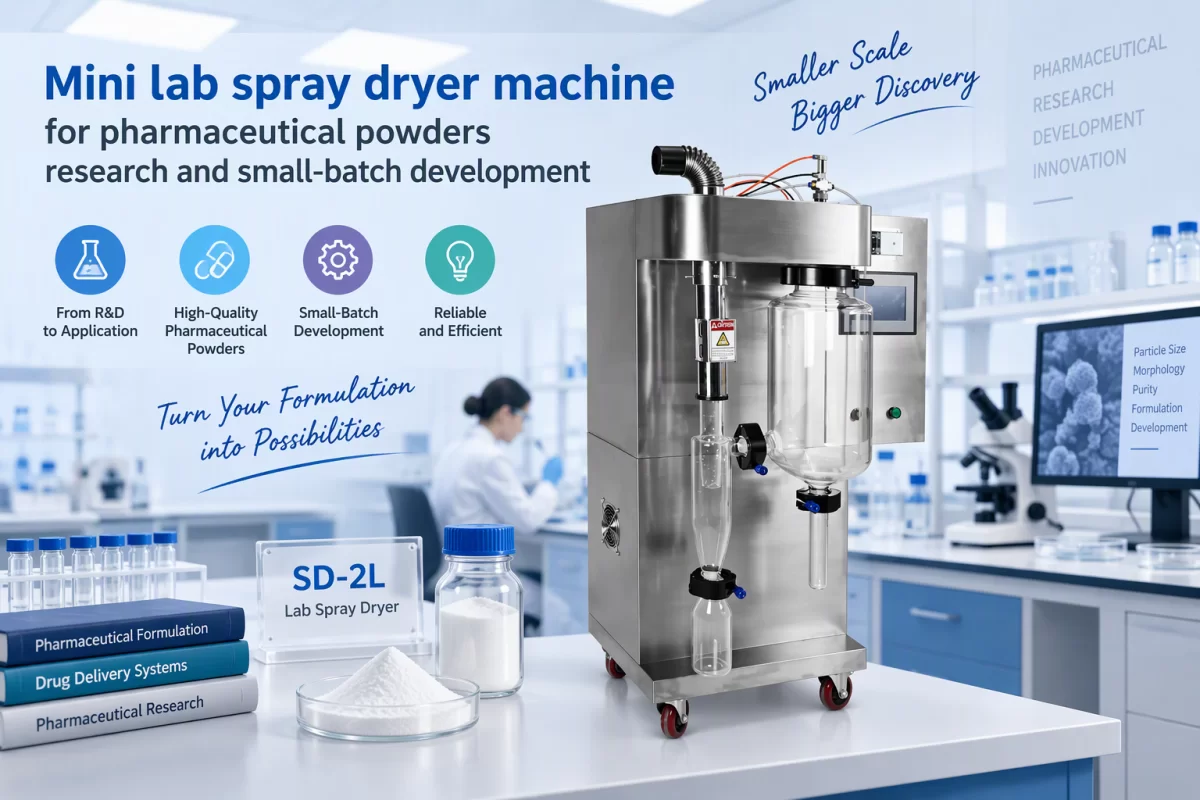
Choosing a mini lab spray dryer machine for pharmaceutical powders starts with the formulation, not just the equipment name. A Spray Dryer converts a compatible liquid feed into powder through atomization and drying. For laboratory development, the SD-2L provides a documented starting point with adjustable temperature controls, peristaltic-pump feeding and a specified water evaporation range of 1,500–2,000 mL/h.
A practical starting point for pharmaceutical powder research
Small-scale spray drying can be considered for exploratory work with compatible aqueous solutions, dispersions or extracts. Potential research tasks include comparing carrier formulations, studying liquid-to-powder conversion and preparing samples for subsequent powder characterization. These are application possibilities, rather than verified performance results for a particular drug or formulation.
The SD-2L specification lists a minimum feed quantity of 50 mL. This is useful when planning trials with limited material, but it does not establish how much usable powder a small batch will deliver. Feed solids, wall deposition, collection losses and the analytical sample requirement all need to be considered before committing valuable material.
For broader context, the guide to spray dryer applications, including pharmaceutical research provides a useful introduction to where this process may fit.
How laboratory spray drying works
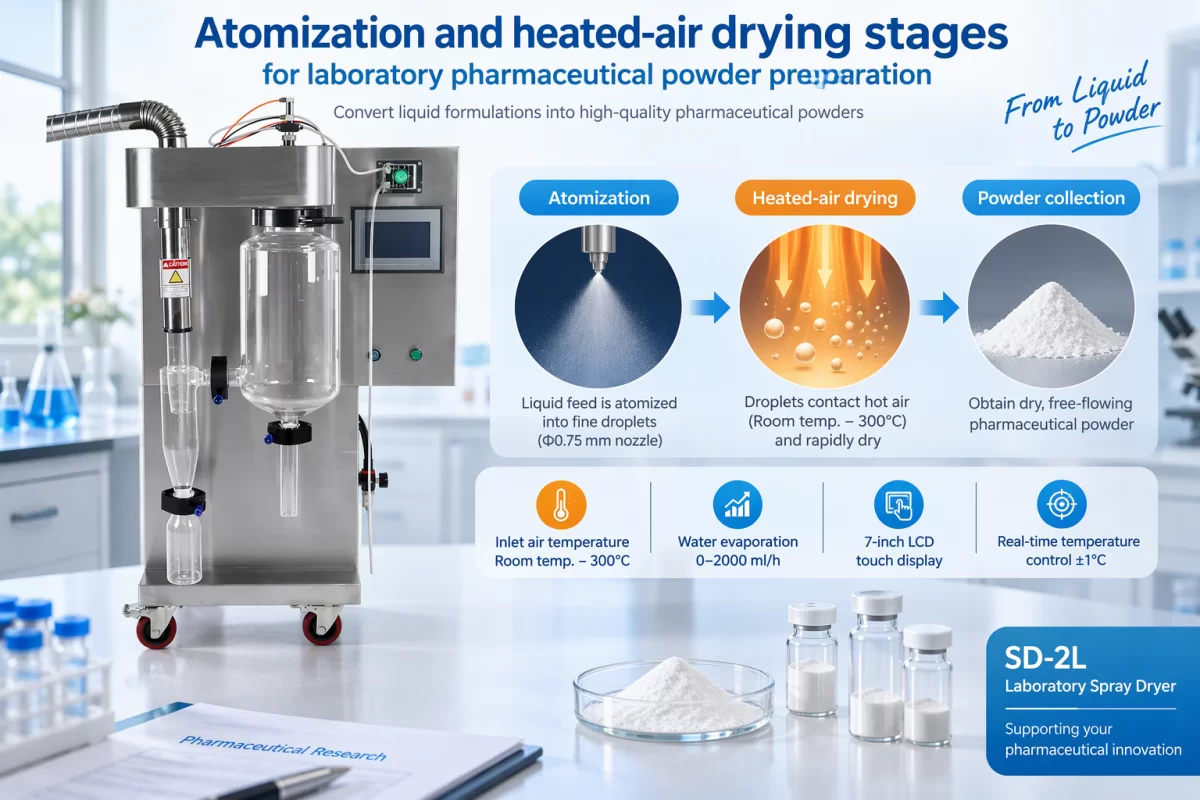
Spray drying brings an atomized liquid into contact with heated air. Breaking the feed into droplets increases the surface area available for evaporation. As liquid evaporates, the nonvolatile feed components form particles that must be separated and collected. The supplied SD-2L data specify peristaltic-pump feed adjustment, a 1.00 mm nozzle and compressed-air working pressure of 2–3 bar.
Temperature, feed rate and atomization conditions interact. Inlet air temperature describes the entering drying air; it is not a direct measurement of particle temperature. Outlet temperature is another operating variable to monitor alongside feed behavior and powder quality. The specified average drying time of 1.0–1.5 seconds does not, by itself, prove that a heat-sensitive pharmaceutical ingredient remains stable.
The accompanying explanation of the spray drying process and working principle offers additional background for interpreting these operating variables.
SD-2L mini lab spray dryer specifications
The following values come from the supplied SD-2L specification document. Temperature control ranges should not be interpreted as a guarantee of full drying capacity at every setting or with every formulation.
| Parameter | Specified value | Unit |
|---|---|---|
| Inlet air temperature control | 30–300 | °C |
| Outlet temperature control | 30–150 | °C |
| Evaporated water | 1,500–2,000 | mL/h |
| Maximum feed volume | 2,000 | mL/h |
| Minimum feed quantity | 50 | mL |
| Feeding method | Peristaltic pump adjustment | — |
| Average drying time | 1.0–1.5 | s |
| Electric heater power | 3.5 | kW |
| Heater electrical supply | AC 220 V, single-phase, grounding required | — |
| Fan power | 0.55 | kW |
| Maximum air volume | 5.6 | m³/min |
| Maximum wind pressure | 1,020 | Pa |
| Air compressor power | 1.2 | kW |
| Maximum gas production | 4.2 | m³/h |
| Compressed air working pressure | 2–3 | bar |
| Dimensions, L × W × H | 600 × 700 × 1,200 | mm |
| Nozzle diameter | 1.00 | mm |
| Equipment weight | 130 | kg |
Installation planning should account for the stated dimensions and weight, plus service access, exhaust arrangements and safe material handling. The heater rating is a component specification, not a stated total equipment power rating. The mini spray dryer product page is a relevant next step for discussing the required configuration.
Comparing mini laboratory and larger LPG spray dryers
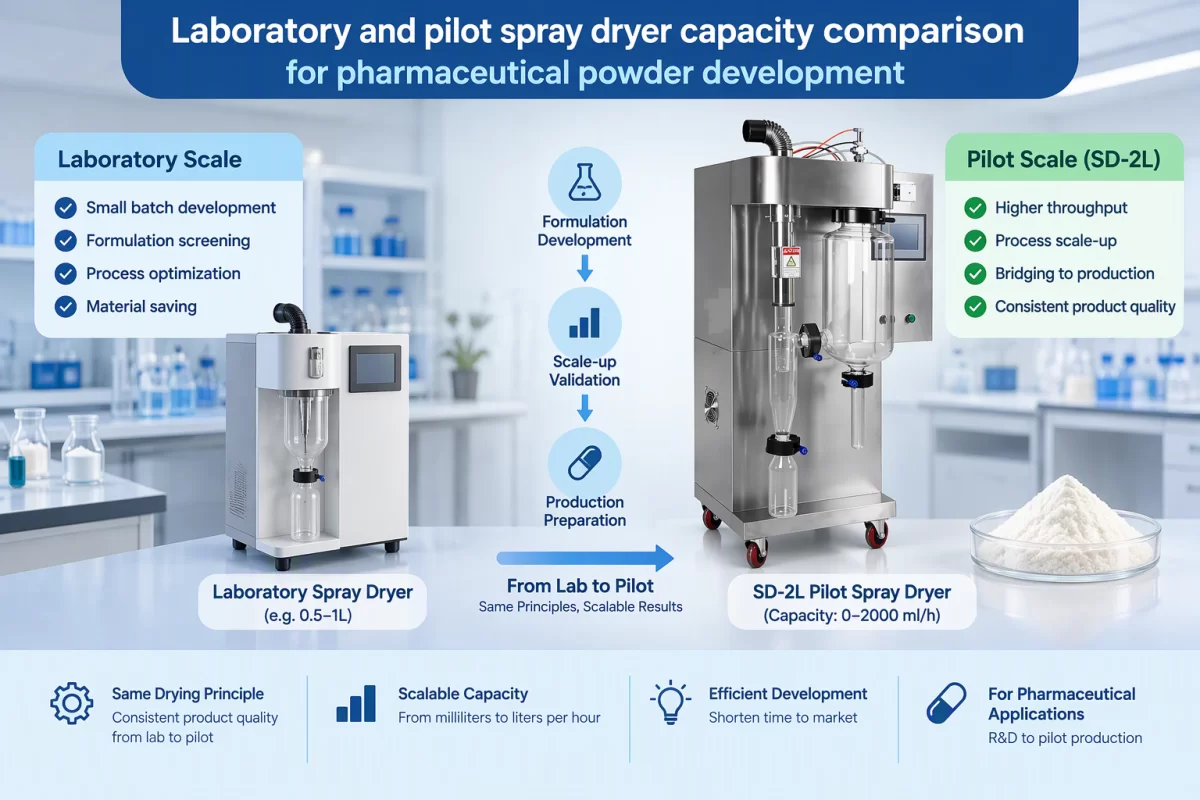
When the research program requires greater liquid removal, the supplied LPG-5 and LPG-10 data offer larger-capacity options to evaluate. Both models list a centrifugal spray head speed of 25,000 rpm and a 50 mm spray disc. This differs from the nozzle-based description supplied for the SD-2L, so scale-up should include atomization and powder-quality checks rather than capacity comparison alone.
| Parameter | LPG-5 | LPG-10 |
|---|---|---|
| Maximum moisture evaporation (kg/h) | 5 | 10 |
| Inlet temperature (°C) | 140–350 | Not separately specified |
| Outlet temperature (°C) | 80–90 | Not separately specified |
| Centrifugal spray head drive | Compressed air transmission | Not separately specified |
| Rotating speed (rpm) | 25,000 | 25,000 |
| Spray disc diameter (mm) | 50 | 50 |
| Heat source | Electricity | Electricity |
| Electric heating power (kW) | 9 | 20 |
| Dimensions, L × W × H (m) | 1.8 × 0.93 × 2.2 | 3.2 × 1.5 × 2.4 |
| Dry powder recovery rate (%) | ≥95 | Not separately specified |
Some LPG-10 cells are blank in the supplied sheet. Confirm whether these entries are intended to share LPG-5 values before purchasing. The listed recovery figure has no accompanying test conditions and should not be transferred to the SD-2L or treated as a guaranteed pharmaceutical formulation yield.
Selection checks for pharmaceutical powder trials
- Define the feed: document solvent composition, solids content, viscosity, suspended particles and available sample quantity. Confirm compatibility with the proposed wetted parts and nozzle.
- Set measurable powder targets: identify the required residual moisture, particle-size distribution, assay and stability tests. The supplied specifications do not establish these product outcomes.
- Review thermal sensitivity: select initial operating conditions through material assessment and controlled testing. A broad temperature range does not demonstrate suitability for every active ingredient.
- Confirm cleaning and containment: ask about product-contact materials, access for cleaning, cross-contamination controls and operator exposure management. These details are not established by the supplied parameter sheets.
- Check utilities and documentation: confirm the complete electrical requirements, compressed-air arrangement, exhaust requirements and any qualification documents needed for the intended laboratory.
Company reference pricing and purchasing value
For budgeting, the supplied company price entries were sorted from low to high, using the lower endpoint for a price range and the upper endpoint to resolve ties. Applying the middle-entry rule selects the following listed range as the company reference price.
Company reference price
US$2,800–3,250
This is a reference range from the supplied company listings, not a confirmed SD-2L quotation. The actual quotation is subject to the selected configuration and inquiry results.
Purchasing value depends on whether the equipment fits the development task. A documented small feed quantity, adjustable feeding and stated operating ranges help define an initial trial plan. Before placing an order, request a configuration-specific specification, an itemized quotation and confirmation of included components. Clarify any installation, training, spare-parts and documentation requirements rather than assuming they are included.
Choosing a mini lab spray dryer for pharmaceutical powders
A mini lab spray dryer machine for pharmaceutical powders should be selected around a validated research need. The SD-2L offers documented laboratory-scale parameters, while LPG-5 and LPG-10 provide higher stated evaporation capacities for further evaluation. None of these figures replaces feed compatibility testing, powder characterization or the safety and documentation review required for pharmaceutical work.
Alice’s recommendation: prepare a concise inquiry describing the formulation, solvent, batch size, powder targets and available utilities. Use that information to request a suitable Spray Dryer configuration and an actual quotation before making the purchasing decision.