
Which jacketed glass reactor is best for crystallization?
Which jacketed glass reactor is best for crystallization? The most defensible answer is the model that matches the intended batch, collection requirements and filtration needs—not simply the largest vessel. The GF-series specifications provide five configurations with material capacities from 10 L to 100 L, making it possible to compare these essentials before requesting a quotation.
Selection in brief: Consider GF-10L/5L for a 10 L nominal vessel requirement, GF-20L/10L or GF-30L/10L for intermediate capacity requirements, and GF-50L/20L or GF-100L/20L when a larger nominal vessel is needed. Confirm the usable working volume and process compatibility before final selection.
Choosing a jacketed glass reactor for crystallization
A useful equipment comparison separates documented hardware from process results that still require verification. The supplied GF specification sheet lists material capacity, approximate jacket capacity, receiving flask volume, stirring speed, sealing and filter details. It does not establish a universally superior model or promise a particular crystal size, yield or cycle time.
Start with the intended charge and the space needed during the process. A listed material capacity should not automatically be treated as the recommended operating fill. Ask for the allowable working volume for the selected configuration, together with any restrictions relevant to the solvent, solids loading and operating procedure.
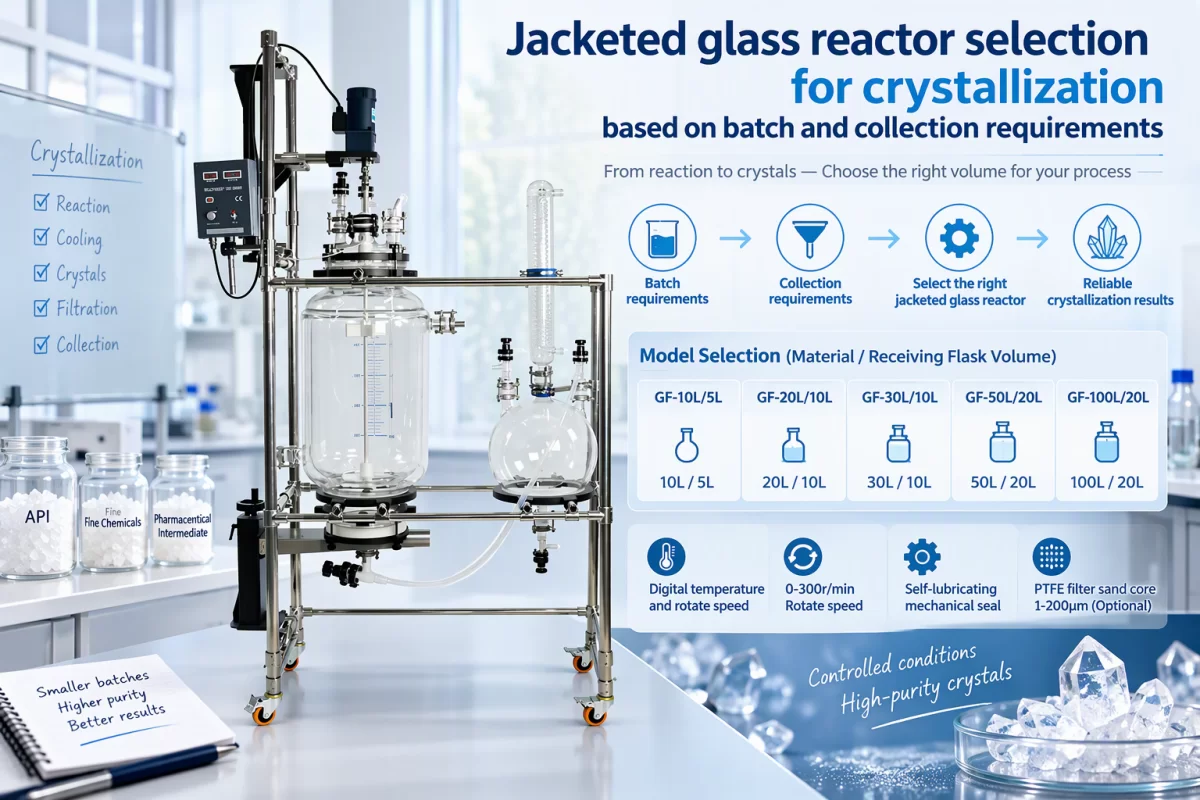
GF crystallization reactor capacity comparison
The model suffixes distinguish the reactor and receiving flask capacities. The jacket volume is listed separately and is approximate. Keeping these three quantities separate prevents a common purchasing mistake: assuming that a larger reactor necessarily comes with a proportionally larger receiving flask.
| Model | Material capacity (L) | Jacket capacity (L) | Receiving flask (L) |
|---|---|---|---|
| GF-10L/5L | 10 | ≈2 | 5 |
| GF-20L/10L | 20 | ≈5 | 10 |
| GF-30L/10L | 30 | ≈8 | 10 |
| GF-50L/20L | 50 | ≈15 | 20 |
| GF-100L/20L | 100 | ≈20 | 20 |
The ≈ symbol indicates an approximate value. Material capacity is not a verified working-fill recommendation.
GF-20L/10L and GF-30L/10L both have a 10 L receiving flask, although their material and jacket capacities differ. Similarly, GF-50L/20L and GF-100L/20L share a 20 L receiving flask. Collection requirements therefore deserve a separate check rather than being inferred from reactor size.
For additional vessel-size context, review the 10 L jacketed glass reactor page or the 50 L jacketed glass reactor page. Confirm the crystallization-specific GF configuration separately; these related pages should not be treated as proof of identical accessories.
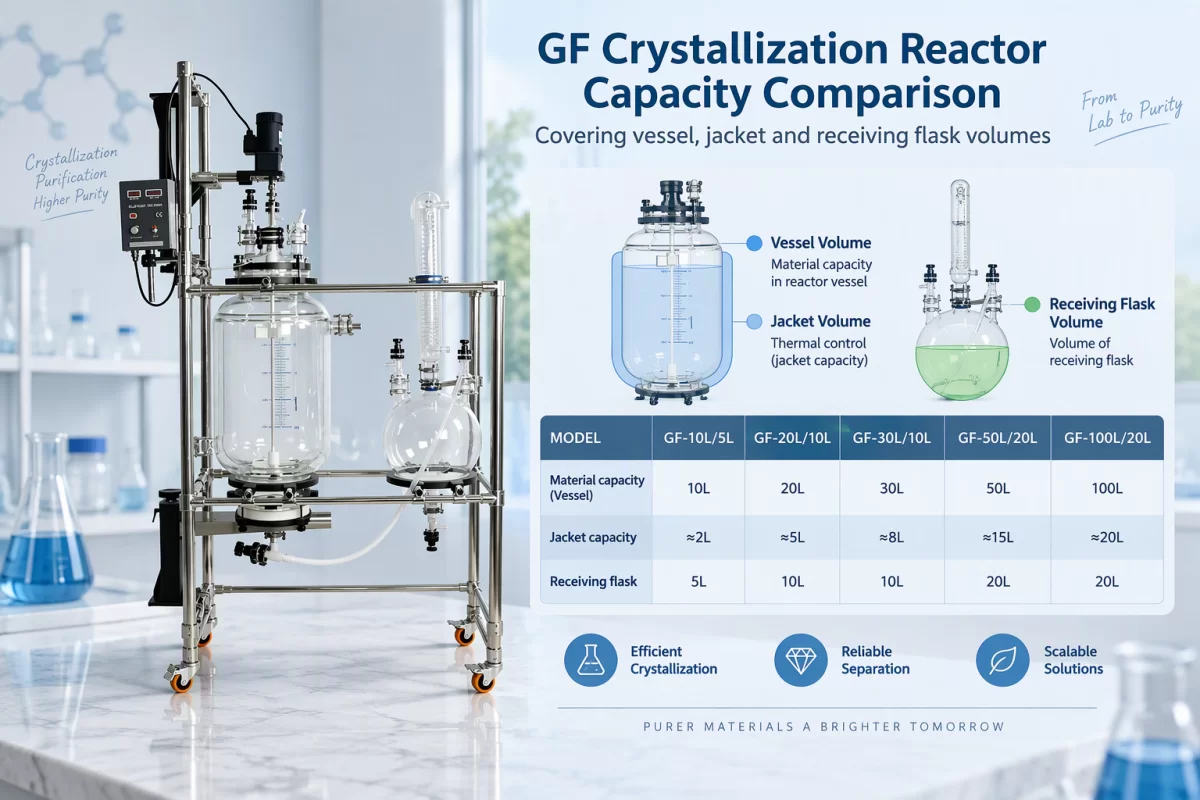
Temperature control and stirring: what the sheet confirms
The specification lists a variable-frequency governor, digital temperature and rotational-speed indication, and a rotation-speed range of 0–300 r/min. These are useful comparison points, but the speed range alone does not establish torque, mixing uniformity or suitability for a particular crystal slurry.
A jacketed configuration also calls for checking the external temperature-control arrangement. The recirculating chiller heater page is relevant when planning supporting equipment. Confirm its compatibility with the selected jacket, required operating temperatures and circulation requirements rather than assuming that a circulator is included.
Motor-power entries are present in the supplied material, but their model-by-model alignment is not clear in the extracted table. Request a confirmed motor specification for the chosen model, including whether the quoted arrangement uses an explosion-proof motor. An explosion-proof motor entry does not establish certification of the complete reactor system.
Filtration, sealing and electrical details
The GF sheet specifies a self-lubricating mechanical seal and a PTFE filter sand-core base plate. It lists an optional sand-core bore diameter of 1–200 μm. This available range is a selection parameter, not a promise of particle retention, filtration speed or crystal recovery for every material.
| Item | Listed specification |
|---|---|
| Speed control | Variable-frequency governor |
| Display | Digital temperature and rotational speed |
| Rotation speed | 0–300 r/min |
| Seal | Self-lubricating mechanical seal |
| Filter base plate | PTFE filter sand core |
| Sand-core bore diameter | 1–200 μm, optional |
| Electrical supply | 220 V / 50 Hz; customization according to customer requirements |
The assembly instruction calls for vacuum grease on the connection surface between the upper reactor body and the cover. Confirm grease compatibility with the process and follow the supplier’s assembly instructions. This instruction is not a stated vacuum rating.
Company reference price and quotation scope
The supplied company price list contains 22 entries across different equipment listings and configurations. After ordering the entries from low to high, the lower of the two middle entries—the 11th entry—is used as the reference.
This is our company’s reference price only. It is not a model-specific quotation for every GF crystallization reactor. The actual quotation is subject to the selected configuration and the inquiry result.
For a useful quotation, provide the desired model, intended working volume, solvent and solids information, filter option, electrical requirements and any motor requirements. Ask the supplier to identify included accessories and separately quoted supporting equipment. The supplied specifications do not establish operating temperature limits, pressure or vacuum limits, chemical compatibility, or complete-system certifications; these should be confirmed before purchase.
The best crystallization reactor is the verified fit
When deciding which jacketed glass reactor is best for crystallization, use the GF capacity table to build a shortlist, then verify working volume, temperature-control compatibility, stirring requirements and filtration options. GF-50L/20L is a candidate when a 50 L nominal vessel and 20 L receiving flask match the requirement; GF-10L/5L is a candidate when the corresponding smaller capacities are appropriate.
My recommendation is to choose by documented configuration and confirmed process suitability, not by an unsupported “best” label. Submit the batch requirements with the preferred GF model so the configuration and final quotation can be checked together.