
Laboratory equipment • Powder development
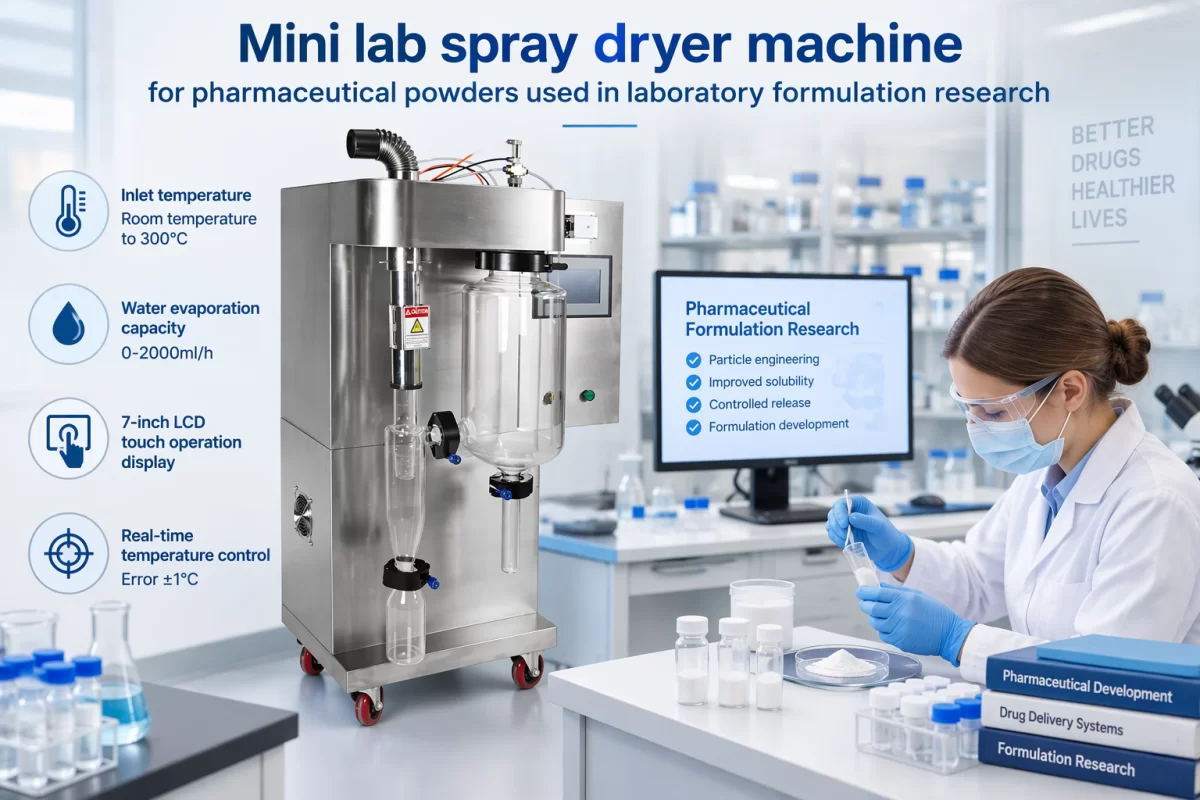
Mini lab spray dryer machine for pharmaceutical powders
A mini lab spray dryer machine for pharmaceutical powders offers a practical way to investigate the conversion of liquid formulations into dry material. For research teams, the useful starting point is not simply machine size: it is the relationship between feed characteristics, evaporation demand, temperature settings, and the powder properties required for the next experiment.
The SD-2L Spray Dryer combines adjustable peristaltic-pump feeding with specified inlet and outlet temperature control ranges. Its laboratory-scale operating specifications make it a candidate for formulation screening and drying trials, subject to the material’s thermal behavior, processing compatibility, and laboratory safety requirements.
Where a mini lab spray dryer fits in pharmaceutical research
Pharmaceutical powder development often begins with a liquid feed containing dissolved or dispersed ingredients. Spray drying provides a route for studying how that feed behaves during rapid moisture removal. Potential research scenarios include aqueous formulation trials, excipient-containing feed studies, and exploratory drying of suitable extracts. Each formulation requires its own assessment; a successful result with one material does not establish suitability for another.
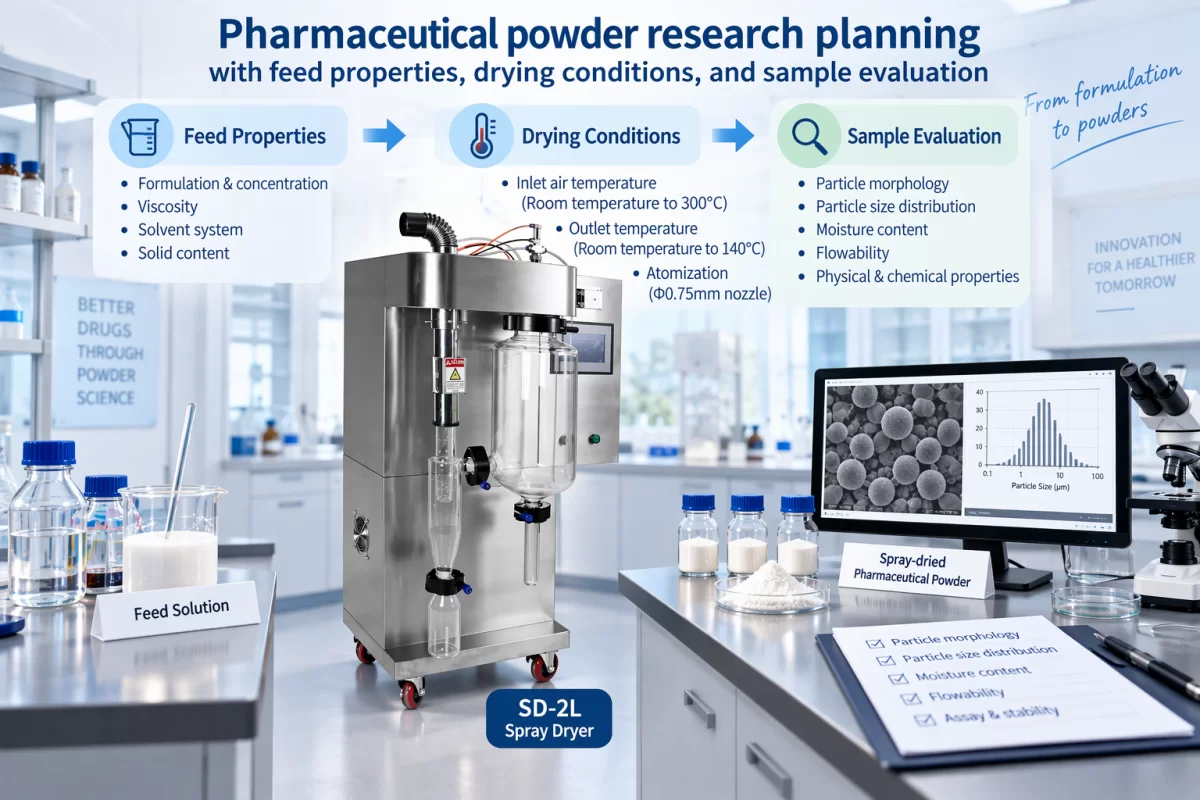
The practical goal is to produce enough sample for meaningful evaluation while using a manageable quantity of starting material. Researchers can compare drying settings and then examine residual moisture, dispersibility, powder handling, or other application-specific attributes. These are experimental objectives rather than guaranteed outcomes of the machine.
Does a laboratory spray dryer automatically qualify a powder for pharmaceutical use?
Alice: I treat spray drying as a development step, not a release decision. Pharmaceutical use requires appropriate material testing, process qualification, cleaning controls, and any applicable regulatory documentation. Equipment selection should support those requirements without being mistaken for proof of product compliance.
Working principle: from liquid feed to pharmaceutical powder
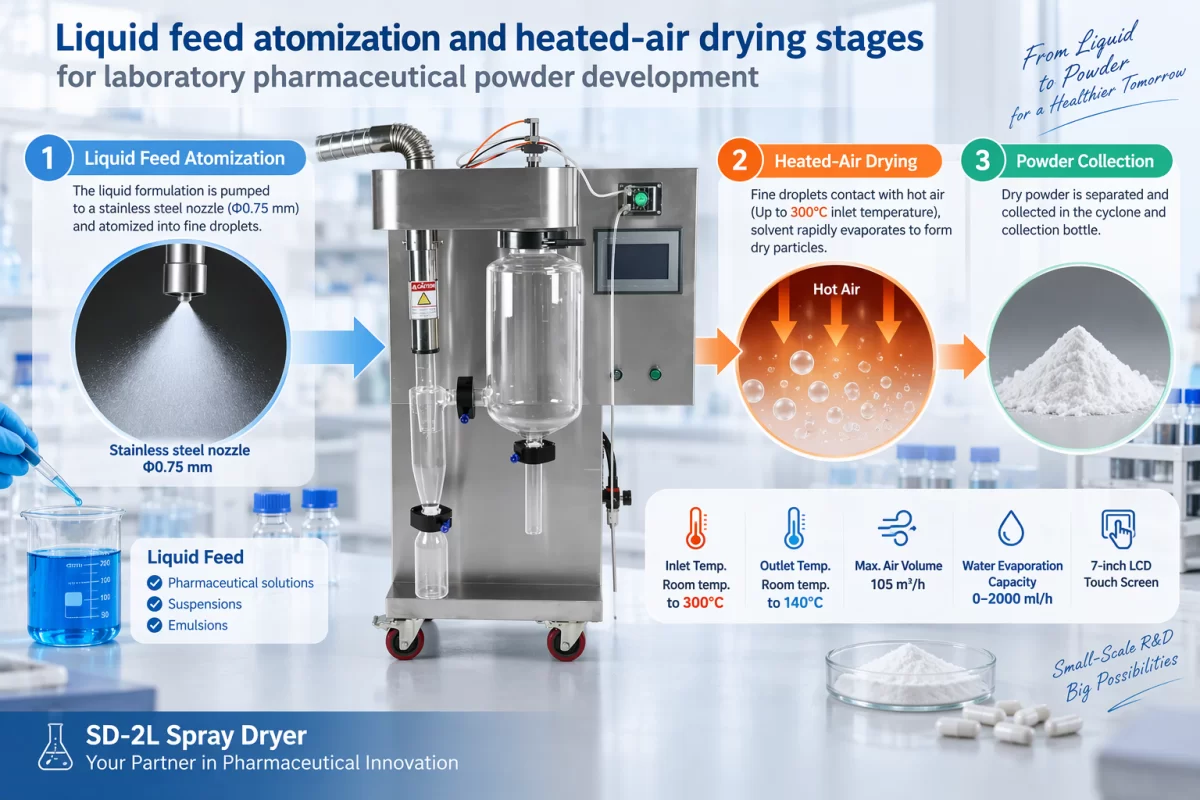
Spray drying begins by delivering liquid feed to an atomizing device. The resulting droplets contact heated drying air, allowing moisture to evaporate as particles form. The dried material is then separated from the outgoing air stream and collected. The interaction between feed delivery, atomization, airflow, and heat input determines how the process develops.
On the SD-2L, feed delivery is adjusted through a peristaltic pump, and the specified nozzle diameter is 1.00 mm. The listed average drying time is 1.0–1.5 seconds. This short drying interval is relevant to process development, but it does not establish that every heat-sensitive ingredient will retain its original properties. Thermal stability must be evaluated against the actual formulation and operating conditions.
The inlet temperature describes the incoming drying air; it should not be treated as a direct measurement of particle temperature. Likewise, the outlet temperature is a useful process variable, not a standalone proof of final moisture content. For a broader introduction, read the spray drying process and working principle. The relationship between droplets and particle formation is also discussed in this guide to spray dryer atomization.
SD-2L laboratory spray dryer specifications
The following specifications apply to the SD-2L. Temperature control ranges describe the equipment’s listed control capability; they are not recommended settings for all pharmaceutical feeds.
| Parameter | SD-2L specification |
|---|---|
| Inlet air temperature control | 30–300 °C |
| Outlet temperature control | 30–150 °C |
| Water evaporation | 1,500–2,000 mL/h |
| Maximum feed rate | 2,000 mL/h |
| Minimum feed quantity | 50 mL |
| Feeding method | Peristaltic pump adjustment |
| Average drying time | 1.0–1.5 s |
| Electric heater power and supply | 3.5 kW; AC 220 V, single-phase, grounded |
| Fan power | 0.55 kW |
| Maximum air volume | 5.6 m³/min |
| Maximum wind pressure | 1,020 Pa |
| Air compressor power | 1.2 kW |
| Maximum compressor gas production | 4.2 m³/h |
| Compressed air working pressure | 2–3 bar |
| Nozzle diameter | 1.00 mm |
| Dimensions, L × W × H | 600 × 700 × 1,200 mm |
| Equipment weight | 130 kg |
Is water evaporation capacity the same as dry powder output?
Alice: I distinguish these figures when comparing machines. Water evaporation describes moisture removal, while powder output depends on feed solids concentration and the amount of material recovered. The SD-2L’s 1,500–2,000 mL/h evaporation specification should not be read as a dry powder production rate.
Selecting a spray dryer for the actual formulation
A useful purchasing brief starts with the material and the experimental workload. Provide the solvent system, solids concentration, viscosity, suspended particle characteristics, available feed quantity, and intended powder tests. These details help determine whether the proposed drying approach matches the formulation.
- Temperature sensitivity: Define the material’s acceptable thermal exposure and plan analytical checks after drying. A broad temperature control range does not replace stability testing.
- Feed behavior: Consider whether the formulation can be pumped consistently and delivered through the nozzle without unacceptable settling or blockage.
- Sample availability: The listed minimum feed quantity is 50 mL, but the amount needed for a useful study also depends on feed concentration and the planned analyses.
- Installation: Allow for the 600 × 700 × 1,200 mm equipment dimensions, its 130 kg weight, and additional working space for operation, cleaning, and service.
- Safety and cleaning: Identify solvent hazards, dust exposure risks, cross-contamination controls, and cleaning needs before selecting a configuration. Flammable-solvent operation requires a specifically suitable system and safety assessment.
For larger evaporation requirements, the LPG-5 and LPG-10 offer separately listed maximum moisture evaporation capacities of 5 kg/h and 10 kg/h, respectively. Their electric heating powers are 9 kW and 20 kW. These are different models, so their specifications should be evaluated separately rather than applied to the SD-2L.
The mini spray dryer product page provides a relevant starting point for discussing laboratory equipment requirements.
Reference pricing and purchasing value
A laboratory spray dryer can be valuable when a team needs to explore drying conditions before committing larger quantities of material. Adjustable feeding and defined temperature control ranges support structured trials, while a documented equipment specification helps with installation planning and procurement comparisons.
Company reference price
USD $2,800–$3,250
This is our company’s reference pricing for spray drying equipment, not a fixed quotation for a particular SD-2L configuration. The actual quotation depends on the selected configuration and the inquiry result.
Assess purchasing value through the complete workflow: suitable feed preparation, safe operation, cleaning access, sample collection, and the analytical work needed after drying. A lower initial equipment cost is not useful if the selected system does not fit the formulation or laboratory operating requirements.
What information makes a spray dryer quotation more useful?
Alice: I recommend submitting the material description, solvent composition, working batch size, target operating conditions, installation utilities, and configuration needs. Adding the intended powder tests helps keep the proposed solution focused on the research objective rather than nominal capacity alone.
Move from equipment specifications to a practical drying trial
Choosing a mini lab spray dryer machine for pharmaceutical powders is a material-specific decision. The SD-2L offers documented feeding, temperature control, evaporation, and installation specifications for planning laboratory studies. Its suitability should be judged against the formulation, the required sample quantity, and the laboratory’s safety and quality expectations.
Prepare a concise description of the feed material, working batch, target drying conditions, and desired configuration. With those details, a corresponding equipment proposal and quotation can address the actual development task rather than relying on machine size alone.