
Laboratory temperature control
Lab recirculating chiller heater for reactor cooling
Choosing a lab recirculating chiller heater for reactor cooling starts with understanding the actual thermal duty. A reactor may need continuous cooling, a low-temperature holding stage, or a process that alternates between heating and cooling. These requirements call for different equipment choices rather than a decision based on reservoir size alone.
The DLSB Recirculating Chiller is a low-temperature cooling-fluid circulator. Its role is to supply cooled fluid to a compatible external circuit, such as a reactor jacket. For laboratories evaluating temperature-control equipment, the key is to match the selected model’s temperature range, circulation specifications, and electrical requirements to the application.
How a recirculating chiller supports reactor cooling
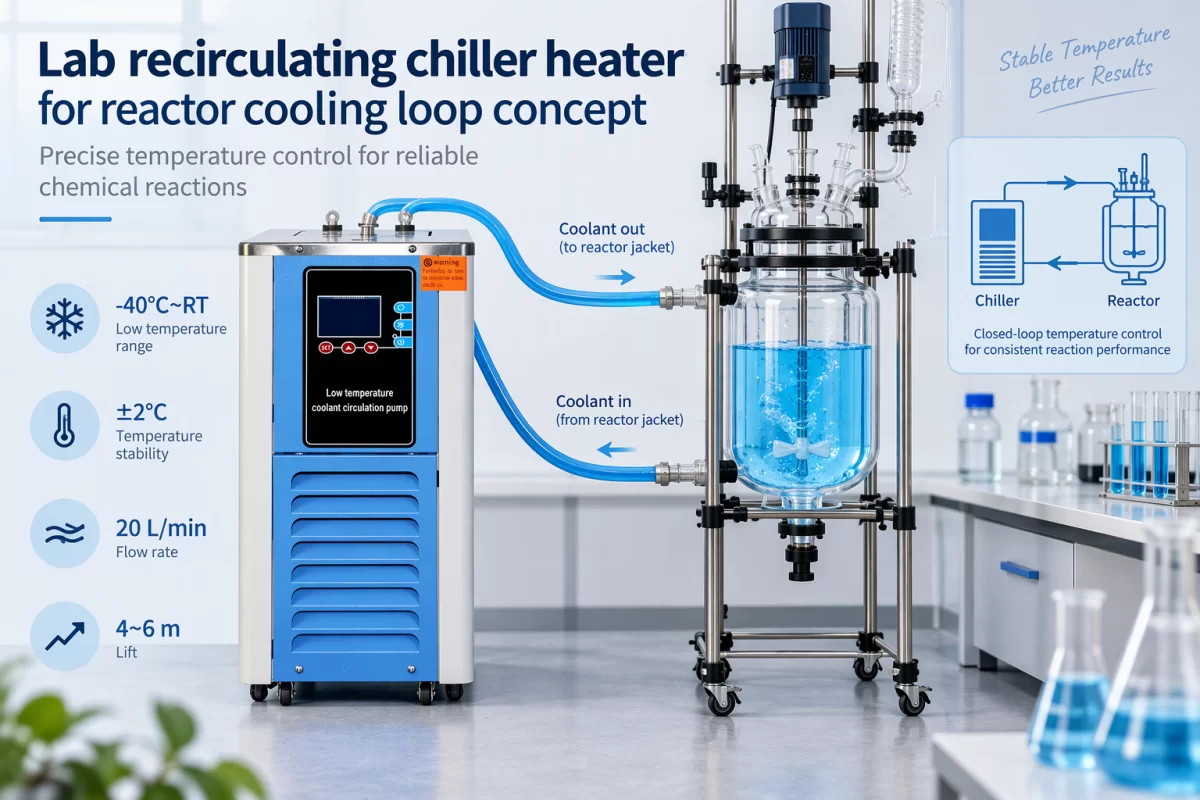
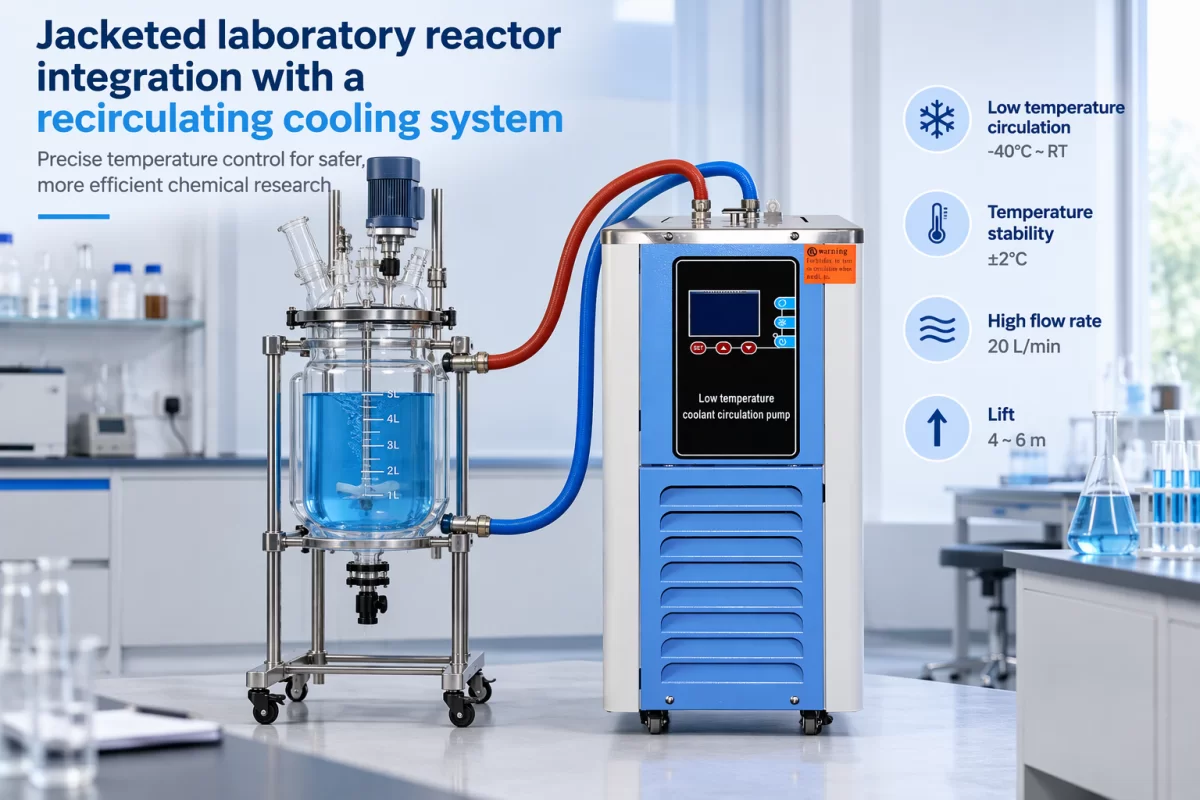
In a typical reactor cooling arrangement, the chiller cools a heat-transfer fluid, and a circulation pump sends that fluid through the reactor jacket. Heat passes from the reaction mixture through the vessel wall into the circulating fluid. The warmer fluid then returns to the chiller, where heat is removed before it circulates again.
This arrangement separates the cooling medium from the reaction contents when used with an intact, compatible jacketed vessel. Cooling performance depends on the complete installation: the reaction’s heat generation, jacket design, fluid properties, hose dimensions, and ambient conditions all affect the result. A minimum temperature specification alone does not establish the temperature achievable inside a loaded reactor.
Selected DLSB model specifications
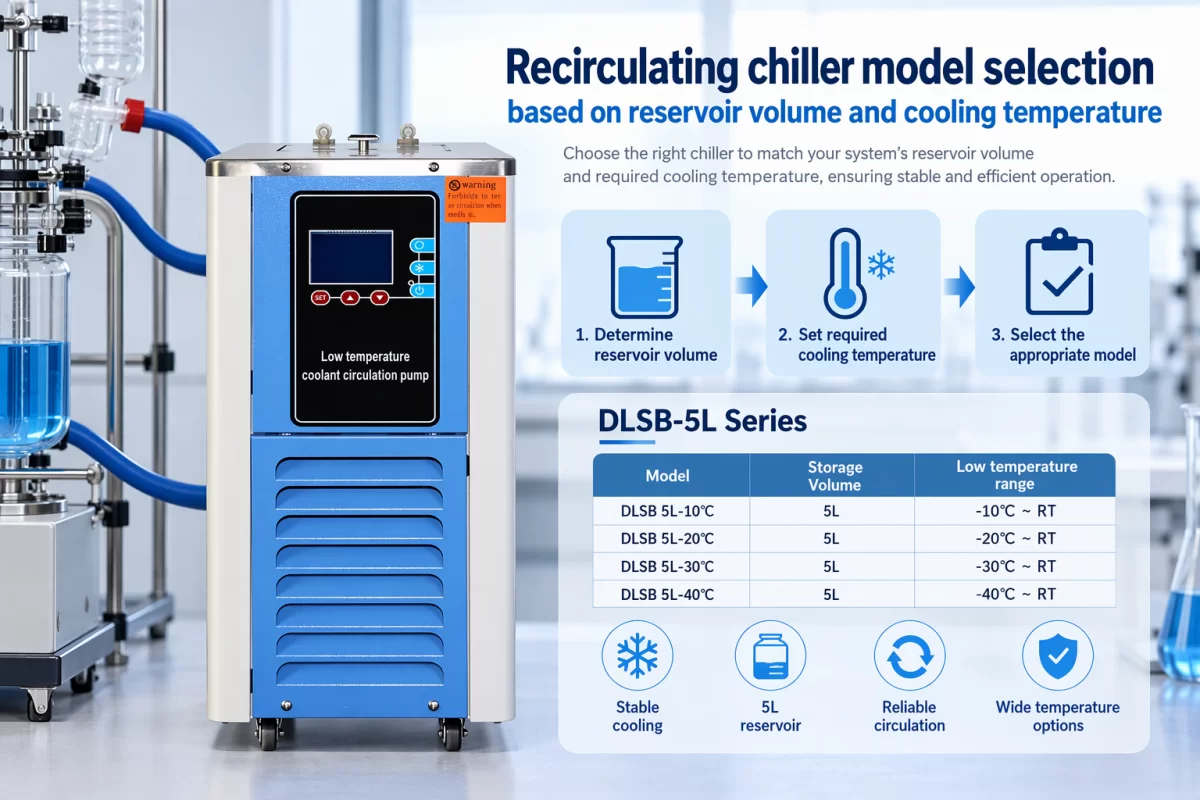
The following comparison keeps each specification attached to its corresponding model. Reservoir volume describes the chiller’s fluid storage, not the reactor’s working capacity. The selected models illustrate differences in temperature range, listed pump flow, head, and power supply without implying a fixed reactor-to-chiller size pairing.
| Model | Reservoir (L) |
Temperature range (°C) |
Listed stability (±°C) |
Flow (L/min) |
Pump head (m) |
Supply (V / Hz) |
|---|---|---|---|---|---|---|
| DLSB 5L-20°C | 5 | −20 to RT | 2 | 20 | 4–6 | 220 / 50 |
| DLSB 10L-30°C | 10 | −30 to RT | 2 | 20 | 6 | 220 / 50 |
| DLSB 20L-40°C | 20 | −40 to RT | 2 | 20 | 6 | 380 / 50 |
| DLSB 30L-60°C | 30 | −60 to RT | 2 | 25 | 11 | 220 / 50 |
| DLSB 50L-40°C | 50 | −40 to RT | 2 | 30 | 10–12 | 380 / 50 |
| DLSB 80L-40°C | 80 | −40 to RT | 2 | 35 | 13 | 220 / 50 |
RT means room temperature. Listed temperature stability is a chiller specification, not a guarantee of reaction-mixture stability. Flow and head should be evaluated against the resistance of the installed circulation loop; the listed values do not establish simultaneous performance at every operating point.
Electrical input power and cooling capacity are different quantities. For example, the DLSB 5L-20°C has a listed rated power of 635 W, while the DLSB 50L-40°C has a listed total power of 5,356 W. These electrical figures should not be used as substitutes for heat-removal capacity at the intended operating temperature.
Applications in laboratory reactor workflows
A recirculating chiller can be considered for jacketed chemical synthesis, low-temperature reaction screening, controlled cooling during crystallization studies, and post-reaction cooldown. Suitability depends on the heat load, required temperature profile, materials compatibility, and the reactor’s permitted operating conditions.
For a setup built around a 10 L jacketed glass reactor, selection should begin with actual working batch volume and reaction duty rather than automatically choosing a 10 L chiller reservoir. The same principle applies to larger equipment: a 50 L jacketed glass reactor requires a cooling assessment based on process heat and jacket characteristics, not merely a matching capacity label.
How to select a lab reactor cooling circulator
- Define the temperature profile. Specify starting temperature, target temperature, holding duration, and acceptable variation. Include any heating stages so that cooling-only and combined systems can be evaluated appropriately.
- Describe the thermal duty. Provide the material, working batch volume, expected heat release, and desired cooldown time. These details are more useful than nominal vessel capacity alone.
- Assess the external loop. Account for jacket passages, hose length, hose bore, connection restrictions, and elevation changes. Pump head is not a direct statement of allowable reactor jacket pressure.
- Select a compatible heat-transfer fluid. Consider the intended temperature range, low-temperature viscosity, freezing behavior, and compatibility with hoses, seals, and the jacket. Fluid choice can materially affect circulation and heat transfer.
- Check laboratory utilities and installation space. Match the exact model’s voltage and frequency to the available supply. Plan electrical protection, ventilation, access, and spill management for the installation.
- Separate coolant control from process measurement. Monitor the reaction mixture independently where the procedure requires it. A coolant setpoint does not necessarily equal the temperature throughout the vessel.
Choose temperature control around the process
The purchasing value of a Recirculating Chiller lies in matching its capabilities to the reactor workflow. A suitable cooling loop can support planned temperature management and reduce reliance on improvised cooling arrangements, while careful sizing helps avoid purchasing equipment on reservoir volume or minimum temperature alone.
For a lab recirculating chiller heater for reactor cooling project, first distinguish cooling-only operation from combined heating and cooling. Then evaluate the relevant DLSB model against the required temperature, heat load, circulation conditions, and electrical supply. Share the process and configuration requirements with ZZKEDA Instrument to request an application-specific equipment proposal and quotation.