
Which rotary evaporator is best for large scale distillation?
Which rotary evaporator is best for large scale distillation? For larger-batch work within the R-series range, the R1050 is a strong starting point because it combines a 50 L rotating flask with a 20 L recovery flask. However, the right purchase depends on the material, usable batch size, cooling system, vacuum equipment and available installation space—not flask capacity alone.
How a rotary evaporator supports large-scale distillation
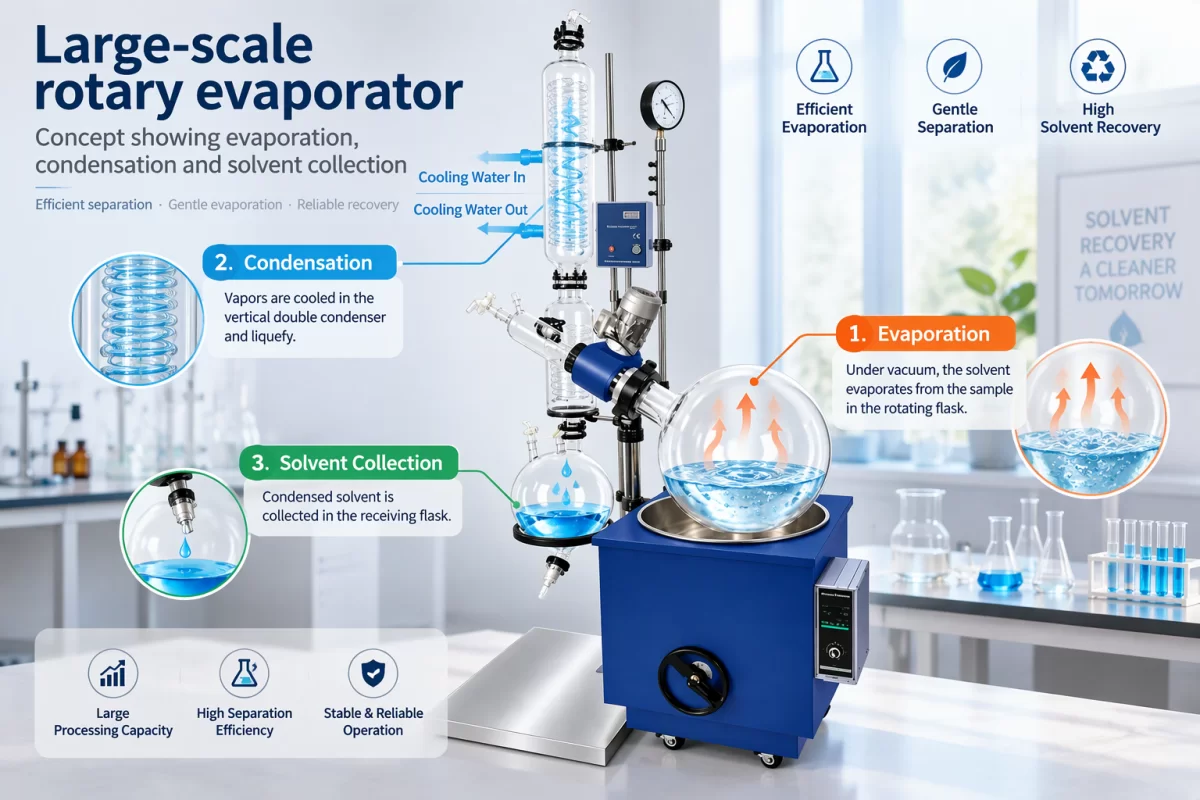
A rotary evaporator is used to remove volatile solvents, concentrate solutions and collect condensed solvent. It is relevant to laboratory chemistry, pilot-scale process development and solvent-removal stages in plant-extract processing. Its suitability depends on whether the solvent can be evaporated and condensed under conditions that preserve the desired material.
The working principle combines rotation, heating, reduced pressure and condensation. Rotation spreads liquid across the inner surface of the flask, increasing the surface available for evaporation. The bath supplies heat, while reduced pressure allows a solvent to boil at a lower temperature than it would at atmospheric pressure. Vapor then travels to the condenser, where cooling converts it back into liquid for collection.
This makes rotary evaporation useful for solvent removal, but it should not automatically be treated as a substitute for every distillation method. A process requiring separation of closely boiling components may need a different separation arrangement. Define whether the objective is concentration, solvent recovery or selective purification before selecting equipment.
Comparing rotary evaporator capacities and installation dimensions
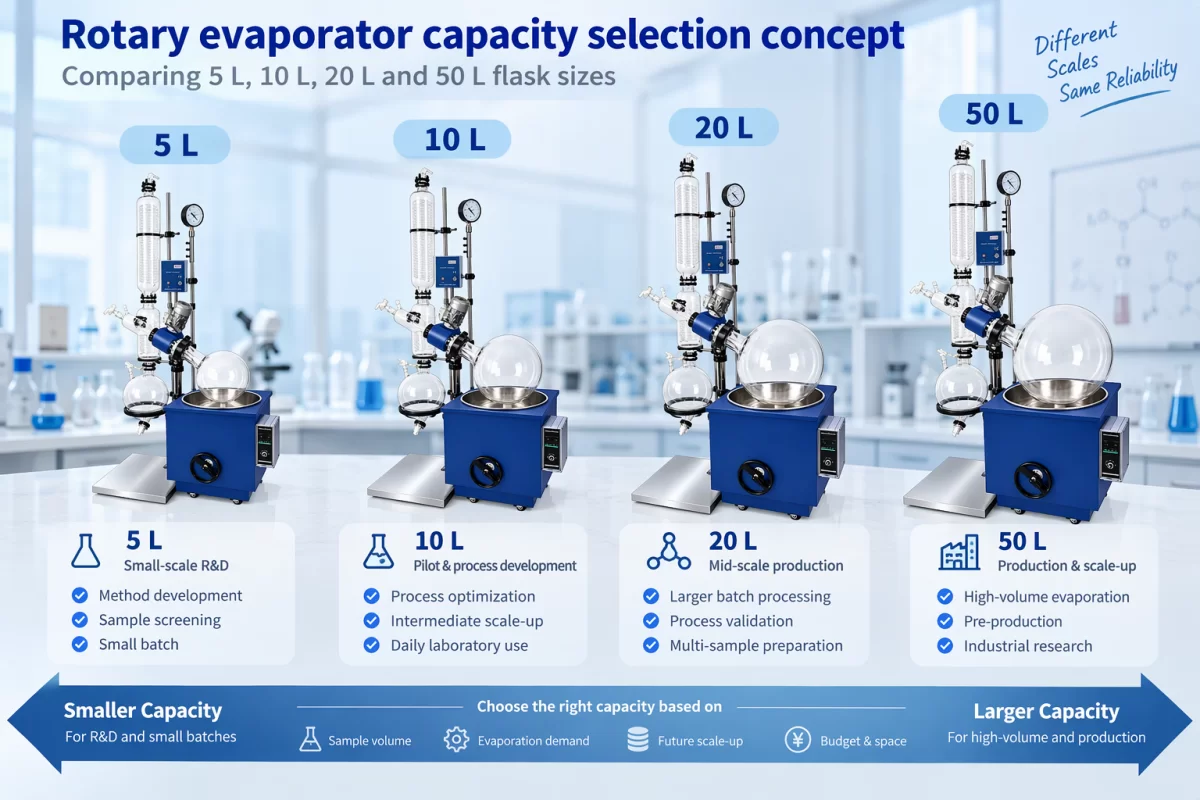
The R-series offers four clearly defined capacity steps. The table below compares model-specific flask capacities, bath dimensions, lift travel and overall dimensions. These parameters help identify a suitable physical scale; they do not establish an evaporation rate or guarantee a particular batch completion time.
| Model | Rotating flask (L) |
Recovery flask (L) |
Bath size (mm; diameter × height) |
Lift travel (mm) |
Overall dimensions (mm) |
|---|---|---|---|---|---|
| R1005 | 5 | 3 | Φ300 × 170 | 0–150 | 660 × 400 × 1020 |
| R1010 | 10 | 5 | Φ350 × 220 | 0–160 | 920 × 550 × 1700 |
| R1020 | 20 | 10 | Φ450 × 260 | 0–190 | 1250 × 600 × 2100 |
| R1050 | 50 | 20 | Φ550 × 320 | 0–180 | 1320 × 770 × 2340 |
The R1005 provides a smaller-scale option, while the R1010 and R1020 offer intermediate capacities for development and larger laboratory batches. The R1050 has the largest rotating flask in this comparison, making it the first model to evaluate when capacity is the limiting factor.
Installation planning becomes particularly important at the larger end of the range. Allow space beyond the equipment envelope for glassware handling, connections, operator access and maintenance. For the larger-capacity product category, explore the 50 L rotary evaporator options alongside the requirements of the proposed process.
Selection priorities beyond flask size
A large rotating flask is only one part of a functioning distillation system. Purchasing decisions should connect the evaporator to the solvent properties, desired endpoint and supporting utilities.
- Material and process objective: Identify the solvent, dissolved material, starting concentration and final concentration. Include any sensitivity to heat, tendency to foam or change in viscosity during concentration.
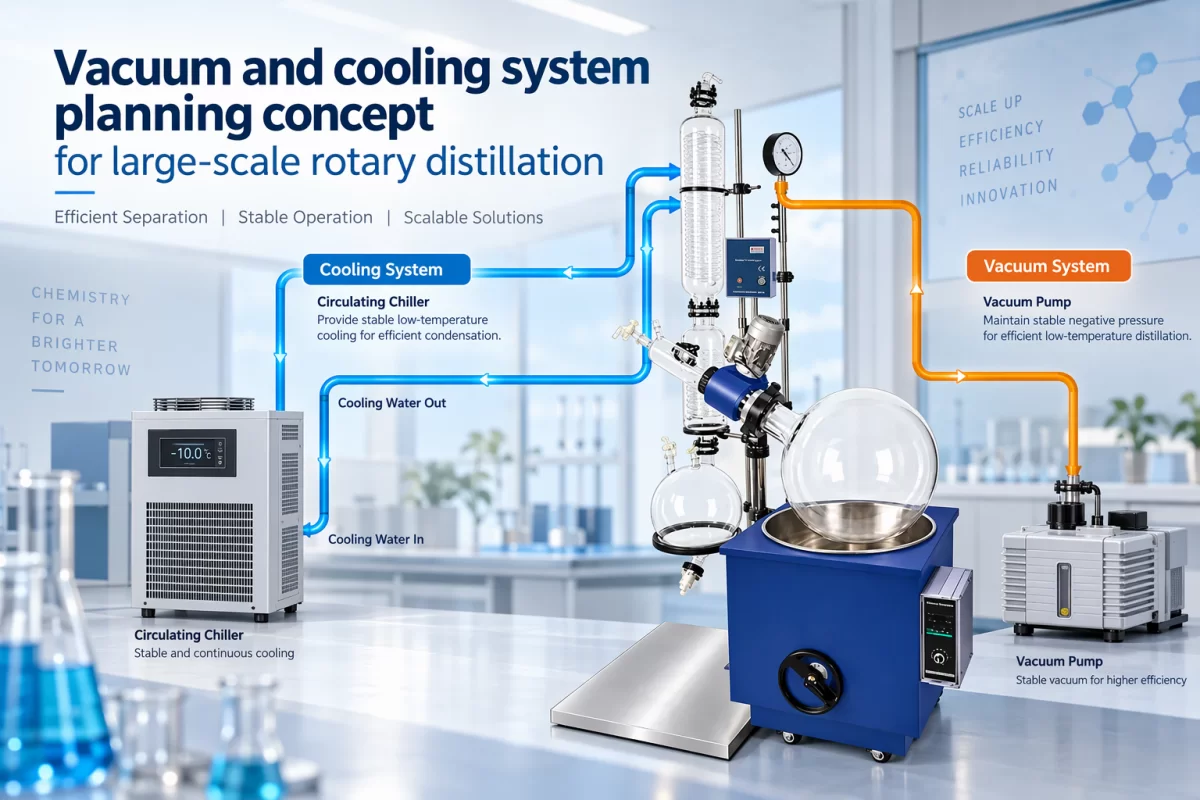
- Vacuum requirements: Match the operating pressure and pump compatibility to the solvent. Stable pressure control matters more than selecting equipment solely by its lowest stated pressure.
- Cooling requirements: Size the cooling system for the expected vapor load and required condensation conditions. A recirculating chiller-heater is a related temperature-control option to evaluate for compatibility with the intended setup.
- Collection and handling: Consider how much solvent must be collected and how the receiver will be emptied safely. Recovery-flask capacity and the operating procedure should be planned together.
- Utilities and safety: Include electrical supply, ventilation, solvent compatibility, operating environment and safe glassware handling in the equipment specification. Hazardous-area requirements must be addressed for the selected equipment and installation.
Reference pricing and purchasing value
Our company’s reference price
This company reference price is a budgeting guide, not a model-specific quotation for the R1050 or a complete 50 L system. The actual quotation depends on the selected configuration and the outcome of the inquiry.
Purchase value should be assessed at system level. Compare the scope of supply, glassware arrangement, vacuum equipment, cooling equipment, installation needs and routine operating costs. A lower initial equipment price may not provide better value if the system does not suit the batch size or process conditions.
Where solvent recovery is the main business objective, the economics of waste-solvent distillation and recycling provide useful context for building an investment case. Evaluate savings using the actual solvent stream, recovered-solvent quality requirements and operating costs rather than an assumed universal payback.
The best large-scale rotary evaporator fits the complete process
For the question “Which rotary evaporator is best for large scale distillation?”, the R1050 is a sensible first candidate when the priority is the largest flask capacity in this R-series comparison. Its 50 L rotating flask and 20 L recovery flask distinguish it from the smaller models. The R1020 or R1010 may be a better fit when the working charge, facility space or development needs favor a smaller system.
The final decision should connect capacity with vacuum, cooling, material behavior and safe operating procedures. That approach supports a more useful purchase than choosing by nominal flask size or reference price alone.
Share the solvent, working batch, target conditions and configuration needs to request a matched rotary evaporator proposal and quotation.