
Stainless Steel Chemical Mixing Reactor with Variable Speed Agitator
Reliable chemical processing requires more than a durable vessel. Mixing intensity, heat transfer, material compatibility, and controlled operation must work together. A Stainless steel chemical mixing reactor with variable speed agitator brings these functions into a configurable system for laboratory development, formulation trials, and pilot-scale batch processing.
Why Variable-Speed Agitation Matters
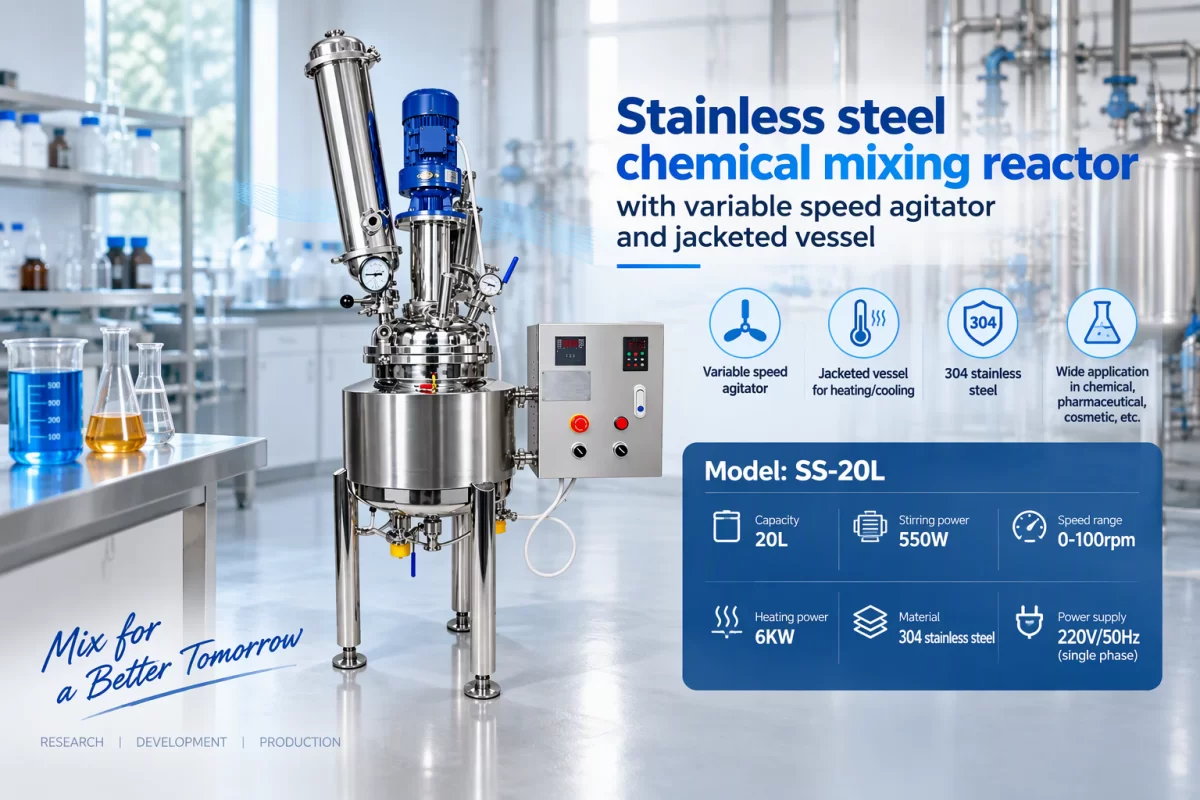
Different process stages often require different mixing conditions. Initial liquid blending may need gentle circulation, while powder addition or suspension maintenance may require stronger agitation. Frequency-converter speed regulation allows the stirring speed to be adjusted instead of limiting the process to a single operating point. This flexibility can help establish a more repeatable mixing procedure as a formulation evolves.
The supplied SS-5L specification lists a stirring range of 0–600 rpm with a digital speed display. The SS-10L through SS-300L series sheet also lists 0–600 rpm frequency-conversion control. However, rotational speed alone does not define mixing performance: impeller diameter, blade geometry, liquid viscosity, fill level, and available torque all influence circulation and suspension.
For broader equipment options, the stainless steel chemical reactor range provides a relevant starting point for discussing vessel size and configuration. The strongest selection approach is to match the agitator to the process rather than choosing only by maximum rpm.
SS-5L: A Compact Reactor for Controlled Development Work
The SS-5L combines a 316 stainless steel reactor vessel with a 304 stainless steel frame and piping. Its nominal reactor volume is 5L, and the listed jacket capacity is 1.5L. Braked swivel casters support repositioning within an appropriate laboratory layout; the unit should be secured before operation.
Circulation heating transfers energy through the jacket, while a PT100 sensor provides digital temperature indication. A mechanical seal is specified for the stirring connection, and a ball-type quick-discharge valve supports batch removal. The lid includes connections for stirring, solid addition, temperature measurement, a pressure gauge, a constant-pressure funnel, and condensation reflux, with customization available.
| Parameter | SS-5L Specification |
|---|---|
| Nominal reactor volume | 5L |
| Jacket capacity | 1.5L |
| Reactor material | 316 stainless steel |
| Frame and pipe material | 304 stainless steel |
| Stirring speed | 0–600 rpm |
| Listed stirring power | 120W; an additional “power increase 1/3” notation requires clarification |
| Speed regulation | Frequency converter with digital display |
| Temperature indication | PT100 sensor with digital display |
| Listed reaction temperature range | −100 to 250°C |
| Listed pressure/vacuum range | −0.098 to 0.5 MPa; pressure basis requires confirmation |
| Power supply | 220V / 60Hz |
| Agitator | 304 stainless steel rod with three blades |
| Connections and discharge | Threaded unions and ball-type quick-discharge valve |
On smaller screens, swipe horizontally to view the complete table.
Coordinate Jacket Temperature with Mixing Conditions
Jacketed construction separates the circulating heat-transfer fluid from the process contents. Agitation helps move liquid near the vessel wall into the bulk batch, which can reduce temperature gradients under suitable operating conditions. Heating and cooling performance still depend on the fluid properties, jacket flow, heat-transfer area, and thermal duty of the reaction.
A compatible recirculating chiller heater can support external temperature control when its operating range, pumping capability, and heating or cooling capacity match the reactor and process. Selection should consider the complete thermal load rather than temperature range alone.
From 10L Trials to 300L Pilot Batches
The larger series covers SS-10L, SS-20L, SS-30L, SS-50L, SS-100L, SS-150L, SS-200L, and SS-300L models. Its sheet describes double-wall stainless steel construction, SUS316/SUS304 materials, paddle agitation, digital frequency-conversion speed regulation, and optional eight-port arrangements.
| Model | Nominal Vessel Volume | Approximate Jacket Volume |
|---|---|---|
| SS-10L | 10L | 3.8L |
| SS-20L | 20L | 5L |
| SS-30L | 30L | 8L |
| SS-50L | 50L | 15L |
| SS-100L | 100L | 20L |
| SS-150L | 150L | 50L |
| SS-200L | 200L | 70L |
| SS-300L | 300L | 95L |
Swipe horizontally on mobile devices if needed.
The series sheet lists a temperature range of −100 to 299°C and working pressure of −0.1 to 0.5 MPa. These are reference specifications, not a substitute for a model-specific approved operating envelope. Motor-power entries are incomplete across the eight models, and the sheet contains different mechanical-seal descriptions, so power and seal construction should be confirmed in the final quotation.
A Separate SS-20L Configuration
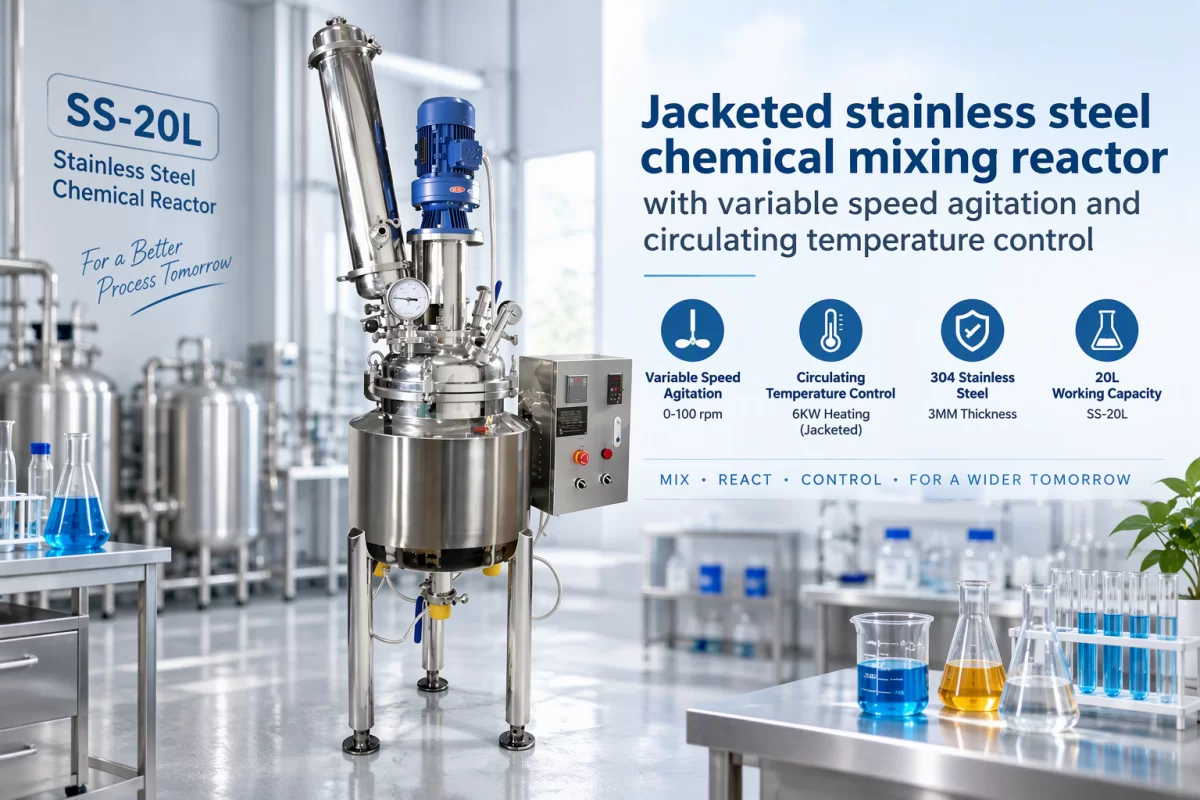
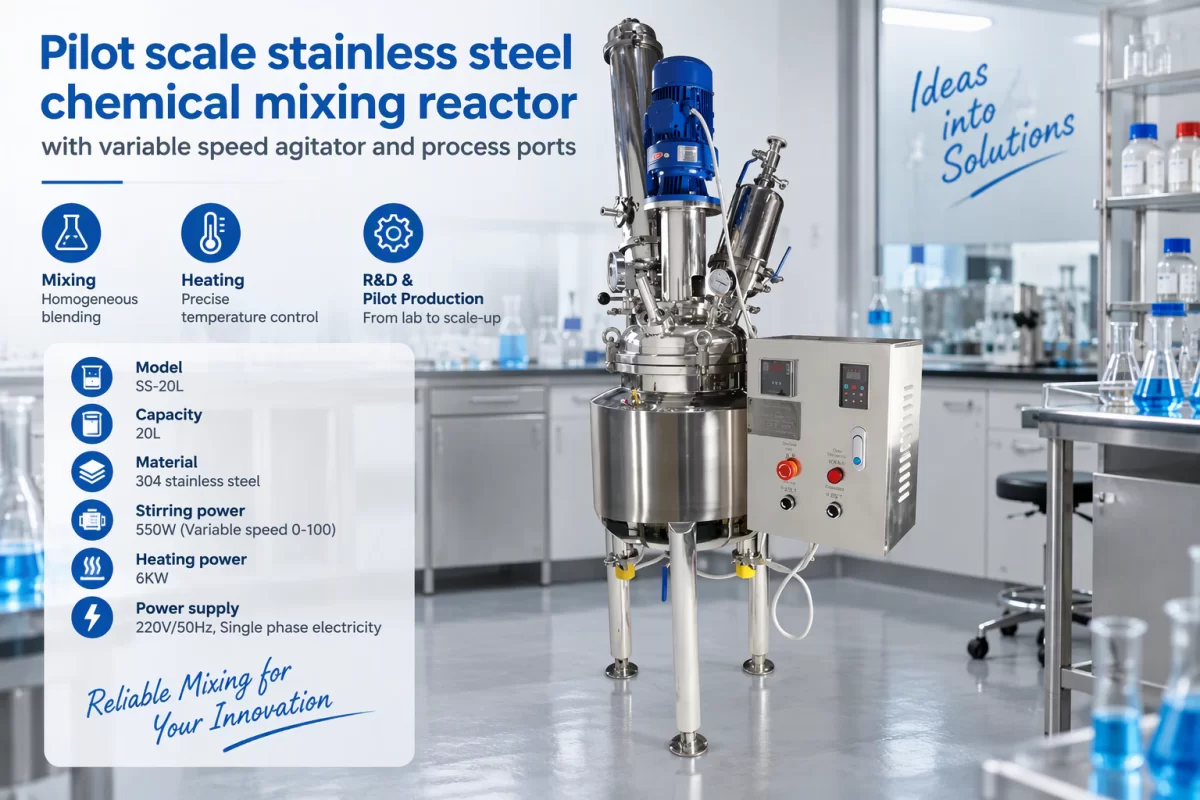
The dedicated SS-20L sheet describes a different arrangement: 20L capacity, 304 stainless steel, 220V/50Hz single-phase supply, 550W stirring power, variable-frequency adjustment listed as 0–100 revolutions, 6kW heating power, and 3mm material thickness. The speed unit should be confirmed as rpm. These values should not be combined with the 0–600 rpm jacketed-series specification.
Scaling up should preserve the required process result, not simply duplicate the laboratory rpm. Mixing trials should examine blend time, solids behavior, temperature uniformity, and discharge characteristics. The working principle of stainless steel reactors offers useful background on how vessel construction, agitation, and heat transfer interact.
Budget for the Required Configuration
Our company price references below provide a starting point for comparing selected listed products. They are not competitor prices or confirmed quotations for every specification discussed above. Final pricing depends on the selected configuration and agreed supply scope.
| Listed Product | Company Reference Price | Configuration Check |
|---|---|---|
| 5L stainless steel reactor with mechanical stirring | $1,485 | Confirm vessel grade, motor specification, seals, and accessories. |
| 20L jacketed stainless steel reactor with mechanical stirring and condenser | $1,634 | Confirm the applicable SS-20L configuration and temperature-control scope. |
| 50L jacketed stainless steel agitated reactor with full-open top | $2,042 | Confirm closure design, pressure limits, and included process connections. |
Swipe horizontally to compare product descriptions and prices on mobile.
Match the Reactor to the Chemistry
A Stainless steel chemical mixing reactor with variable speed agitator can be considered for compatible chemical synthesis, liquid blending, dissolution, suspension preparation, and resin-development processes. Suitability depends on the chemistry and operating conditions, especially where corrosive liquids, abrasive solids, flammable solvents, or significant gas generation are involved.
Formulation and Dissolution
Adjustable agitation supports controlled ingredient addition and mixing trials. Impeller selection should account for viscosity changes during dissolution, rather than assuming the starting liquid represents the final batch.
Temperature-Sensitive Batch Development
Jacketed temperature control and measured agitation can help develop reproducible heating, holding, and cooling stages. Temperature-sensor placement and process validation remain essential for establishing actual batch conditions.
Pilot-Scale Process Evaluation
Larger vessels provide opportunities to assess mixing, heat transfer, charging, and discharge before further scale-up. Nominal vessel volume should not be treated as the allowable working fill; adequate headspace must be established for the specific process.
Build a Better-Specified Mixing System
The value of a stainless steel mixing reactor lies in how well its configuration supports the intended process. Before selecting a model, define the actual working volume, chemical compatibility requirements, viscosity range, temperature profile, and pressure or vacuum conditions.
- Confirm material compatibility: Review every wetted component, not only the reactor vessel.
- Specify agitation: Match impeller geometry, speed range, power, and torque to the batch.
- Verify thermal capability: Coordinate the jacket, circulating equipment, fluid, and process heat load.
- Resolve configuration differences: Confirm the exact SS-20L version and all model-specific specifications.
- Define the supply scope: Document accessories, utilities, safety requirements, and quotation inclusions.
From the compact SS-5L to larger jacketed models, the available range offers a practical foundation for developing a controlled mixing system. A clearly specified Stainless steel chemical mixing reactor with variable speed agitator can support repeatable batch procedures while keeping equipment selection aligned with chemistry, operating requirements, and budget.