
High Efficiency Stainless Steel Mixing Reactor for Pharmaceuticals
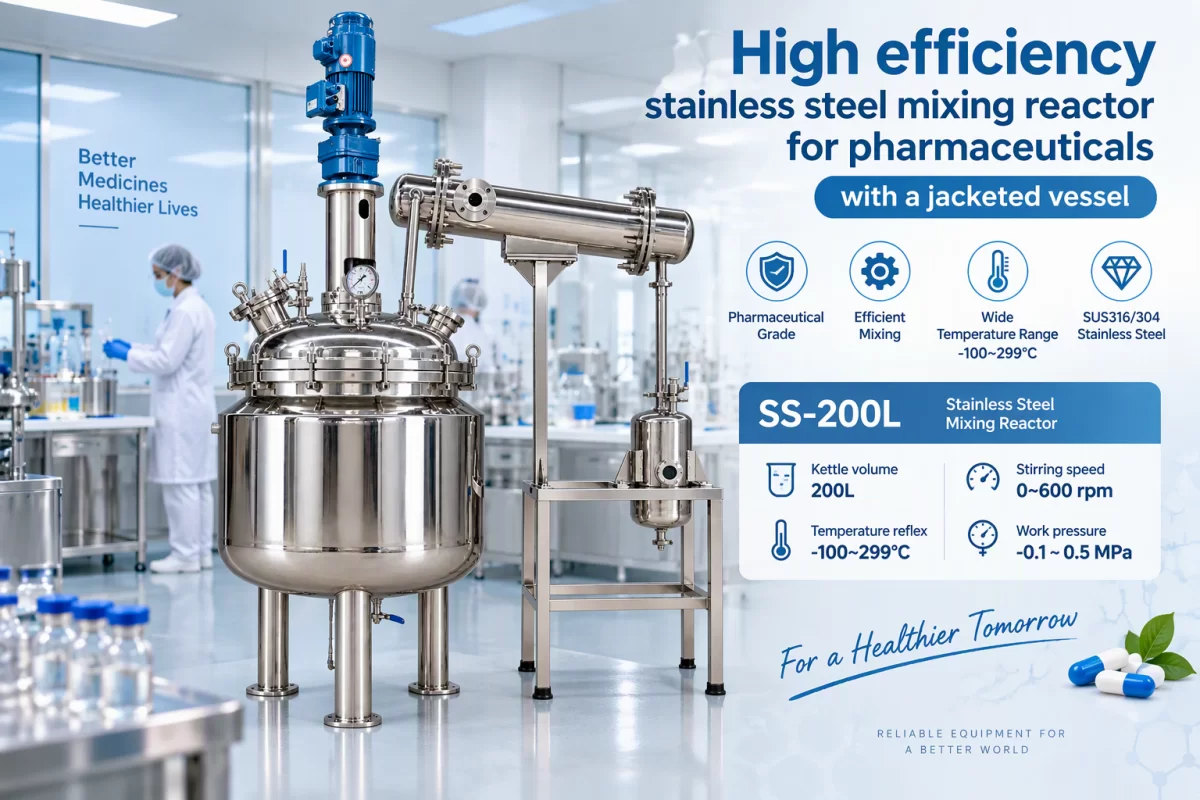
Consistent pharmaceutical processing begins with controlled mixing, dependable temperature management, and carefully selected product-contact materials. A high efficiency stainless steel mixing reactor for pharmaceuticals can support these goals when its configuration matches the chemistry, batch size, and quality requirements of the application.
Efficiency Means More Than Stirring Faster
Pharmaceutical development often involves dissolving raw materials, blending liquid intermediates, suspending solids, and controlling reaction conditions. Effective agitation helps distribute ingredients and heat throughout the vessel. However, maximum rotational speed is not automatically the most productive setting: excessive agitation can introduce air, increase foaming, or damage sensitive particles.
The practical advantage of a variable-speed reactor is flexibility. Mixing conditions can be adjusted as viscosity, solids loading, and batch volume change. A jacketed vessel also allows heating or cooling through a circulating thermal fluid, helping coordinate temperature control with agitation rather than treating them as separate operations.
Our stainless steel chemical reactor range provides a starting point for evaluating these features. Actual efficiency should be demonstrated through process trials, including mixing time, temperature uniformity, discharge performance, and cleaning time.
SS-5L: A Compact Starting Point for Process Development
The SS-5L combines a 5L reactor vessel with a 1.5L jacket. Its reactor material is specified as 316 stainless steel, while the frame, piping, and three-blade stirring rod are specified as 304 stainless steel. This distinction matters because material compatibility must cover every wetted component, not only the vessel wall.
Frequency-converter speed control and a digital speed display support adjustable agitation. Temperature indication uses a PT100 sensor with a digital display. Braked swivel casters allow equipment repositioning, although the assembly should be secured and utility connections checked before operation.
On smaller screens, scroll horizontally to read the complete specification table.
| Parameter | Listed specification | Selection consideration |
|---|---|---|
| Reactor / jacket volume | 5L / 1.5L | Establish the permissible working fill for the process. |
| Materials | 316 vessel; 304 frame, piping, and stirring rod | Check the complete wetted-material list. |
| Temperature range | −100 to 250°C | Confirm the assembled system’s approved operating limits. |
| Listed pressure range | −0.098 to 0.5 MPa | Confirm pressure basis and allowable pressure at temperature. |
| Stirring speed | 0–600 rpm | Select speed through mixing trials. |
| Stirring power | 120W | The additional “power increase 1/3” notation requires clarification. |
| Electrical supply | 220V / 60Hz | Check compatibility with the installation site. |
| Seal and discharge | Mechanical seal; quick-discharge ball valve | Assess seal compatibility, drainability, and cleaning access. |
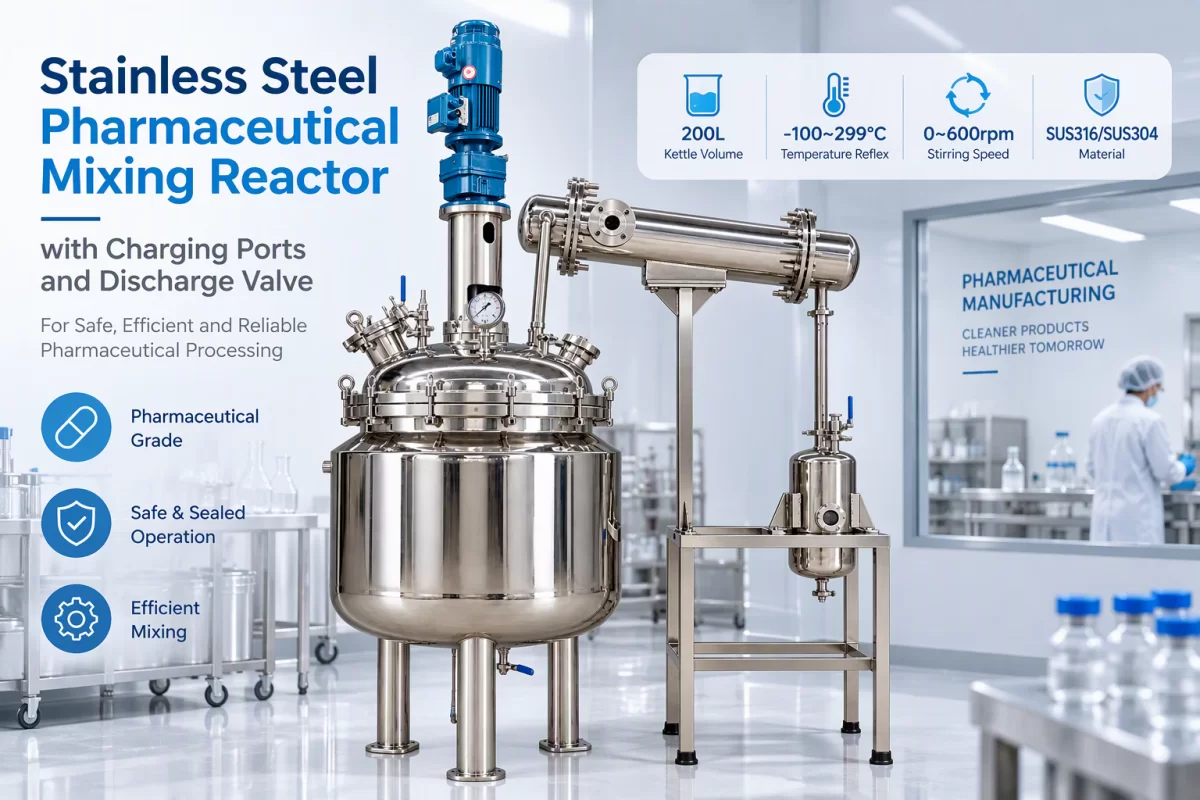
The lid includes ports for stirring, solid charging, temperature measurement, a pressure gauge, a constant-pressure funnel, and condensation reflux. Port arrangements can be customized according to requirements, making early discussion of charging and sampling procedures especially useful.
Match Thermal Control to the Chemistry
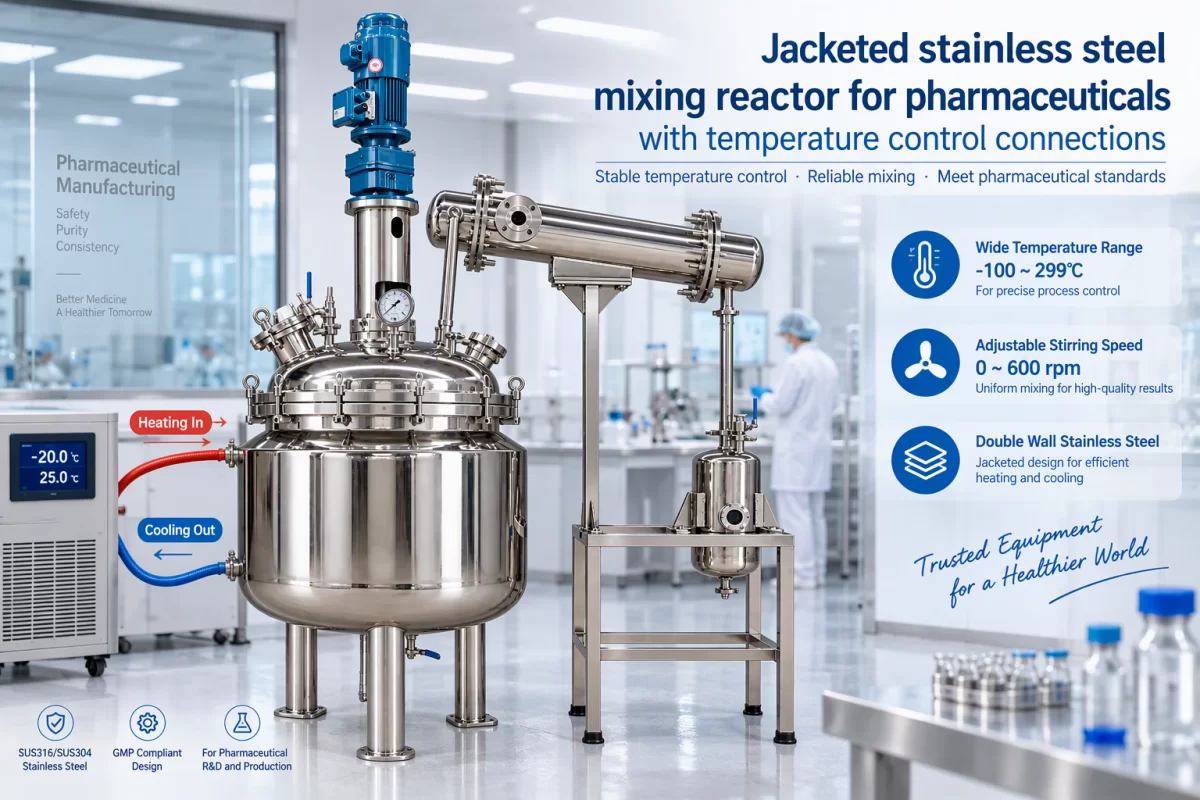
A broad listed temperature range does not mean every reaction can safely operate at its endpoints. Heating and cooling performance depends on the circulating unit, thermal-fluid properties, jacket flow, insulation, batch volume, and heat released by the reaction. Seal materials and connected accessories may impose narrower limits than the vessel specification.
A compatible recirculating chiller heater can supply the jacket with controlled thermal fluid. Selection should consider heating capacity, cooling capacity at the required temperature, pump performance, and fluid compatibility. The temperature range of the reactor alone cannot establish the achievable batch heating or cooling rate.
Scale from Laboratory Batches to Larger Development Runs
The supplied SS series lists vessel capacities of 10, 20, 30, 50, 100, 150, 200, and 300 liters. The series sheet describes double-wall stainless steel construction, digital frequency-conversion speed regulation, paddle-type stirring, a 0–600 rpm speed range, and a listed temperature range of −100 to 299°C.
Larger volume should not be treated as a simple multiplication of laboratory conditions. Impeller dimensions, available torque, heat-transfer area, mixing time, and addition rates all influence scale-up. Maintaining the same rpm across different vessel sizes does not guarantee equivalent mixing.
Scroll horizontally on mobile to compare vessel and jacket capacities.
| Model | Vessel volume | Approximate jacket volume |
|---|---|---|
| SS-10L | 10L | 3.8L |
| SS-20L | 20L | 5L |
| SS-30L | 30L | 8L |
| SS-50L | 50L | 15L |
| SS-100L | 100L | 20L |
| SS-150L | 150L | 50L |
| SS-200L | 200L | 70L |
| SS-300L | 300L | 95L |
Plan the Equipment Budget with Clear Listing Prices
Our supplied price list provides the following company listing references for selected stainless steel reactor products. These fixed-price entries offer a straightforward starting point without implying that every accessory or pharmaceutical documentation package is included.
Scroll horizontally on mobile to view all product and pricing details.
| Listed product | Company price | Before ordering |
|---|---|---|
| 5L stainless steel reactor with mechanical stirring | $1,485 | Confirm vessel material and included accessories. |
| 10L stainless steel reactor | $1,541 | Confirm the configuration and approved operating envelope. |
| 20L jacketed stainless steel reactor with mechanical stirring and condenser | $1,634 | Confirm the specific 20L variant and condenser package. |
| 50L jacketed stainless steel reactor with open top | $2,042 | Confirm closure design, seals, and cleaning access. |
Final quotations should specify the thermal circulator, vacuum equipment, sensors, fittings, shipping, taxes, and documentation where applicable. Listing names alone do not establish suitability for hydrogenation, sterile manufacture, or a particular pressure-temperature combination.
Build a Reactor Package Around the Actual Process
A high efficiency stainless steel mixing reactor for pharmaceuticals is most useful when purchased as a clearly defined process package. For development work, that may mean adjustable agitation and reliable temperature indication. For regulated manufacturing, additional hygienic design, qualification records, and validated procedures may be necessary.
- Define the batch: Record working volume, viscosity, solids loading, solvent composition, and required headspace.
- Verify compatibility: Review vessel, impeller, piping, valves, seal faces, and elastomers against the process chemistry.
- Confirm the operating envelope: Obtain allowable pressure at temperature, relief requirements, and component limits. Listed maximum values are not necessarily simultaneous operating conditions.
- Review cleaning: Assess accessible surfaces, residual hold-up, discharge geometry, and cleaning-validation requirements.
- Address process hazards: Evaluate flammable solvents, ventilation, grounding, electrical area classification, and any required explosion-protected equipment.
For additional background on agitation and jacketed heat transfer, the guide to the working principle of stainless steel reactors explains the core equipment functions. Application-specific engineering remains essential before installation and use.
Choose Controlled Processing, Not Just a Larger Vessel
The right stainless steel mixing reactor brings together appropriate materials, effective agitation, thermal control, and a practical operating configuration. Our 5L laboratory option and listed 10–300L series provide multiple starting points for pharmaceutical process development.
A configuration-specific quotation should match batch characteristics, utilities, cleaning expectations, safety requirements, and documentation needs. With those details established, reactor selection becomes a focused investment in repeatable processing rather than a comparison of volume and price alone.