
Chemical Stainless Steel Mixing Reactor with Agitation Control
Consistent chemical processing starts with a vessel that brings mixing, temperature management, and practical operation together. A Chemical stainless steel mixing reactor with agitation control provides an adjustable platform for laboratory development, formulation trials, and appropriately configured pilot-scale batches.
Our stainless steel reactor range includes compact 5L equipment and jacketed models from 10L to 300L. Selecting the right configuration means matching the vessel, agitator, thermal system, and sealing arrangement to the actual process—not simply choosing the largest capacity or highest stirring speed.
Why Adjustable Agitation Matters in Chemical Processing
Agitation helps distribute ingredients, maintain suspended solids, and improve contact between the reaction mixture and the vessel wall. However, mixing intensity must suit the formulation. Excessive speed can encourage vortex formation, air entrainment, or unwanted shear, while insufficient agitation can leave concentration and temperature differences within the batch.
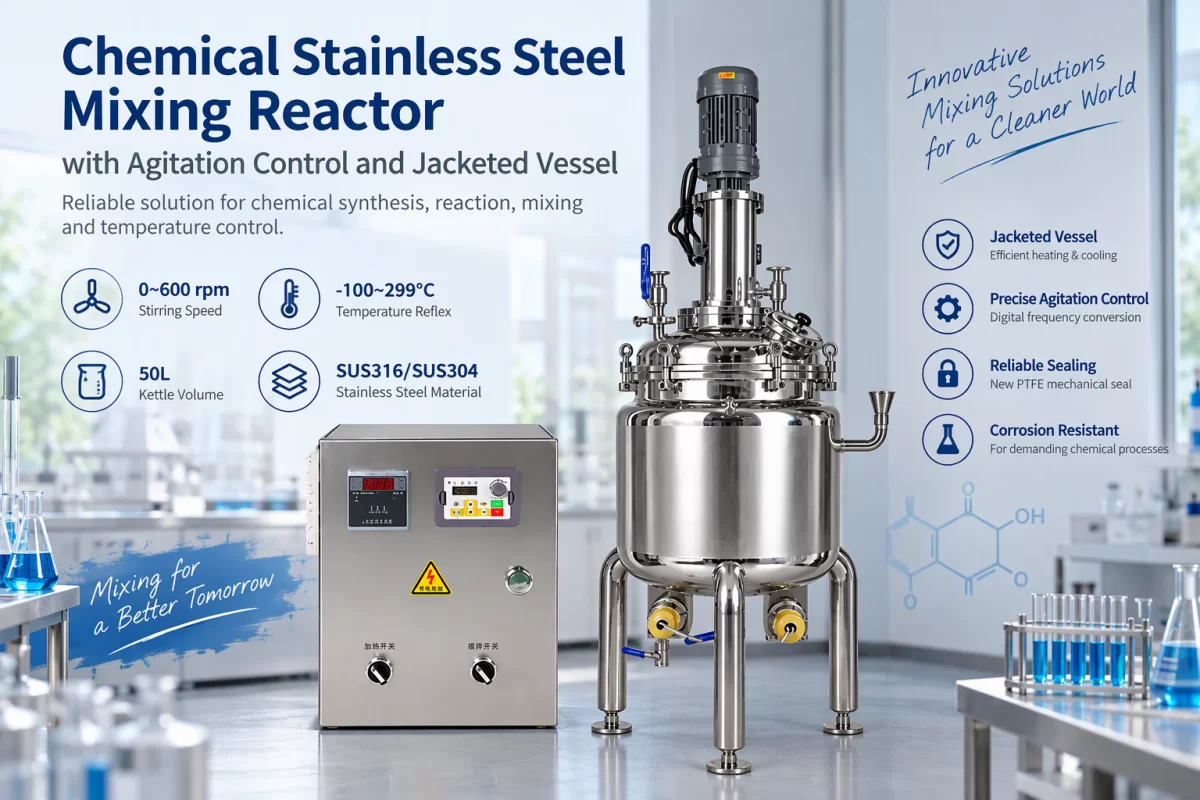
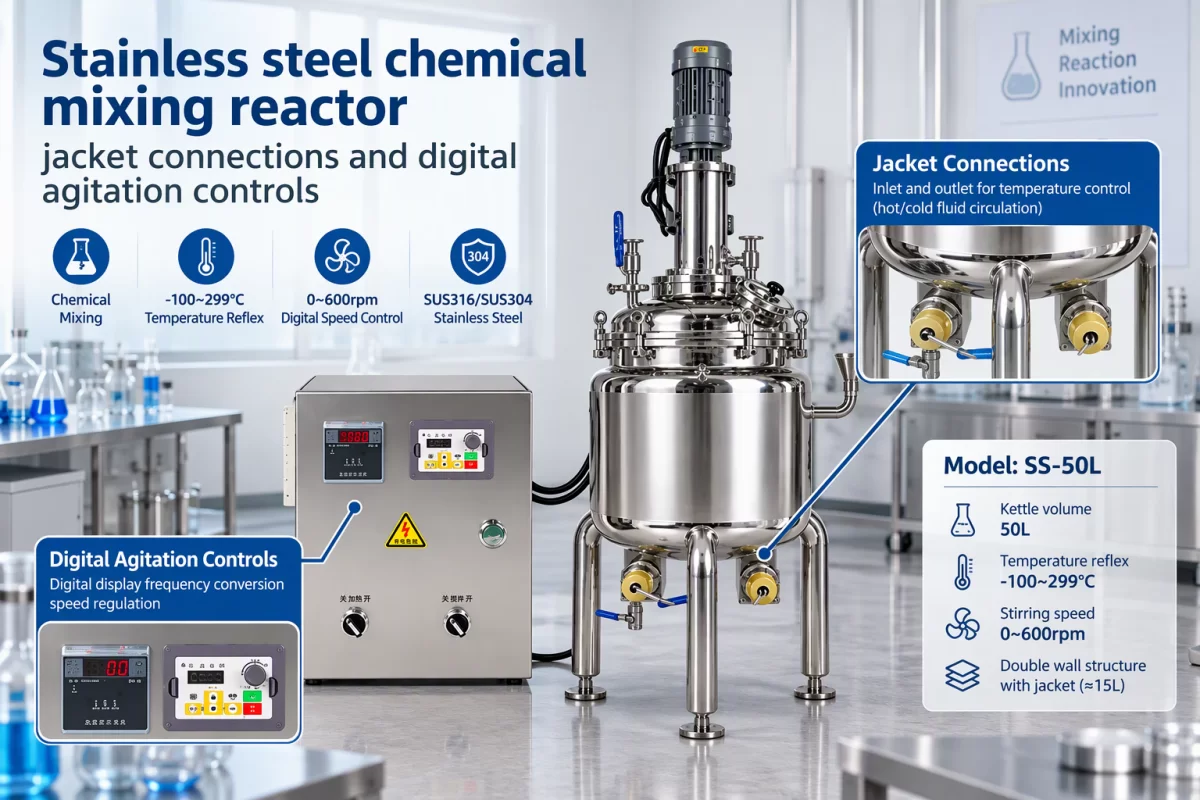
Frequency-converter speed regulation gives operators a practical way to adjust the stirring setpoint during charging, dissolution, reaction, and cooling. Digital speed indication also makes operating conditions easier to record between batches. The jacketed SS-5L and SS-10L–300L specifications list a stirring range of 0–600 rpm, although the usable speed under load depends on viscosity, impeller geometry, fill level, and available torque.
For a broader explanation of the equipment, the working principle of stainless steel reactors describes how the vessel, agitation system, and heat-transfer arrangement function together.
SS-5L: Compact Construction with Useful Process Access
The SS-5L is a practical starting point for small-batch chemical development. Its reactor vessel is specified as 316 stainless steel, while the frame, piping, and three-blade stirring rod are listed as 304 stainless steel. This distinction matters when evaluating chemical compatibility: the vessel material alone does not establish the compatibility of every wetted component.
The 1.5L jacket supports circulation heating, and a PT100 sensor provides digital temperature indication. Mechanical sealing, threaded union connections, and a ball-type quick-discharge valve support a practical laboratory arrangement. Braked swivel casters allow the equipment to be repositioned and secured before operation.
On smaller screens, swipe horizontally to view the complete specification table.
| Parameter | Listed specification | Selection consideration |
|---|---|---|
| Reactor / jacket volume | 5L / 1.5L | Confirm the recommended working fill for the process. |
| Vessel material | 316 stainless steel | Review compatibility with chemicals and cleaning agents. |
| Stirring system | 0–600 rpm; listed power 120W | Confirm motor rating and torque for the intended load. |
| Speed control | Frequency converter; digital display | Supports adjustable, recordable speed settings. |
| Listed reaction temperature | −100 to 250°C | Verify the assembled system’s operating limits. |
| Listed pressure range | −0.098 to 0.5 MPa | Confirm pressure reference and approved operating envelope. |
| Power supply | 220V / 60Hz | Check compatibility with the installation site. |
| Temperature indication | PT100 sensor with digital display | Verify sensor location and calibration requirements. |
Configuration note: The SS-5L lid includes stirring, solid charging, temperature measurement, pressure gauge, constant-pressure funnel, and condensation reflux ports, with customization available according to requirements. The motor entry also contains a “power increase 1/3” notation; its meaning should be clarified in the final technical quotation.
Coordinate Agitation with Jacket Temperature Management
A jacketed reactor transfers heat through the vessel wall using a circulating thermal fluid. Agitation helps move the batch past that heat-transfer surface, but a jacket temperature setting is not the same as the actual reaction temperature. Sensor placement, fluid flow, batch viscosity, and heat generation all influence thermal response.
A compatible recirculating chiller heater can supply heating and cooling to the reactor jacket. Selection should consider the required temperature range, heating and cooling duty, pump performance, hose compatibility, and jacket pressure limit. Thermal equipment should be sized for the process rather than matched by vessel volume alone.
Compare the 10L–300L Jacketed Range Carefully
The supplied larger-series specification lists double-wall stainless steel construction, SUS316/SUS304 material options, digital frequency-conversion speed regulation, and paddle-type stirring. Its stated temperature range is −100 to 299°C, with a listed working pressure range of −0.1 to 0.5 MPa. These values require model-specific verification before operation.
| Model | Vessel capacity | Approximate jacket capacity |
|---|---|---|
| SS-10L | 10L | 3.8L |
| SS-20L | 20L | 5L |
| SS-30L | 30L | 8L |
| SS-50L | 50L | 15L |
| SS-100L | 100L | 20L |
| SS-150L | 150L | 50L |
| SS-200L | 200L | 70L |
| SS-300L | 300L | 95L |
A separate SS-20L specification describes a different configuration: 20L capacity, 304 stainless steel, 3mm material thickness, 220V/50Hz single-phase power, a 550W stirring motor, 0–100 rpm variable-speed operation, and 6kW heating power. These figures should not be combined with the jacketed-series SS-20L data as though they describe one identical machine.
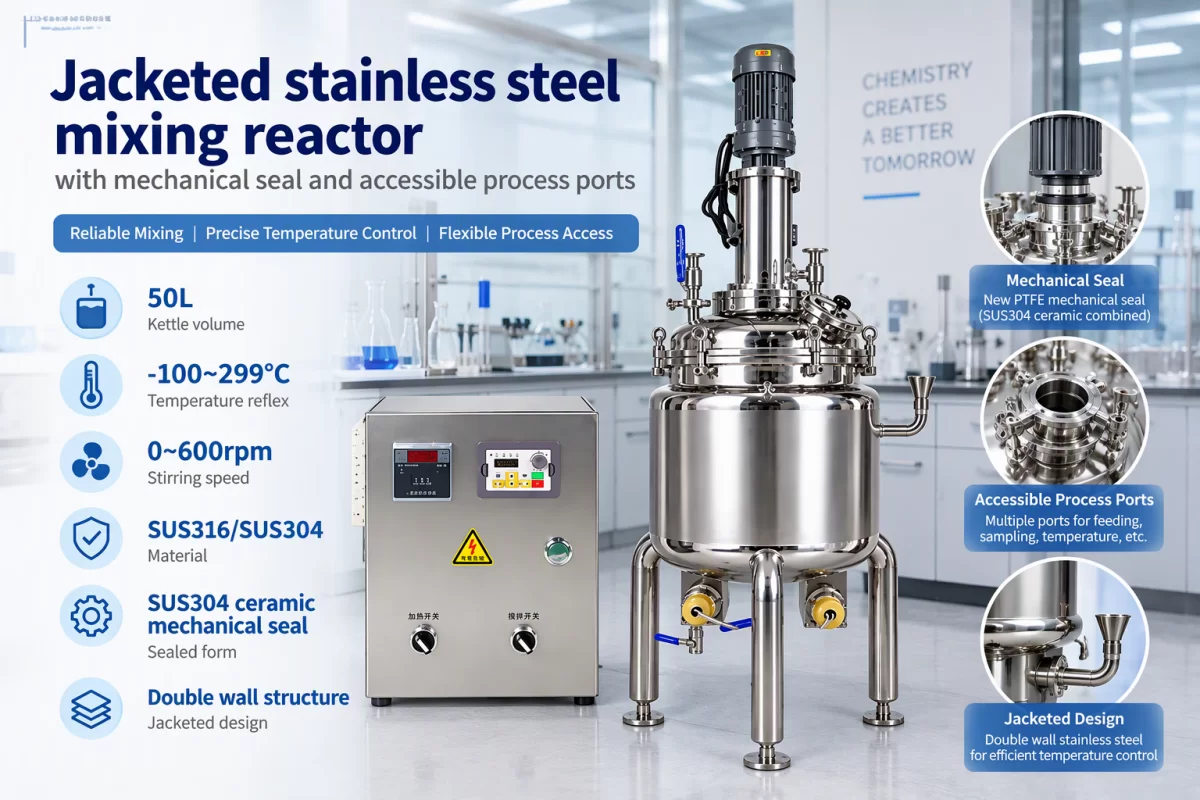
Confirm before ordering: The larger-series document includes both ceramic-combination and PTFE mechanical-seal entries, and its motor-power row does not clearly assign a rating to every model. Request a final model-specific drawing and specification identifying the motor, seal, wetted materials, ports, and utilities.
Specify a Reactor Around the Chemical Process
A well-specified Chemical stainless steel mixing reactor with agitation control should fit both the chemistry and the operating workflow. Our stainless steel chemical reactor product information provides a starting point for discussing vessel capacity and configuration requirements.
-
Identify the complete chemical-contact system
Review the vessel, stirring shaft, impeller, seals, valves, and connected accessories. Stainless steel grade selection must account for concentration, temperature, exposure duration, and cleaning chemistry.
-
Define agitation requirements beyond rpm
State the expected viscosity range, solids content, batch fill, and shear limitations. Variable speed is useful, but adequate torque and suitable impeller geometry are equally important.
-
Plan utilities, cleaning, and discharge
Confirm electrical supply, thermal-fluid connections, ventilation, drain access, and cleaning procedures. Port layout should allow practical charging, measurement, sampling where specified, and accessory installation.
-
Verify process-specific safety requirements
Establish requirements for pressure relief, overtemperature protection, guarding, and hazardous-area equipment where applicable. The supplied specifications do not establish explosion-proof certification or suitability for high-pressure hydrogenation.
Plan the Purchase with Clear Equipment Price References
The following prices come from our company’s supplied product price list. They provide useful budgeting references for the listed reactor products, but they do not establish identical accessory packages or guarantee that every specification above is included.
| Listed product | Company price | Quotation check |
|---|---|---|
| 5L stainless steel reactor with mechanical stirring | $1,485 | Confirm seal, motor, and included accessories. |
| 20L jacketed stainless steel reactor with mechanical stirring and condenser | $1,634 | Confirm the exact 20L configuration and condenser package. |
| 50L jacketed stainless steel reactor with full-open top | $2,042 | Confirm closure design, utilities, and agitation specification. |
Final pricing should be confirmed against the agreed technical configuration, order quantity, delivery terms, and accessory scope. Ask whether the quotation includes the thermal circulator, condenser, vacuum equipment, instrumentation, freight, and applicable taxes rather than assuming these items are part of the listed reactor price.
Build a More Suitable Chemical Mixing Setup
From compact laboratory trials to larger jacketed batches, adjustable agitation and stainless steel construction provide a flexible foundation for chemical processing. The best purchase combines an appropriate working volume with compatible wetted materials, adequate mixing capability, and a verified operating envelope.
For a tailored equipment quotation, prepare the target batch volume, chemical composition, viscosity, operating temperature, pressure requirements, electrical supply, and preferred accessories. A clearly defined process makes reactor selection more precise and helps avoid unnecessary equipment costs.