
Stainless Steel Mixing Reactor Tank for Pharmaceutical Production
A well-configured stainless steel mixing reactor provides controlled heating, cooling, agitation, vacuum operation, material charging, condensation, and hygienic discharge in one compact processing system. This guide explains how 5L to 300L reactor configurations can support pharmaceutical research, formulation development, pilot production, and controlled batch processing.
Why Stainless Steel Reactors Suit Pharmaceutical Processing
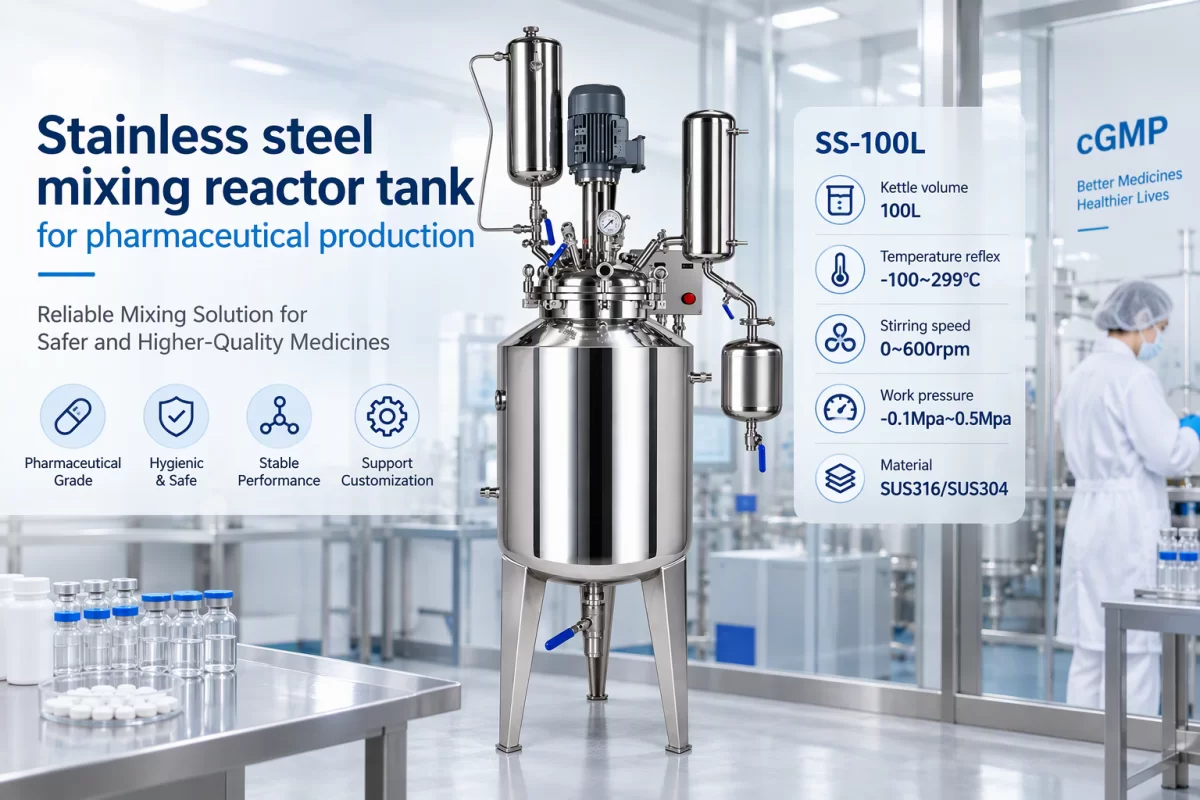
Pharmaceutical processing depends on repeatable mixing, stable temperature conditions, compatible construction materials, and reliable sealing. A Stainless steel mixing reactor tank for pharmaceutical production combines these functions in a robust vessel that can be configured for liquids, powders, solvents, intermediates, extracts, suspensions, and other process materials.
Stainless steel is valued because it offers mechanical strength, broad chemical compatibility, corrosion resistance, and a surface that can be cleaned more easily than many untreated metals. The SS-5L configuration uses a 316 stainless steel reactor body, while its frame, piping, and three-blade stirring rod use 304 stainless steel. Larger models from 10L through 300L can be supplied in SUS316 or SUS304, allowing the material selection to be matched to the formulation and cleaning procedure.
For readers comparing vessel design and operating principles, this overview of stainless steel reactors provides additional information about heat transfer, agitation, and reaction control.
- Closed-vessel processing helps reduce external contamination and uncontrolled vapor release.
- Jacket circulation enables controlled heating or cooling without direct contact between the utility fluid and product.
- Frequency-converter speed regulation supports gradual and repeatable agitation adjustment.
- Mechanical sealing helps maintain vacuum or positive pressure during suitable processes.
- Multiple lid ports support feeding, temperature measurement, pressure indication, reflux, and customized accessories.
Temperature, Pressure, and Agitation Control
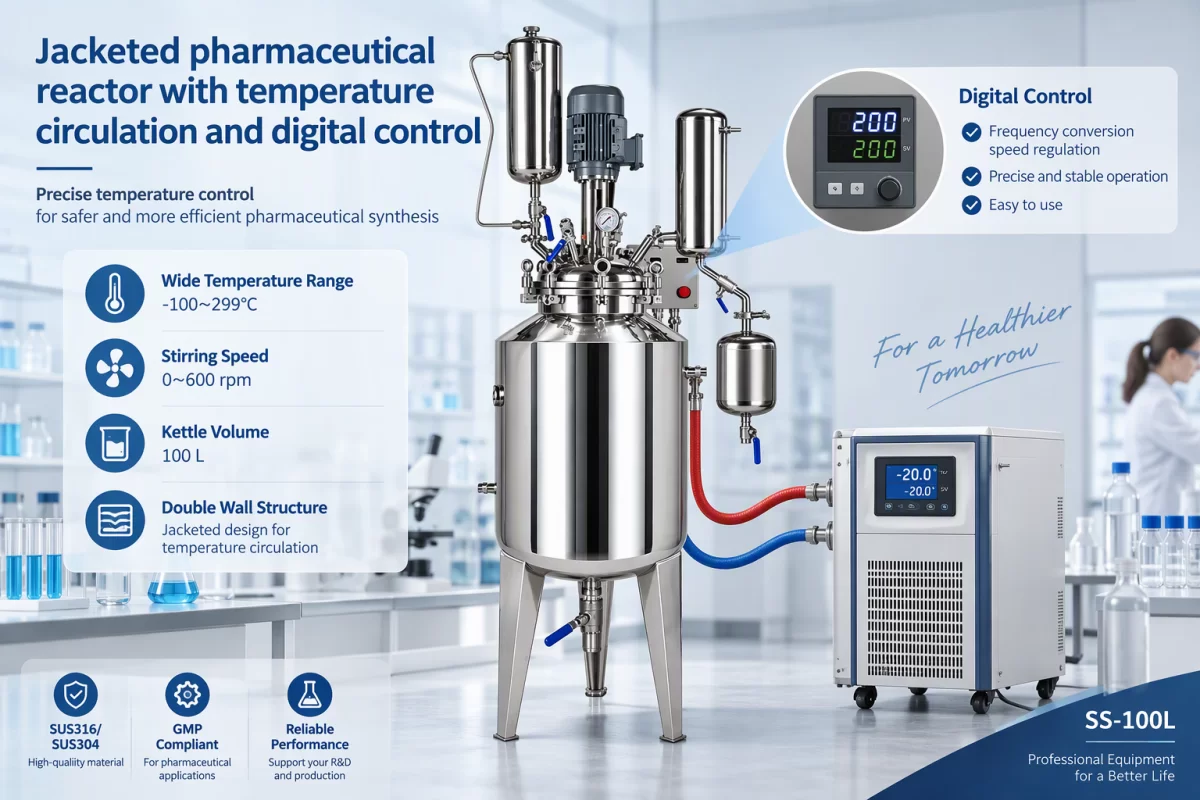
Thermal consistency has a direct influence on dissolution, extraction, crystallization, blending, synthesis, and concentration. The 5L unit supports circulation heating and a stated kettle reaction temperature range of -100°C to 250°C. Models from 10L to 300L provide a stated temperature reference range of -100°C to 299°C. Actual operating limits depend on the thermal fluid, connected circulator, seals, process pressure, and complete system configuration.
A compatible recirculating chiller heater can deliver heating or cooling fluid through the jacket. This arrangement separates the process material from the heat-transfer medium and permits controlled temperature changes. A properly sized circulator should be selected according to vessel volume, desired ramp rate, heat load, temperature range, jacket resistance, and external tubing length.
Variable-Speed Mixing
The SS-5L and the listed 10L–300L series provide variable agitation up to 600 rpm through digital frequency-conversion control. A paddle-style impeller is specified for larger configurations, while the 5L unit uses a three-blade 304 stainless steel stirring rod. Variable speed gives operators greater flexibility during charging, wetting, dissolving, reaction, and discharge stages.
One separate SS-20L configuration is designed for lower-speed, higher-power mixing. It offers a 0–100 rpm range, a 550W stirring motor, 6kW electric heating, 3mm material thickness, and a 220V/50Hz single-phase power supply. This illustrates why the model number alone is not enough: mixing torque, power, speed, heating arrangement, and electrical standard must all be confirmed before ordering.
Model and Technical Specification Comparison
Capacity selection should account for working volume rather than nominal vessel volume alone. Adequate headspace may be necessary for powder addition, foaming, reflux, expansion, or gas introduction. A small 5L system is suitable for laboratory development, while 20L to 50L configurations can support process optimization and pilot batches. Capacities from 100L to 300L provide a pathway toward larger batch production.
On mobile devices, swipe horizontally to review all columns in the tables.
| Model | Vessel Volume | Jacket Volume | Stirring Speed | Main Material Options |
|---|---|---|---|---|
| SS-5L | 5L | 1.5L | 0–600 rpm | 316 vessel; 304 frame, pipe, and stirring rod |
| SS-10L | 10L | Approx. 3.8L | 0–600 rpm | SUS316 or SUS304 |
| SS-20L | 20L | Approx. 5L | 0–600 rpm* | SUS316 or SUS304 |
| SS-30L | 30L | Approx. 8L | 0–600 rpm | SUS316 or SUS304 |
| SS-50L | 50L | Approx. 15L | 0–600 rpm | SUS316 or SUS304 |
| SS-100L | 100L | Approx. 20L | 0–600 rpm | SUS316 or SUS304 |
| SS-150L | 150L | Approx. 50L | 0–600 rpm | SUS316 or SUS304 |
| SS-200L | 200L | Approx. 70L | 0–600 rpm | SUS316 or SUS304 |
| SS-300L | 300L | Approx. 95L | 0–600 rpm | SUS316 or SUS304 |
*A separately configured SS-20L model is available with 0–100 rpm mixing, 550W stirring power, 6kW electric heating, and 304 stainless steel construction. Specifications should be confirmed according to the selected configuration.
Important SS-5L Details
| Specification | SS-5L Configuration |
|---|---|
| Reaction temperature | -100°C to 250°C |
| Pressure range | -0.098 MPa to 0.5 MPa |
| Stirring power | 120W, with one-third power increase specification |
| Voltage and frequency | 220V / 60Hz |
| Speed control and display | Frequency converter with digital display |
| Temperature display | PT100 sensor with digital display |
| Seal | Mechanical seal |
| Discharge | Ball-type quick discharge valve |
| Movement | Braked swivel casters |
| Connections | Threaded unions |
Ports, Seals, and Process Integration
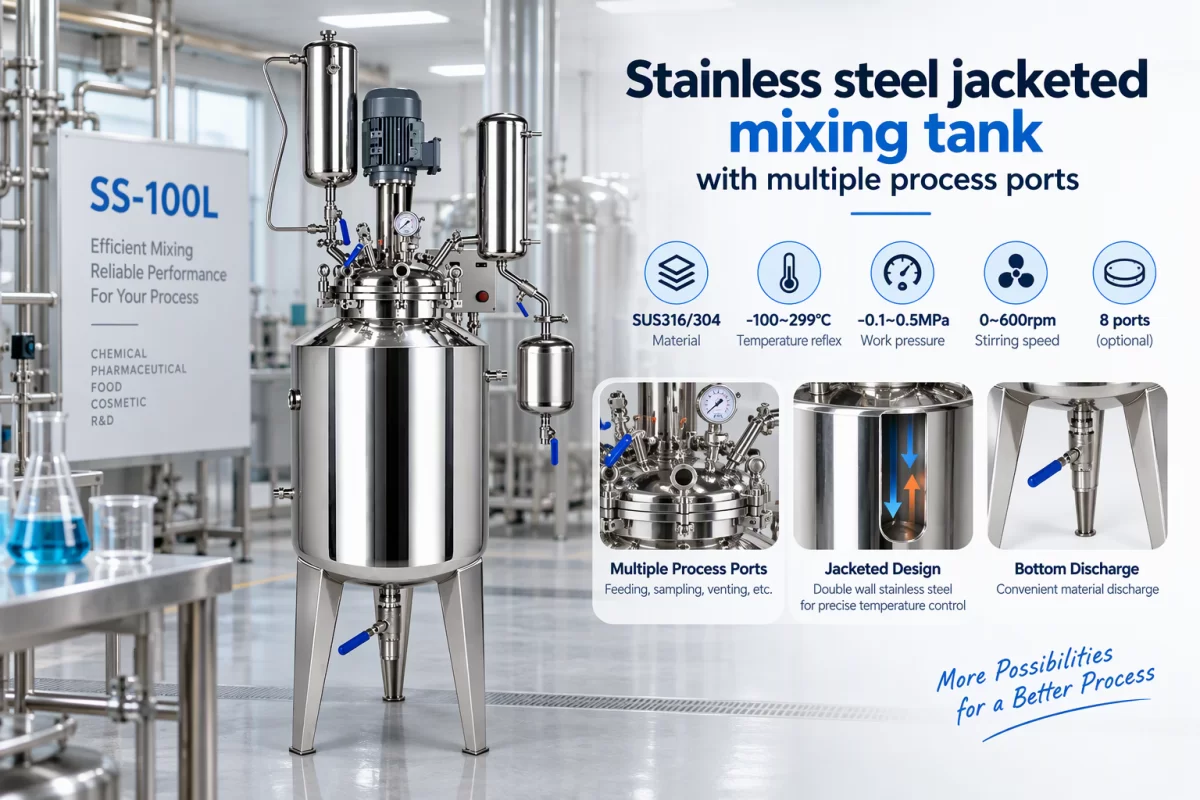
A reactor becomes more useful when its vessel ports match the intended workflow. The SS-5L lid can include a stirring port, solid-material port, temperature-measurement port, pressure-gauge port, constant-pressure funnel port, and condensation-reflux port. Customization is available to accommodate process-specific feeding, sensing, sampling, or vapor-management requirements.
The larger double-wall series can be configured with eight vessel ports. It uses digital frequency-conversion control, a mechanical sealing arrangement, and paddle agitation. Listed pressure capability extends from approximately -0.1 MPa vacuum to 0.5 MPa positive working pressure. Because pressure service introduces additional engineering and safety requirements, allowable temperature and pressure must always be evaluated as a combined operating condition.
Where pharmaceutical synthesis requires substantially higher pressure, equipment should be selected specifically for that service. A dedicated high pressure reactor is more appropriate than operating a conventional jacketed tank beyond its stated design limits.
Applications in Pharmaceutical Development and Production
A stainless steel pharmaceutical reactor can support many controlled batch operations, provided the construction and accessories are suitable for the product. Typical uses include solution preparation, active ingredient intermediate processing, botanical extraction, reagent blending, pH adjustment, crystallization trials, heated dissolution, vacuum concentration, and preparation of suspensions.
- Material charging: Liquids and solids enter through designated ports while unnecessary openings remain sealed.
- Controlled agitation: The frequency converter gradually adjusts impeller speed to improve wetting and distribution.
- Thermal processing: Heating or cooling fluid circulates through the jacket as the PT100 sensor monitors the vessel temperature.
- Vacuum or controlled pressure: A suitable sealed configuration supports approved process conditions within the equipment limits.
- Condensation and reflux: The condenser connection returns condensed vapor or directs recovered condensate into an appropriate receiver.
- Batch discharge: Process material exits through the quick-discharge valve for downstream filtration, drying, filling, or further processing.
Company Price References
Reactor cost depends on vessel capacity, stainless steel grade, heating method, motor power, pressure design, condenser, control system, port configuration, surface treatment, and documentation. The following figures are company price references for representative configurations. They are intended to support initial budgeting and may change when optional components or custom engineering are added.
| Representative Configuration | Company Price Reference | Typical Scale |
|---|---|---|
| 5L jacketed stainless steel reactor | $1,485 | Laboratory development |
| 10L stainless steel reactor | $1,541 | Laboratory or small batch |
| 20L jacketed stainless steel reactor | $1,634 | Process development |
| 50L jacketed stainless steel reactor | $2,042 | Pilot processing |
| 100L jacketed stainless steel reactor | $3,800 | Pilot or production batch |
A useful quotation should identify the vessel material, working volume, jacket volume, motor and gearbox, impeller, temperature range, pressure requirement, electrical standard, seals, condenser, valves, instruments, control system, surface treatment, documentation, packaging, and requested custom ports. A clear process description reduces the risk of selecting an underpowered or incompatible system.
Prices shown above are this company’s reference prices and do not include every optional accessory, shipping charge, tax, certification requirement, or project-specific modification. Final pricing is based on the confirmed technical configuration.
How to Select the Right Pharmaceutical Mixing Reactor
Begin with a written process requirement covering the product, batch size, viscosity, solids content, corrosiveness, operating temperature, vacuum level, positive pressure, and required mixing result. Next, define whether the reactor will be used for research, scale-up, repeated pilot batches, or routine production.
- Select 304 or 316 stainless steel after reviewing process and cleaning-fluid compatibility.
- Leave sufficient headspace for expansion, foaming, reflux, gas flow, and powder charging.
- Match motor torque and impeller design to viscosity instead of relying only on maximum rpm.
- Size the heating and cooling system according to the real process heat load and desired cycle time.
- Confirm that seals, valves, hoses, gaskets, and instruments tolerate the specified temperature and chemicals.
- Verify the local voltage, frequency, plug, grounding, and electrical-area requirements.
- Request appropriate pressure protection, operating procedures, and certification where regulated service applies.
- Discuss cleanability, internal finish, drainability, documentation, and validation expectations before production.
The best Stainless steel mixing reactor tank for pharmaceutical production is not necessarily the largest or fastest unit. It is the reactor whose material, agitation, thermal control, seal design, ports, and working limits correspond to the process. Careful specification improves repeatability, simplifies scale-up, and helps protect both product quality and equipment service life.
Plan a Reactor Configuration Around the Process
Available capacities range from compact 5L laboratory systems to 300L double-wall reactors. Provide the target batch volume, material characteristics, temperature range, pressure or vacuum requirement, stirring demand, electrical supply, and preferred stainless steel grade to receive a suitable configuration and current company quotation.