
Industrial Rotary Evaporator for Large Scale Solvent Recovery
Efficient evaporation is essential when laboratories, pilot plants, extraction facilities, and chemical processors need to recover valuable solvents without exposing the product to unnecessary thermal stress. The RE-1002, RE-2002, and RE-5002 rotary evaporator series provides scalable processing capacities for controlled vacuum evaporation.
Why Rotary Evaporation Fits Industrial Solvent Recovery
An industrial rotary evaporator for large scale solvent recovery removes volatile liquid from a process mixture under reduced pressure. Vacuum lowers the solvent’s boiling point, while the heated bath supplies controlled thermal energy. At the same time, the rotating evaporation flask continuously spreads the material into a thin film across the internal glass surface.
This combination of vacuum, rotation, controlled heating, and condensation creates a large effective evaporation area. It can shorten processing time while reducing the temperature required for solvent removal. The technology is particularly valuable for heat-sensitive extracts, pharmaceutical intermediates, botanical concentrates, fine chemicals, and research materials.
Readers requiring a basic explanation of the operating cycle can review this guide to how a rotovap works. Understanding the evaporation and condensation stages makes it easier to size the bath, chiller, vacuum pump, and receiving vessel as one coordinated system.
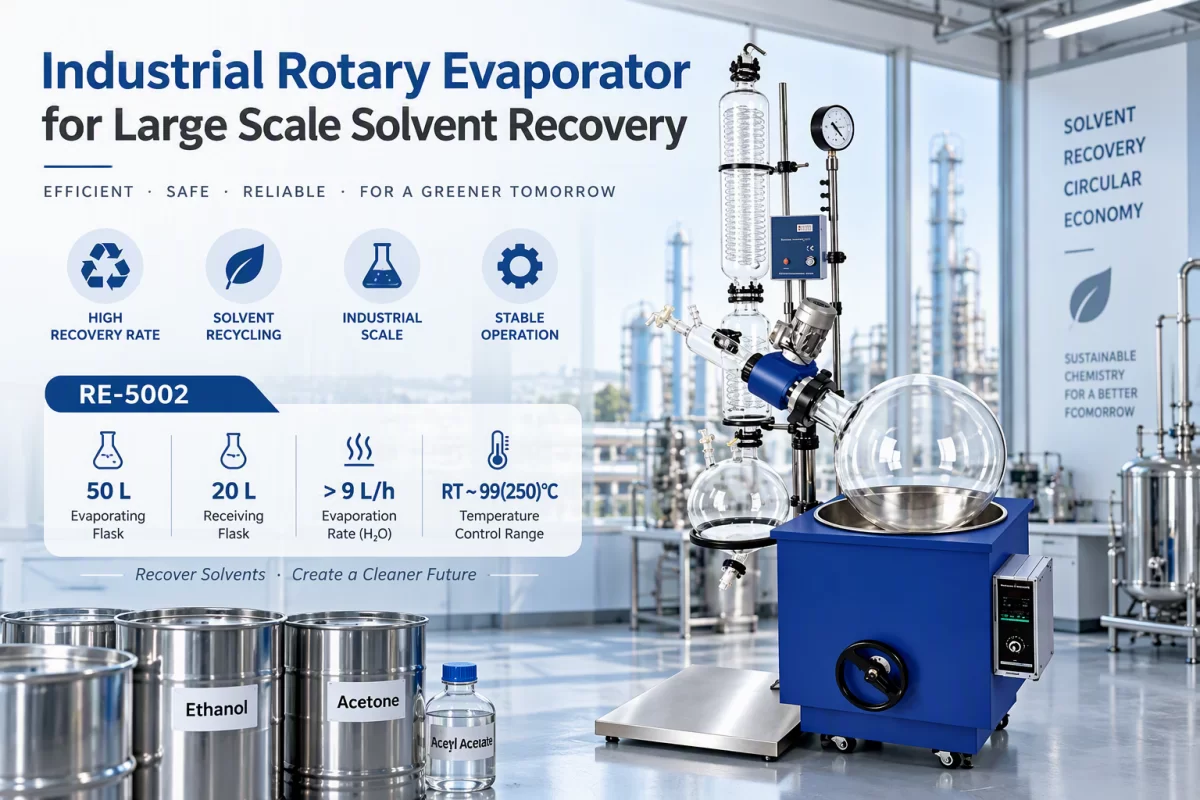
A complete evaporation system combines rotating glassware, a heated bath, condensation, vacuum control, and solvent collection.
- Lower-temperature evaporation: Vacuum operation helps process thermally sensitive materials at reduced boiling temperatures.
- Expanded liquid surface: Flask rotation forms a thin film that promotes consistent heat and mass transfer.
- Solvent collection: Vapor is cooled in the condenser and transferred to the receiving flask for reuse or further treatment.
- Scalable processing: Multiple flask capacities support laboratory scale-up, pilot production, and larger batch recovery.
RE-1002, RE-2002, and RE-5002 Selection Overview
Selecting an industrial rotovap begins with the evaporation flask capacity, but nominal volume should not be treated as usable processing volume. Space must remain inside the flask for film formation, vapor expansion, and stable rotation. Foaming liquids and materials prone to bumping may require a lower fill ratio and slower vacuum application.
In my assessment, the decision should be based on working batch volume, target daily recovery, solvent behavior, cooling capacity, vacuum stability, and loading time. Flask volume alone does not provide a reliable throughput estimate.
| Model | Evaporation Flask | Receiving Flask | Rotation Range | Bath Heating | Typical Scale |
|---|---|---|---|---|---|
| RE-1002 | 10 L | 5 L | Up to 120 rpm | Approx. 3 kW | Scale-up and small pilot batches |
| RE-2002 | 20 L | 10 L | Up to 120 rpm | Approx. 5 kW | Pilot production and medium batches |
| RE-5002 | 50 L | 20 L | Up to 90 rpm | Approx. 6 kW | Large batches and production recovery |
Specifications represent standard reference configurations. Voltage, frequency, bath temperature range, glassware arrangement, sealing configuration, and supporting utility requirements should be confirmed for the final order.
The RE-1002 is suitable when a process is moving beyond benchtop evaporation but does not yet require production-scale glassware. The RE-2002 provides a practical balance between batch capacity and manageable solvent volume. For higher-volume campaigns, the RE-5002 reduces the number of cycles required and provides a larger receiving capacity.
Further details about intermediate-scale operation are available in the 20 liter rotary evaporator guide. Facilities comparing maximum batch capacity can also examine the 50L rotary evaporator configuration.
Capacity Is Only One Part of Recovery Efficiency
A larger flask can hold more material, but it does not independently guarantee a higher evaporation rate. The system must remove vapor as quickly as evaporation produces it. An undersized chiller, unstable vacuum pump, restricted vapor path, or incorrectly selected bath temperature may reduce performance even when the rotary evaporator itself is appropriately sized.
From my perspective, the answer is no. Practical recovery speed depends on condenser temperature, vacuum depth, solvent boiling point, bath temperature, flask loading, rotation speed, and the available condensing surface. These factors must remain balanced throughout the batch.
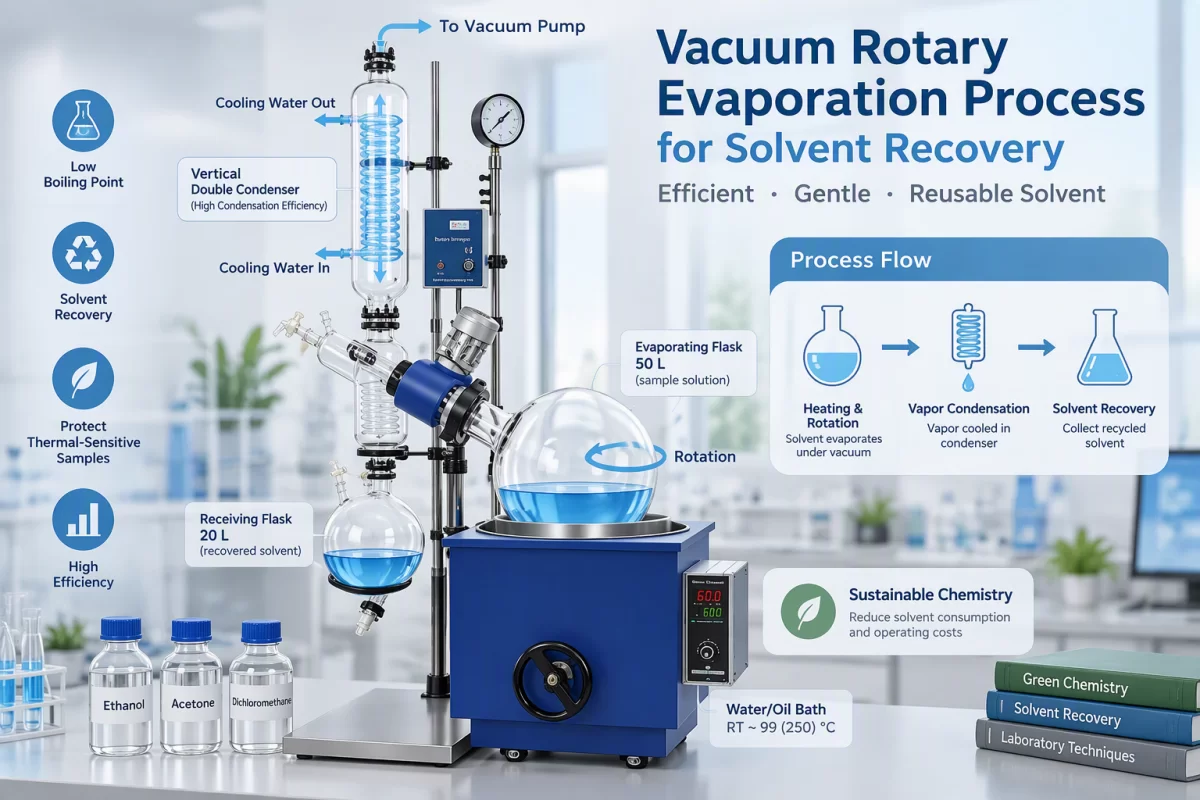
Stable vacuum and adequate cooling are essential for transferring solvent from the evaporation flask to the receiver.
Vacuum pump selection
The pump should be chemically compatible with the target solvent and capable of maintaining the required operating pressure under vapor load. Pump capacity should not be selected only according to the lowest published vacuum value. Flow rate, chemical resistance, control accuracy, vapor protection, and maintenance requirements are equally important.
Cooling capacity
Chiller selection should account for solvent vapor load, inlet temperature, ambient conditions, and continuous operating time. A colder set point is not always the only solution. Sufficient circulation flow and condenser surface contact are also needed to remove heat effectively.
Controlled heating
The heating bath must provide stable temperature control across the working range. Excessive bath temperature may cause violent boiling, foaming, product carryover, or unnecessary degradation. A controlled temperature difference between the bath and condenser usually delivers more predictable recovery than aggressive heating.
How the Industrial Recovery Cycle Works
- Load the process liquid. The evaporation flask is filled below its maximum nominal capacity, leaving enough headspace for rotation and vapor development.
- Begin condenser circulation. Cooling should be stable before substantial vapor generation starts, particularly when handling low-boiling solvents.
- Start flask rotation. The selected speed should create an even film without splashing material into the vapor duct.
- Apply vacuum gradually. Controlled pressure reduction minimizes bumping and gives the operator time to observe foam or sudden boiling.
- Introduce bath heating. Heat is raised progressively until a stable evaporation and condensation rate is established.
- Collect and evaluate the solvent. Condensed liquid enters the receiving flask and can be tested before reuse in a qualified process.
Why Condenser Capacity Matters
The condenser is the bridge between evaporation and successful solvent collection. Once solvent vapor leaves the rotating flask, it must release heat and return to liquid form. If the condenser cannot handle the vapor load, solvent may pass toward the vacuum pump, recovery efficiency can fall, and emissions or pump contamination may increase.
In my view, adequate condenser capacity protects both process yield and equipment reliability. It captures valuable vapor, supports stable vacuum conditions, reduces solvent exposure at the pump, and improves the consistency of each recovery batch.
Cooling conditions should be matched to the solvent rather than selected by a single universal setting. A low-boiling solvent generally requires a colder and more capable cooling loop than water. Mixed solvents can be more complex because the vapor composition changes as the batch progresses. Monitoring vapor behavior and receiver temperature can help determine whether operating conditions remain suitable.
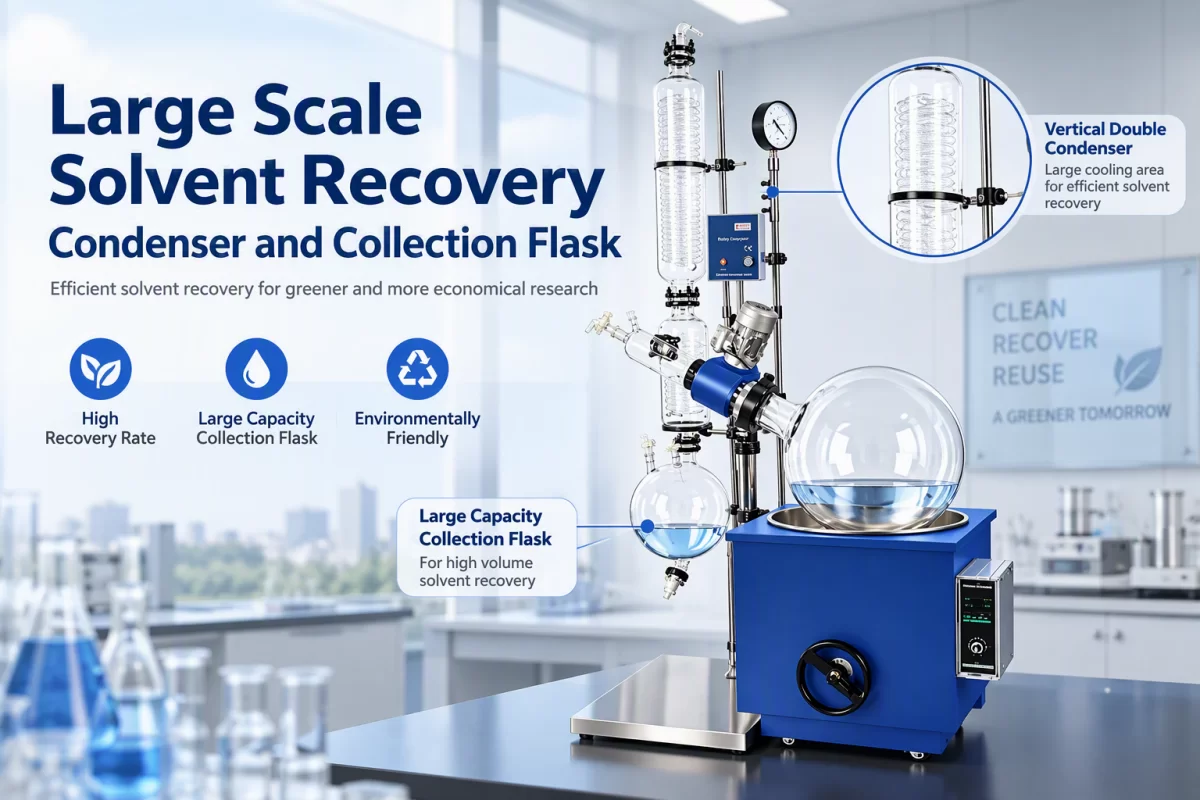
Efficient condensation supports solvent capture, vacuum stability, and cleaner operation during extended recovery cycles.
Key Factors Before Choosing a Large Scale Rotary Evaporator
Solvent compatibility
Review all wetted materials, seals, tubing, valves, and pump components for compatibility with the process solvent.
Real working volume
Calculate usable fill volume rather than relying only on the evaporation flask’s nominal capacity.
Facility utilities
Confirm voltage, frequency, electrical load, ventilation, cooling capacity, vacuum connections, and installation clearance.
Cleaning and changeover
Consider drainage, glassware access, residue viscosity, cross-contamination control, and the required cleaning frequency.
The physical properties of the feed should also be evaluated. High-viscosity concentrates may stop forming an effective film near the end of a batch. Foaming mixtures can require reduced loading and a gentler vacuum ramp. Materials containing suspended solids may create deposits that interfere with heat transfer or complicate discharge.
Safety planning is equally important. Industrial solvent recovery may involve flammable or hazardous vapors. Appropriate ventilation, grounding, operating procedures, compatible electrical equipment, solvent detection, and local regulatory compliance should be reviewed by qualified personnel before installation. A rotary evaporator should never be treated as an isolated appliance; it is part of a complete process system.
Where Large Scale Rotary Evaporators Add Value
Large rotary evaporators are commonly used in pharmaceutical research, natural product extraction, chemical development, food ingredient processing, fragrance production, environmental testing, and pilot manufacturing. Typical duties include removing ethanol after extraction, concentrating botanical solutions, exchanging solvents, preparing material for downstream purification, and recovering volatile liquids from qualified process streams.
Solvent reuse can reduce fresh-solvent purchasing and decrease the amount of liquid sent for disposal. However, recovered solvent should be tested for purity, water content, nonvolatile residue, or other process-specific requirements before it is returned to production. Recovery does not automatically mean that every collected solvent is suitable for every application.
Batch records can improve long-term performance. Useful data include feed volume, solvent type, bath temperature, vacuum level, condenser inlet and outlet temperatures, rotation speed, recovery time, recovered volume, and final concentrate condition. Comparing these values helps identify the most stable operating window and provides a sound basis for future scale-up.
Building a Balanced Solvent Recovery System
The best industrial rotary evaporator for large scale solvent recovery is not simply the model with the largest flask. It is the system that balances feed volume, thermal sensitivity, vapor generation, condenser duty, vacuum performance, operator workflow, and facility utilities.
The RE-1002 provides a useful step between laboratory and pilot processing. The RE-2002 is well suited to medium batch requirements where production capacity must remain manageable. The RE-5002 supports larger recovery campaigns and can reduce repeated loading cycles when the cooling and vacuum systems are sized correctly.
Before final configuration, representative solvent data and process objectives should be reviewed. Important details include the solvent composition, boiling range, expected batch size, required final concentration, preferred recovery time, cooling-water conditions, electrical supply, and whether the material tends to foam or become viscous. This information supports a more accurate equipment recommendation than capacity alone.
Plan a More Efficient Solvent Recovery Process
Match the evaporation flask, condenser, vacuum pump, chiller, bath power, and receiving capacity to actual operating conditions. A properly balanced RE-1002, RE-2002, or RE-5002 system can deliver controlled evaporation, reliable solvent collection, and a practical route from pilot work to larger batch processing.