
The best stainless steel mixing reactor for pharmaceutical production is not simply the largest or most powerful vessel. It is the reactor that matches the batch size, product chemistry, mixing behavior, temperature range, pressure requirement and cleaning plan. For pharmaceutical research, formulation development and pilot processing, a jacketed reactor with controlled agitation can combine mixing, heating, cooling, vacuum operation and controlled discharge in one compact system.
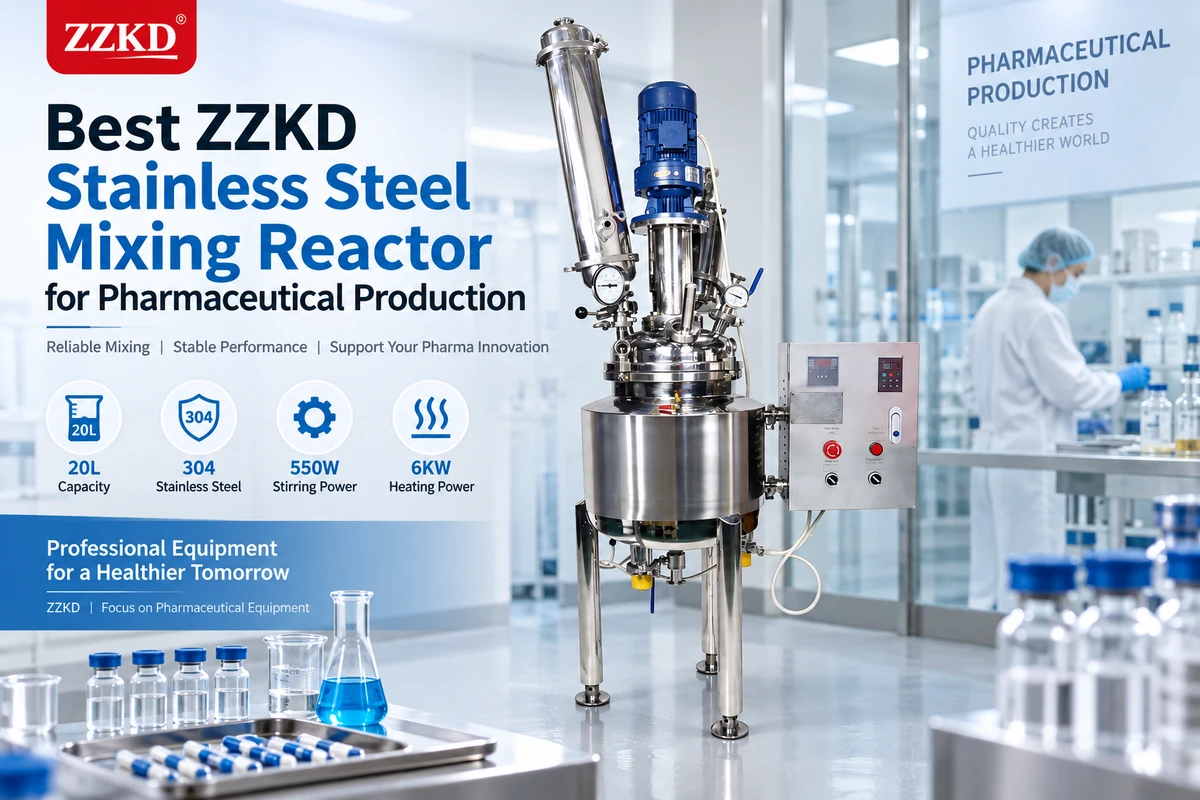
ZZKD stainless steel reactors are available in laboratory and pilot-scale capacities, including practical 5L, 20L, 50L and 100L options. Depending on the selected model, the vessel can use SUS304 or SUS316 stainless steel, digital variable-frequency speed control, a double-wall jacket and a mechanical seal. These features make the equipment suitable for tasks such as solution preparation, crystallization trials, extraction, reaction development and intermediate blending. Final suitability must always be confirmed against the process, cleaning validation and applicable pharmaceutical quality requirements.
Why Stainless Steel Is Used in Pharmaceutical Mixing
Stainless steel offers strength, temperature resistance and a cleanable surface. SUS304 is a widely used general-purpose choice for non-aggressive formulations. SUS316 contains molybdenum and normally provides better resistance to pitting in chloride-containing environments. ASTM A240 specifies a typical Type 316 composition of 16–18% chromium, 10–14% nickel and 2–3% molybdenum. This composition is one reason 316 is often considered for demanding process contact service.
Material grade alone does not create a pharmaceutical-compliant system. Surface finish, weld quality, gasket material, drainability, cleaning procedure and documentation also matter. The U.S. FDA requirement in 21 CFR 211.65 states that equipment surfaces contacting drug components or products must not be reactive, additive or absorptive in a way that changes product safety, identity, strength, quality or purity. WHO good manufacturing practice guidance also emphasizes equipment design that reduces contamination risk and permits effective cleaning. In practical terms, reactor selection should be based on both mechanical performance and the complete quality system.
Which material is better for pharmaceutical production: 304 or 316?
Author’s answer: SUS316 is the safer starting point when the process involves chlorides, corrosive ingredients or frequent cleaning chemicals, while SUS304 can be economical for compatible, mild formulations. A corrosion review using the actual recipe, temperature and cleaning solution should make the final decision.
ZZKD Reactor Specifications That Matter Most
The ZZKD SS-5L is especially useful for small-batch pharmaceutical development. Its reactor vessel is made from 316 stainless steel, while the frame, piping and three-blade stirring rod use 304 stainless steel. The 5L vessel has a 1.5L jacket, circulation heating, a stated reaction temperature range of -100 to 250°C and stirring from 0 to 600 rpm. A 120W motor, frequency-converter speed control, digital speed display and PT100 digital temperature display support repeatable process adjustment. Its stated operating range is from -0.098 MPa vacuum to 0.5 MPa pressure.
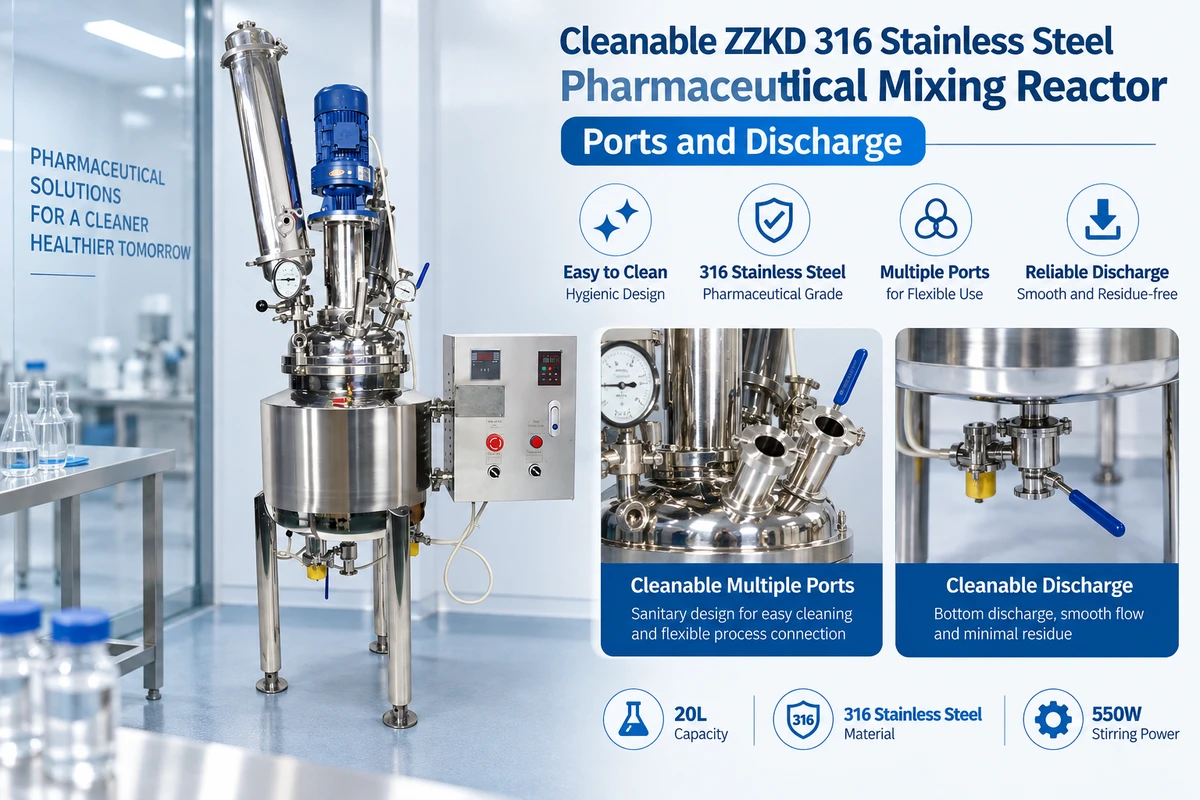
The SS-5L also uses a mechanical seal and a ball-type quick discharge valve. Standard lid openings can include a stirring port, solids port, temperature port, pressure-gauge port, constant-pressure funnel port and condensation-reflux port. Port arrangements can be customized, which is valuable when a process needs controlled feeding, sampling or condenser connection.
For larger batches, the ZZKD range covers 10L to 300L. The family specification lists SUS304 or SUS316 construction, a double-wall vessel, digital frequency-conversion speed regulation, stirring up to 600 rpm, a temperature range of -100 to 299°C and a working pressure range of -0.1 to 0.5 MPa. A ceramic combined mechanical seal and a newer PTFE mechanical stirring seal are listed for this series. Exact motor power, port size and jacket volume vary by capacity.
| Capacity | Useful selection details | Typical role | Listed price reference |
|---|---|---|---|
| 5L | 316 reactor, 0–600 rpm, -100 to 250°C, PT100 display, mechanical seal | Formulation screening and small R&D batches | US$1,485 |
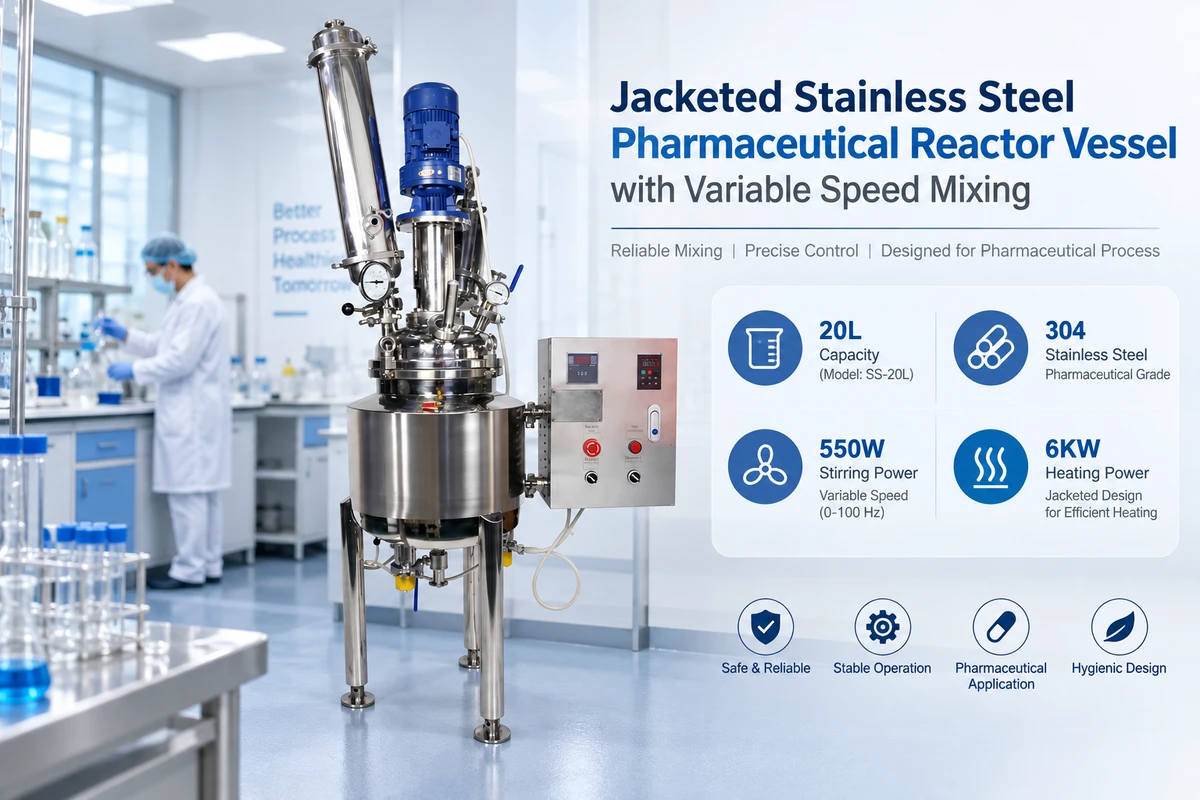
| 20L | 304 stainless steel, 550W stirring, 0–100 rpm, 6kW heating, 3mm material thickness | Process development and larger laboratory batches | US$1,634 |
| 50L | 304/316 option, about 15L jacket, variable-frequency control, jacketed structure | Pilot trials and small production campaigns | US$2,042 |
| 100L | 304/316 option, about 20L jacket, configurable ports and paddle agitation | Pilot production and scale-up verification | About US$4,000 |
Price note: These are product-list references rather than final quotations. The 100L figure uses a relatively economical middle value from the listed US$3,300–5,100 range. Vessel grade, controls, motor, seals, surface treatment, pressure design, accessories, freight and validation documents can change the final cost.
How to Choose the Correct Capacity and Agitator
Reactor capacity should be selected from the required working batch, not only from the nominal vessel volume. Headspace is needed for foaming, gas expansion and safe mixing. A 5L model is a sensible choice for recipe screening and expensive active ingredients because it limits material use. A 20L reactor supports process optimization, while 50L and 100L systems are better for pilot-scale transfer and repeated production campaigns.
Agitation must match viscosity and process purpose. Faster speed can help disperse low-viscosity liquids, but speed alone does not guarantee good mixing. Impeller shape, diameter, liquid level, motor torque and baffles all affect circulation. The ZZKD three-blade or paddle-style agitator is a useful general configuration, while viscous creams, suspensions or crystallization processes may require a customized anchor, pitched blade or other impeller.
Does a higher stirring speed always produce a better pharmaceutical batch?
Author’s answer: No. Excess speed can introduce air, create foam, damage sensitive crystals or raise product temperature. The better approach is to define the required mixing result, then select an impeller and operating range that achieves uniformity without unnecessary shear.
Temperature control deserves equal attention. A jacket transfers heat between the reactor wall and a circulating fluid, allowing controlled heating or cooling without placing an exposed heater inside the product. A compatible recirculating chiller heater can support ramping, holding and cooling steps. Very low or high stated equipment limits should not be treated as the normal process range until the heat-transfer fluid, seals, hoses and connected instruments are checked for the same conditions.
Pressure, Vacuum, Sealing and Cleaning
Vacuum can help with deaeration, lower-temperature processing and solvent handling. Positive pressure may support gas reactions or closed transfer. However, pressure capability must be verified for the exact vessel configuration. For regulated work, request the design basis, pressure rating, material certificates and inspection documents required by the installation location. A standard jacketed mixing reactor should not be substituted for a certified high-pressure unit. Processes requiring more severe conditions may need a dedicated lab-scale high-pressure reactor.
The mechanical seal is important because the agitator shaft passes through the vessel lid. A suitable seal reduces leakage and limits outside contamination. Seal material must be chemically compatible with the formulation and cleaning agents. Ports, valves and threaded unions should also be reviewed for cleanability, dead legs and complete drainage.
Can a standard ZZKD stainless steel reactor be called GMP compliant immediately?
Author’s answer: Not automatically. GMP applies to the equipment, installation, procedures, records and quality controls working together. The reactor can be configured for a pharmaceutical process, but the buyer must define surface finish, contact materials, weld treatment, seals, cleaning method, calibration, documentation and qualification needs before purchase.
Best Overall Choice for Pharmaceutical Production
For small pharmaceutical R&D batches, the ZZKD SS-5L is the strongest all-around option in this range because it combines a 316 stainless steel product vessel, wide variable-speed agitation, PT100 temperature display, circulation heating, vacuum capability and multiple functional ports. For process development, the 20L model provides more capacity and a 550W stirrer. A 50L or 100L jacketed stainless steel mixing reactor is more appropriate when the main goal is pilot production or scale-up.
Before ordering, provide ZZKD with the batch size, ingredients, solvent and chloride content, viscosity, target temperature, vacuum or pressure, agitation goal, preferred voltage, cleaning method and documentation requirements. This information helps determine whether SUS304 or SUS316 is appropriate and whether the standard motor, mechanical seal, discharge valve and port arrangement are sufficient.
More configurations can be reviewed on the ZZKD stainless steel chemical reactor product page. A technically suitable quotation should list the vessel and jacket volume, contact material, agitator type, motor power, seal material, temperature and pressure ratings, control instruments, included accessories and delivery scope. That clear comparison is the most reliable way to find the best stainless steel mixing reactor for pharmaceutical production without paying for unnecessary capacity or overlooking a critical process requirement.
Request a ZZKD Reactor Configuration
Selecting the correct pharmaceutical stainless steel reactor starts with real process data. Submit the intended batch volume, material properties and operating conditions to receive a matched ZZKD reactor configuration and current quotation.