
Choosing a stainless steel chemical reactor for a plant is not only about buying a tank with a motor. The reactor is the center of mixing, heating, cooling, pressure control, and product quality. If the model is too small, production becomes slow. If the material is wrong, corrosion can shorten service life. If the stirring or sealing system is weak, the batch may be unstable or unsafe. This guide explains the main points in simple language so plant managers, engineers, and buyers can select a suitable ZZKD stainless steel reactor with more confidence.
1. Start with the Real Process, Not Only the Reactor Size
The first question is: what will the reactor do every day? A reactor used for synthesis, extraction, decarboxylation, polymerization, crystallization, hydrogenation preparation, or pilot testing may need different configurations. Before choosing a model, list your raw materials, solvent type, viscosity, solid content, reaction time, operating temperature, pressure, cleaning method, and target batch output.
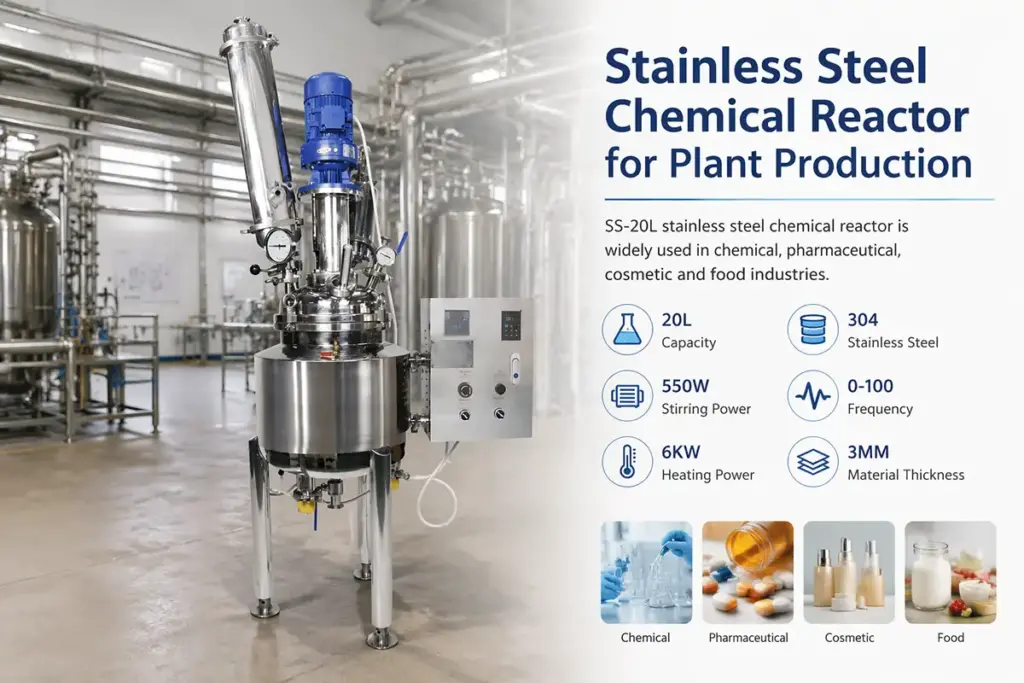
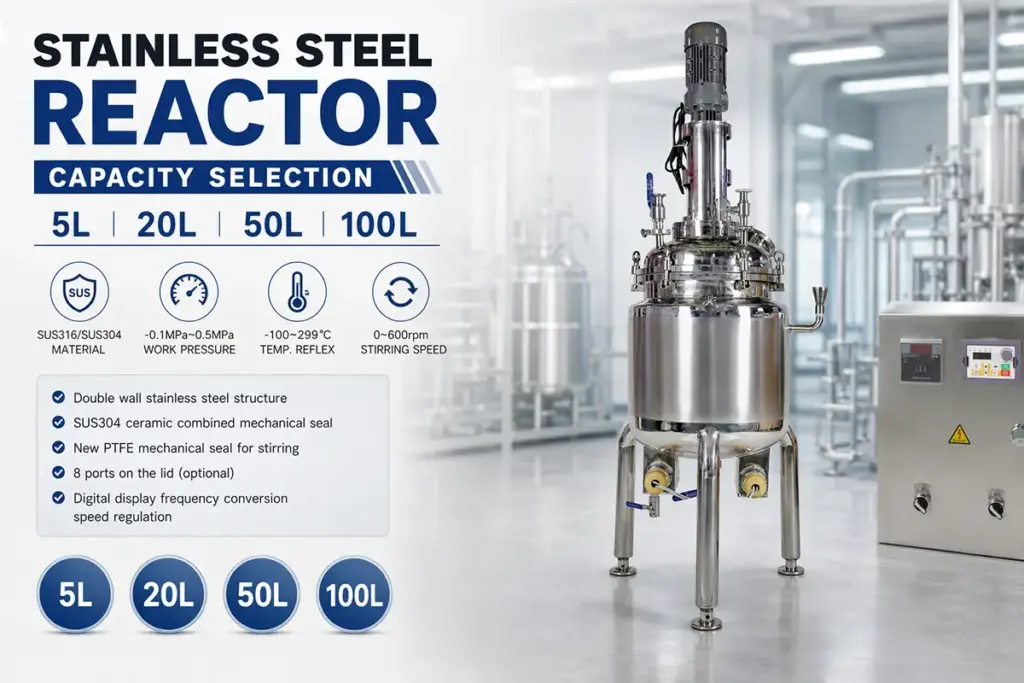
For example, a 5L reactor is useful for laboratory development, recipe verification, and small-batch testing. A 20L or 50L reactor is more suitable for pilot production, scale-up trials, and process optimization. A 100L reactor can support small plant production or pre-production batches. ZZKD stainless steel reactors are available in multiple capacities, so the buyer can match the equipment to the production stage instead of forcing the process to fit one standard tank.
2. Choose the Right Capacity and Leave Enough Headspace
Many buyers only compare the nominal volume, such as 5L, 20L, 50L, or 100L. In real plant operation, the usable working volume is usually lower than the full kettle volume. You need headspace for stirring, vapor, foam, gas expansion, and safety. If the process foams easily or releases gas, do not run the reactor too close to the top.
ZZKD data shows typical choices such as SS-5L, SS-20L, SS-50L, and SS-100L. The SS-5L model has a 5L reactor volume and about 1.5L jacket capacity. Larger series models include 10L, 20L, 30L, 50L, 100L, 150L, 200L, and 300L options. If you are moving from lab testing to plant use, a practical path is to test the formula in 5L, confirm mixing and temperature behavior in 20L or 50L, then move to 100L or larger production equipment.
3. Decide Between 304 and 316 Stainless Steel
Material is one of the most important decisions. 304 stainless steel is widely used and cost-effective for many general chemical, food, cosmetic, and plant extraction applications. 316 stainless steel has stronger corrosion resistance, especially when the process involves acidic materials, chlorides, stronger solvents, or more demanding cleaning cycles.
The ZZKD SS-5L model uses 316 stainless steel for the reactor body, with 304 stainless steel for the frame and pipes. The larger series can be configured with SUS316 or SUS304 according to the process. If the reaction medium is mild and budget is sensitive, 304 may be enough. If corrosion risk is uncertain, 316 is usually the safer long-term choice. A lower purchase price is not a saving if the reactor needs early repair or replacement.
For buyers comparing general options, ZZKD’s stainless steel chemical reactor page is a useful reference for product positioning and applications.
4. Check Temperature Range, Heating Method, and Jacket Design
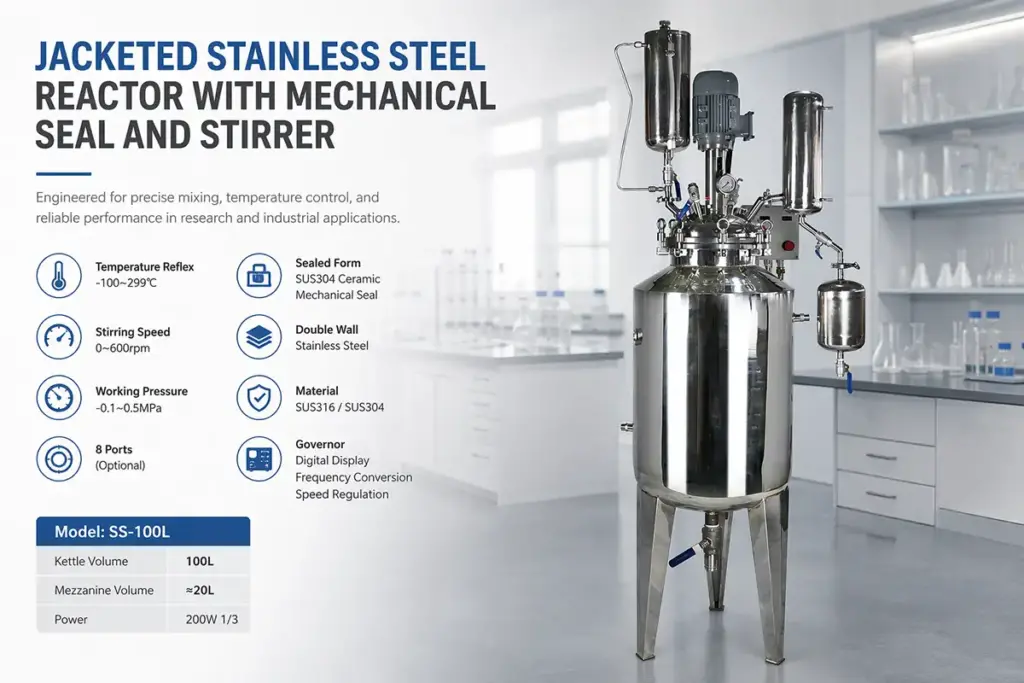
Plant reactions often need stable temperature control. Some processes require heating, some require cooling, and many require both. The SS-5L reactor supports circulation heating and a kettle reaction temperature range of about -100 to 250°C. The larger ZZKD stainless steel reactor series lists temperature control from about -100 to 299°C, depending on configuration and supporting circulation equipment.
A jacketed stainless steel reactor is often preferred for plant work because heat transfer is more uniform than direct heating. The jacket can connect with a circulating chiller heater, oil bath, or other temperature control unit. For a plant, the question is not only “how hot can it get?” but also “how quickly can it heat or cool the batch?” Thick liquids, larger volumes, and strong exothermic reactions require more careful heat transfer planning.
5. Match Stirring Power to Viscosity and Solids
Stirring affects reaction speed, heat transfer, uniformity, and final product quality. Low-viscosity liquids may only need standard paddle stirring. Higher-viscosity materials, suspensions, or products with solid particles may require stronger motors or customized agitators. The SS-5L model uses 0-600 rpm speed control and a 120W stirring motor. The SS-20L model lists 550W stirring power, while the larger series includes frequency conversion speed regulation and paddle-type stirring.
For plant use, a frequency converter is helpful because operators can adjust speed smoothly. Digital speed display also makes batch records easier. If your process includes powders, crystals, resin, plant fibers, or heavy slurry, discuss agitator type with the supplier before purchase. Good mixing is usually cheaper than solving quality problems after the reactor arrives.
6. Do Not Ignore Pressure, Vacuum, and Sealing
A plant reactor must match the real pressure condition. Some reactions run under vacuum, some at normal pressure, and some under positive pressure. ZZKD stainless steel reactors can support vacuum and pressure work within the rated design. The SS-5L document lists a vacuum and pressure range from about -0.098 MPa to 0.5 MPa. The larger series lists working pressure around -0.1 MPa to 0.5 MPa.
Sealing is equally important. A mechanical seal helps reduce leakage around the stirring shaft, especially during vacuum or pressure operation. ZZKD models use mechanical sealing designs, and the larger series mentions SUS304 ceramic combined mechanical seals and new PTFE mechanical seals. If your plant handles volatile solvents, odor-sensitive materials, or pressure reactions, sealing quality should be a key purchase point, not an afterthought.
If your process is closer to pressure chemistry or scale-up experiments, it may also help to review ZZKD’s guide to a high pressure reactor before finalizing the design.
7. Look at Ports, Discharge, Cleaning, and Daily Operation
A good reactor is easy to operate every day. Check the lid openings before purchase. Common ports include a stirring port, solid feeding port, temperature measurement port, pressure gauge port, constant pressure funnel port, and condenser reflux port. The ZZKD SS-5L lid can be customized according to requirements, which is useful when the plant needs extra sensors, feeding devices, reflux, gas inlet, or sampling functions.
Discharge method also matters. A bottom ball quick discharge valve is convenient for liquids and many low-viscosity products. For thicker materials, the valve size and outlet structure should be checked carefully. Cleaning access is another plant issue. If operators cannot clean the reactor easily, cross-contamination and downtime can increase.
8. Use Price as a Guide, Not the Only Decision
Price is important, but plant equipment should be evaluated by total value. Based on the provided ZZKD stainless steel reactor price list, common reference prices include about $1,485 for 5L models, about $1,634 for 20L models, about $2,042 for 50L models, and about $3,300 for a 100L jacketed stainless steel reactor configuration. Some products have a price range because configuration, ports, material, condenser, control system, and customization can change the final cost.
When comparing offers, ask whether the quotation includes the reactor body, jacket, stirrer, motor, mechanical seal, condenser, pressure gauge, temperature sensor, discharge valve, control box, and packing. A cheap quote may exclude important accessories. A complete ZZKD stainless steel reactor solution can help reduce installation uncertainty and make the plant start-up smoother.
9. Simple Selection Checklist for Plant Buyers
- Choose capacity by working volume, not only full volume.
- Select 304 stainless steel for general use and 316 stainless steel for stronger corrosion resistance.
- Confirm the real working temperature, heating/cooling speed, and jacket connection.
- Match stirring power and agitator type to viscosity, solids, and batch size.
- Check pressure rating, vacuum requirement, and mechanical seal design.
- Confirm lid ports, condenser, feeding method, sampling, discharge valve, and cleaning access.
- Compare complete configurations, not only the lowest listed price.
- Ask for customization if your plant process has special materials, pressure, ports, or control needs.
Conclusion
To choose a stainless steel chemical reactor for a plant, start from the process: material compatibility, batch size, temperature, pressure, stirring, sealing, and daily operation. For small testing, ZZKD SS-5L is a practical starting point. For pilot and small production, SS-20L and SS-50L offer more working capacity. For plant-scale batches, SS-100L and larger stainless steel reactors provide a stronger production platform. The best choice is not always the largest or cheapest model. It is the reactor that matches your chemical process, runs safely, gives stable results, and leaves room for future production growth.