
Choosing the right stainless steel chemical reactor is less about chasing the “biggest and most powerful” system, and more about matching volume, temperature, pressure, materials, mixing power and sealing to the actual process. This article uses real SS‑series data (5–300 L) to explain what actually matters when buying.
Why Stainless Steel Chemical Reactors Are the Default Choice
In modern chemical, pharmaceutical and fine‑chemical plants, stainless steel reactors have become the standard for many processes that go beyond the limits of glass or plastic. The main reasons are:
- Chemical resistance – 304/316 stainless steels resist many acids, alkalis and solvents.
- Temperature range – they can safely handle deep cooling and high‑temperature reactions.
- Pressure capability – stainless steel shells are structurally robust for vacuum to positive pressure.
- Cleanability and GMP compatibility – smooth, polished surfaces are easier to clean and validate.
Data point: According to a 2022 survey by the European Fine Chemicals Group, over 60% of new small‑scale reactors installed in member facilities used stainless steel 304 or 316 as the primary construction material for multi‑purpose plants. This confirms the trend towards flexible, corrosion‑resistant equipment.
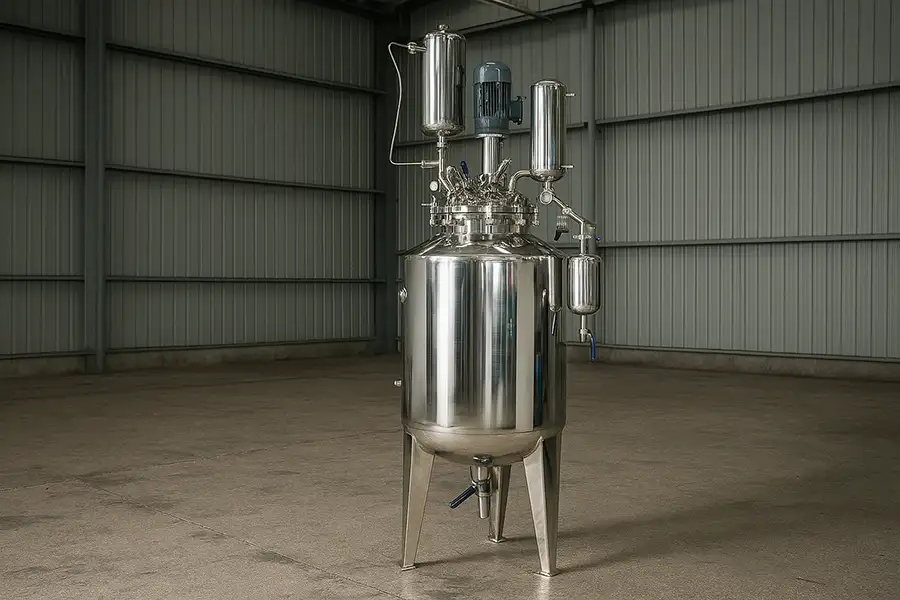
However, knowing that stainless steel is “good” does not tell which model is suitable. When looking to buy stainless steel chemical reactor equipment, the important part is to connect parameters like jacket volume, agitation power and sealing type with the process requirements.
2 · Specification essentials
Key Specifications to Check Before Buying
Reactor data sheets can look intimidating, but most decisions boil down to a few core parameters.
2.1 Volume: Working vs. Nominal
Nominal volume (e.g., 5 L, 20 L, 50 L) is the total geometric volume of the vessel. The actual working volume is usually 60–80% of that, depending on foam and agitation.
When planning to buy stainless steel chemical reactor, how much “freeboard” volume is typically needed for safe mixing and foaming control?
In practice, keeping 20–40% of the reactor volume free is a safe rule of thumb. For strongly foaming or gas‑evolving reactions, working at 50–60% of nominal volume is often safer.
2.2 Material: 304 vs 316 Stainless Steel
In the SS series, the following combination is common:
- Reactor material: 316 stainless steel (better pitting and chloride resistance).
- Frame & pipes: 304 stainless steel (sufficient for structural parts and many fluids).
- Stirring rod: 304 stainless steel with three‑blade impeller.
For example, the SS‑5L uses a 316 stainless steel reactor with 304 stainless steel frame and piping, which balances chemical resistance and cost.
2.3 Temperature and Heating/Cooling
Two specs matter here: the reactor temperature range and the jacket (mezzanine) system.
- SS‑5L: kettle reaction temperature from -100 ℃ to 250 ℃, with circulation heating.
- Larger SS‑10L to SS‑300L: typical temperature reflex range -100 ℃ to 299 ℃.
A double‑wall stainless steel body with a mezzanine (jacket) volume allows heating and cooling by circulating oil, water or glycol. For instance:
- SS‑10L: mezzanine volume ≈3.8 L
- SS‑50L: mezzanine volume ≈15 L
- SS‑100L: mezzanine volume ≈20 L
2.4 Pressure and Vacuum Capability
The SS‑5L specification lists a vacuum degree of -0.098 MPa to -0.5 MPa, and larger models typically work in the range of -0.1 MPa to 0.5 MPa. This covers:
- Vacuum distillation and solvent removal.
- Inert‑gas blanket (approx. atmospheric pressure).
- Mild overpressure (up to 0.5 MPa) when designed and certified accordingly.
Pressure rating should always be matched with local codes and safety requirements.
2.5 Agitation: Speed, Power and Control
All SS models share variable‑speed agitation:
- Stirring speed: 0–600 rpm (SS‑5L and 10–300 L range).
- Power: from 120 W for small systems up to 400 W (with ~1/3 power increase margin on certain models).
- Governor: digital display frequency conversion speed regulation.
Frequency inverters allow smooth control and protect the motor from overload, which is important for viscous or crystallizing mixtures.
2.6 Sealing and Ports
A common weak point in reactors is the mechanical seal and the cover design. The SS series uses:
- SUS304 ceramic combined mechanical seal for the stirring shaft.
- PTFE mechanical stir seal to enhance chemical resistance.
- Multiple cover ports (often 8), including:
- Stirring port
- Solid material charging port
- Temperature measurement port
- Pressure gauge port
- Constant pressure funnel port
- Condensation reflux port
2.7 Instrumentation and Display
For process control and documentation:
- Speed display: digital display.
- Temperature measurement: PT100 sensor with digital display.
- Pressure gauge: 50.5 chuck ± integrated pressure gauge.
2.8 Mobility and Discharge
For smaller units, mobility is important for lab layout flexibility:
- Movement method: braked swivel casters on SS‑5L.
- Discharging method: ball quick discharge valve (fast and easy draining).
- Interface connection: threaded unions for modular piping.
If a deeper dive into pressure reactor design is needed, additional background can be found in the high pressure reactors explainer, which discusses pressure limits, materials and safety in more depth.
3 · Real SS models
SS‑Series Model Comparison: From SS‑5L Lab to SS‑100L Pilot
Based on manufacturer datasheets (SS‑5L, SS‑20L, SS‑10L–SS‑300L).
3.1 SS‑5L: Flexible Lab‑Scale Stainless Steel Reactor
Key Parameters – SS‑5L Model
| Parameter | SS‑5L Value |
|---|---|
| Model | SS‑5L |
| Reactor material | 316 stainless steel |
| Frame material | 304 stainless steel |
| Pipe material | 304 stainless steel |
| Reactor volume | 5 L |
| Mezzanine capacity | 1.5 L |
| Temperature range | -100 to 250 ℃ |
| Vacuum degree | -0.098 MPa to -0.5 MPa |
| Stirring speed | 0–600 rpm |
| Stirring power | 120 W (power increase 1/3) |
| Voltage / frequency | 220 V / 60 Hz |
| Heating method | Circulation heating |
| Movement | Braked swivel caster |
| Sealing method | Mechanical seal |
| Discharge | Ball quick discharge valve |
SS‑5L is suitable for lab development, small‑batch synthesis, and temperature‑sensitive processes needing a wide range from deep cooling to moderate high temperatures.
For laboratories that already use rotary evaporators, a stainless steel reactor like SS‑5L can be a natural upstream step for synthesis before solvent removal. The dedicated stainless steel chemical reactor product page lists configuration and accessory options in more detail.
3.2 SS‑20L: Larger Working Volume with Stronger Agitation
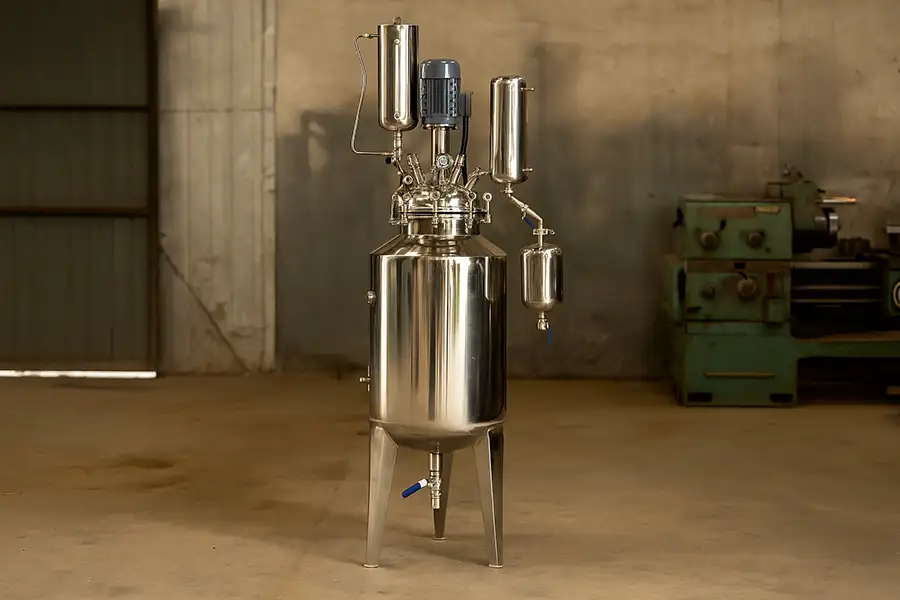
The SS‑20L model (20 L capacity, 304 stainless steel) is often used for pilot batches or small production:
- Capacity: 20 L effective volume.
- Material: stainless steel 304.
- Power supply: 220 V / 50 Hz single‑phase.
- Stirring power: 550 W.
- Frequency: 0–100 (via frequency converter).
- Heating power: 6 kW (significantly higher than SS‑5L).
- Material thickness: 3 mm shell.
For scale‑up from 5 L to 20 L, is it enough to simply scale volumes linearly when calculating heating power and mixing power requirements?
In practice, simple linear scaling often underestimates needs. As volume increases, heat transfer surface‑to‑volume ratio decreases and mixing becomes more demanding. That is why SS‑20L uses 6 kW heating power and 550 W stirring power, much more than four times the SS‑5L values. For viscous systems or crystallization, power per liter typically increases during scale‑up.
3.3 SS‑10L to SS‑100L (and Above): Family Overview
From 10 L to 300 L, the SS family shares common design elements: double‑wall stainless steel body, 0–600 rpm agitation, digital frequency control and mechanical sealing. Below is an excerpt focusing on 10–100 L, which are common for pilot and kilo‑lab.
SS‑10L to SS‑100L – Selected Parameters
| Model | Kettle volume | Mezzanine volume | Temperature reflex | Stirring speed | Power | Material | Work pressure | Sealed form |
|---|---|---|---|---|---|---|---|---|
| SS‑10L | 10 L | ≈3.8 L | -100 to 299 ℃ | 0–600 rpm | 120 W (1/3) | SUS316 / SUS304 | -0.1 to 0.5 MPa | SUS304 ceramic mechanical seal |
| SS‑20L | 20 L | ≈5 L | -100 to 299 ℃ | 0–600 rpm | 200 W (1/3) | SUS316 / SUS304 | -0.1 to 0.5 MPa | SUS304 ceramic mechanical seal |
| SS‑30L | 30 L | ≈8 L | -100 to 299 ℃ | 0–600 rpm | 200 W (1/3) | SUS316 / SUS304 | -0.1 to 0.5 MPa | SUS304 ceramic mechanical seal |
| SS‑50L | 50 L | ≈15 L | -100 to 299 ℃ | 0–600 rpm | 400 W (1/3) | SUS316 / SUS304 | -0.1 to 0.5 MPa | SUS304 ceramic mechanical seal |
| SS‑100L | 100 L | ≈20 L | -100 to 299 ℃ | 0–600 rpm | 400 W (1/3) | SUS316 / SUS304 | -0.1 to 0.5 MPa | SUS304 ceramic mechanical seal |
The consistency of design across sizes simplifies scale‑up: similar agitation concepts, sealing and instrumentation mean fewer unknowns when moving from 10 L experiments to 100 L campaigns.
4 · Sizing decisions
How to Size a Reactor: 5 L vs 20 L vs 50–100 L
When planning to buy stainless steel chemical reactor systems, sizing is often the first decision. Oversizing wastes budget and utilities, while undersizing blocks production.
4.1 Starting with Lab‑Scale – When 5 L Makes Sense
Consider a 5 L unit if:
- Most runs are 0.5–3 L of solution or slurry.
- Frequent changes of chemistry and cleaning are needed.
- Temperature range and vacuum capability are more critical than throughput.
A 5 L reactor can cover early‑stage route scouting, catalyst screening and safety studies under realistic temperature and pressure conditions.
4.2 Moving to Pilot – Why 20 L is a Common Step
A 20 L stainless steel reactor is typically chosen when:
- Producing 1–10 kg per batch, depending on density.
- Validating crystallization and filtration behaviors at larger scale.
- Collecting process data for future 100–1000 L design.
4.3 Toward Kilo‑Lab and Small Production – 50–100 L
50 L and 100 L reactors are used when:
- Batches in the 10–80 kg range are required.
- More robust agitation (400 W, 0–600 rpm) is needed for viscous slurries.
- There is enough floor space and utilities (e.g., hot oil, chilled water) available.
For a process that currently runs at 2 L lab scale, is it better to jump directly to 100 L, or pass through an intermediate 20 L or 50 L step?
Experience from kilo‑lab and manufacturing shows that at least one intermediate scale (e.g., 20 L or 50 L) greatly reduces scale‑up risk. Parameters such as heat release, mixing time and filtration behavior often change non‑linearly with volume. So passing through an SS‑20L or SS‑50L before investing in 100 L or more is usually safer and cheaper long term.
5 · Application scenarios
Typical Use Cases and Configuration Tips
5.1 Organic Synthesis Under Inert Gas
For moisture‑sensitive or air‑sensitive reactions, stainless steel reactors with multiple lid ports and pressure gauge are useful:
- Use inert gas (N2 or Ar) via the feeding or gas port.
- Monitor pressure via the integrated gauge.
- Use the constant pressure funnel port for controlled addition of reagents.
5.2 Crystallization and Slurry Handling
Crystallization requires controlled cooling and uniform agitation:
- Double‑wall stainless steel with appropriate mezzanine volume for cooling ramps.
- 0–600 rpm paddle‑type impeller for crystal suspension.
- Ball quick discharge valve for easy emptying of slurry.
5.3 Vacuum Distillation and Solvent Recovery
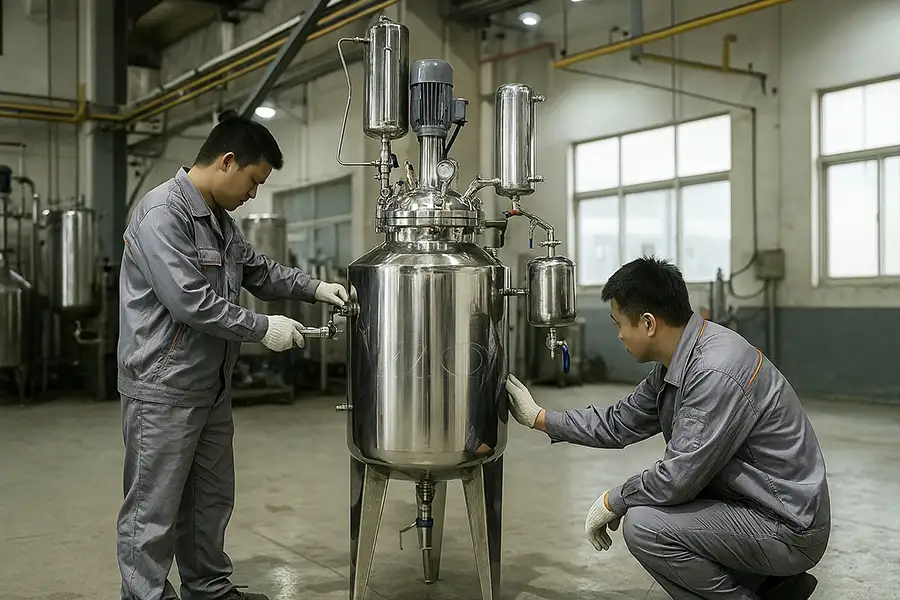
When paired with condensers and receivers, a reactor can also serve as a small distillation pot. The solvent recovery distillation unit guide shows how reactors and distillation systems can be integrated for industrial solvent recycling.
5.4 Temperature‑Sensitive APIs and Intermediates
For pharmaceutical intermediates, tight temperature control and cleanability are critical:
- Use 316 stainless steel for the wetted surfaces.
- Take advantage of PT100 digital temperature sensing for reproducible control.
- Ensure surfaces are polished enough for easy cleaning between campaigns.
Reference studies from chemical engineering journals indicate that for temperature‑sensitive API steps, improving temperature control from ±3 ℃ to ±1 ℃ can reduce impurity levels by 15–30%, underscoring the value of good sensors and jacket design in stainless steel reactors.
6 · Purchase checklist
Quick Checklist Before Ordering a Stainless Steel Reactor
To make the decision to buy stainless steel chemical reactor equipment easier, the following checklist can be used during supplier discussions:
- Volume and scale
- Target batch size and working volume range.
- Planned scale‑up path (e.g., 5 L → 20 L → 100 L).
- Materials
- Confirm 316 vs 304 requirements for all wetted parts.
- Check compatibility with expected solvents and reagents.
- Temperature and pressure
- Required temperature range and heating/cooling medium.
- Necessary vacuum and/or overpressure rating.
- Agitation
- Viscosity and solids content of the mixture.
- Required rpm range and power; consider future more viscous products.
- Sealing and ports
- Mechanical seal type and materials (ceramic, PTFE).
- Number and size of lid openings; any custom ports needed.
- Utilities and layout
- Available voltage and frequency (e.g., 220 V / 50 or 60 Hz).
- Floor space, access and mobility (casters vs fixed).
- Instrumentation
- Digital temperature and speed display requirements.
- Need for additional sensors or data logging.
Conclusion: Turning Specifications into a Working Decision
When viewed through the lens of real parameters, buying a stainless steel chemical reactor becomes more structured:
- Define the process window (volume, temperature, pressure, viscosity).
- Match it to a reactor family with consistent design (such as the SS‑series 5–300 L).
- Use intermediate scales (20 L, 50 L) to manage scale‑up risk.
- Pay attention to “small” details like seals, ports and measurement – they often decide uptime and product quality.
With these points clarified, it becomes much easier to choose the right size and configuration for the next reactor purchase, rather than relying on guesswork or overspecification.View stainless steel reactor options
References and Further Reading
- European Fine Chemicals Group (2022). Equipment trends in small‑scale multipurpose plants.
- Various chemical engineering journal articles on temperature control and impurity formation in API synthesis (2018–2023).
- Manufacturer technical datasheets for SS‑5L, SS‑20L and SS‑10L–SS‑300L stainless steel reactor series.