
A solvent recovery system is one of the most practical ways for a chemical manufacturing plant to reduce waste solvent, lower daily operating cost, and keep valuable solvent in circulation. For many plants, the question is not only “Can we recover solvent?” but also “Which machine size, recovery rate, safety design, and budget make sense for our process?” This guide explains the answer in simple language, with ZZKD solvent recovery machines as the reference equipment.
What is a solvent recovery system?
A solvent recovery system is equipment that separates reusable solvent from waste liquid by heating, evaporation, condensation, and collection. In a chemical plant, waste solvent may come from reaction cleaning, resin production, coating, adhesive manufacturing, extraction, pharmaceutical intermediates, printing chemicals, or laboratory scale-up work. Instead of sending all used solvent out as hazardous waste, the plant can distill the liquid and collect purified solvent for reuse.
The basic working principle is easy to understand. Dirty solvent is loaded into the tank. The machine heats the liquid to evaporate the solvent. The vapor moves into a condenser, changes back into liquid, and flows into a clean collection container. Heavy residues, pigments, resin, oil, sludge, or other high-boiling materials stay in the distillation tank. This is why a solvent distillation unit is often used when the target solvent has a clear boiling point and the impurities are less volatile.
Why chemical manufacturing plants use solvent recovery
The first reason is cost control. Solvents such as acetone, ethanol, ethyl acetate, toluene, xylene, IPA, and cleaning thinner can be consumed in large quantities. If a plant can recover a large part of this material, it buys less fresh solvent and pays less for waste disposal. For plants using the same solvent every day, the payback can be fast.
The second reason is waste reduction. Waste solvent storage takes space, requires careful labeling, and may increase environmental management pressure. A recovery system helps reduce the amount of waste liquid shipped away. It also supports cleaner production goals and makes internal solvent management more predictable.
The third reason is process stability. When recovered solvent quality is suitable for cleaning, washing, or non-critical process steps, the plant can build a stable internal solvent loop. Fresh solvent can then be reserved for high-purity operations, while recovered solvent is used where it makes technical and economic sense.
Key ZZKD solvent recovery machine specifications
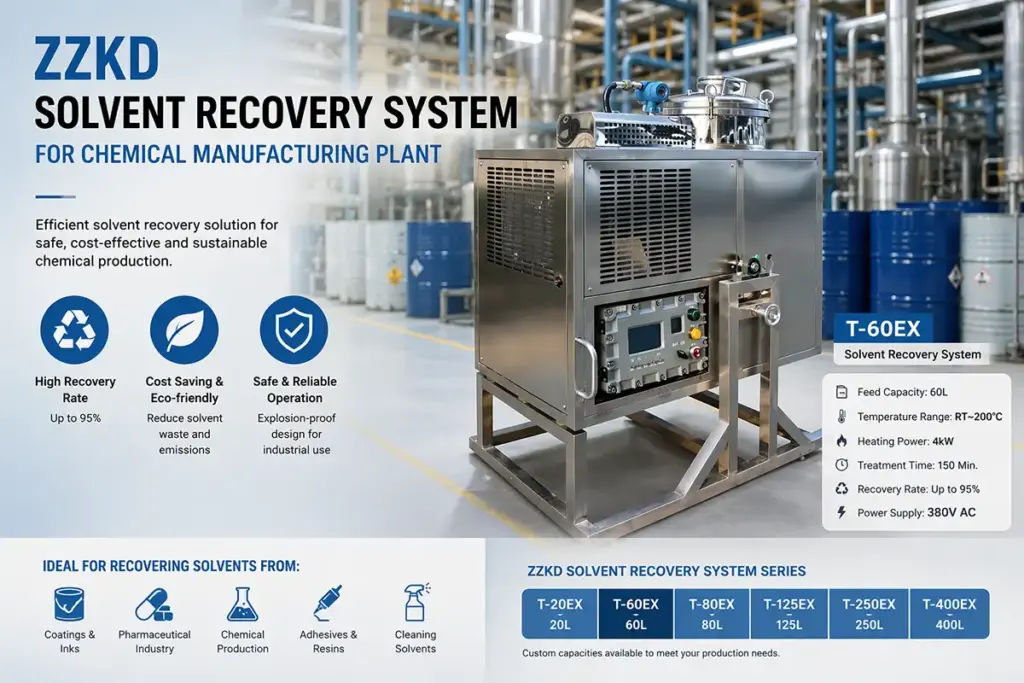
ZZKD solvent recovery machines are available in several feed capacities for different production scales. The supplied equipment parameters show models from 20 L to 400 L feed capacity, with a working temperature range from room temperature to 200°C and a recovery rate around 95%. This makes the system suitable for many common organic solvents used in chemical manufacturing and industrial cleaning.
| Model | Feed Capacity | Heating Power | Temperature Range | Treatment Time | Recovery Rate |
|---|---|---|---|---|---|
| T-20Ex | 20 L | 2 kW | RT-200°C | 120 min | 95% |
| T-60Ex | 60 L | 4 kW | RT-200°C | 150 min | 95% |
| T-80Ex | 80 L | 5 kW | RT-200°C | 180 min | 95% |
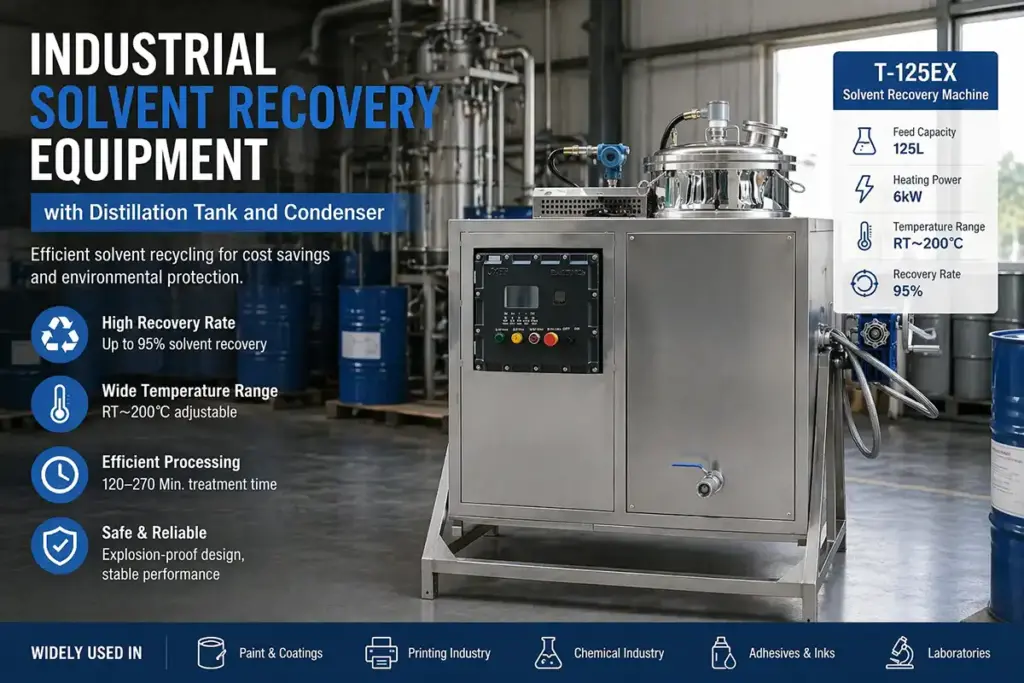
| T-125Ex | 125 L | 6 kW | RT-200°C | 210 min | 95% |
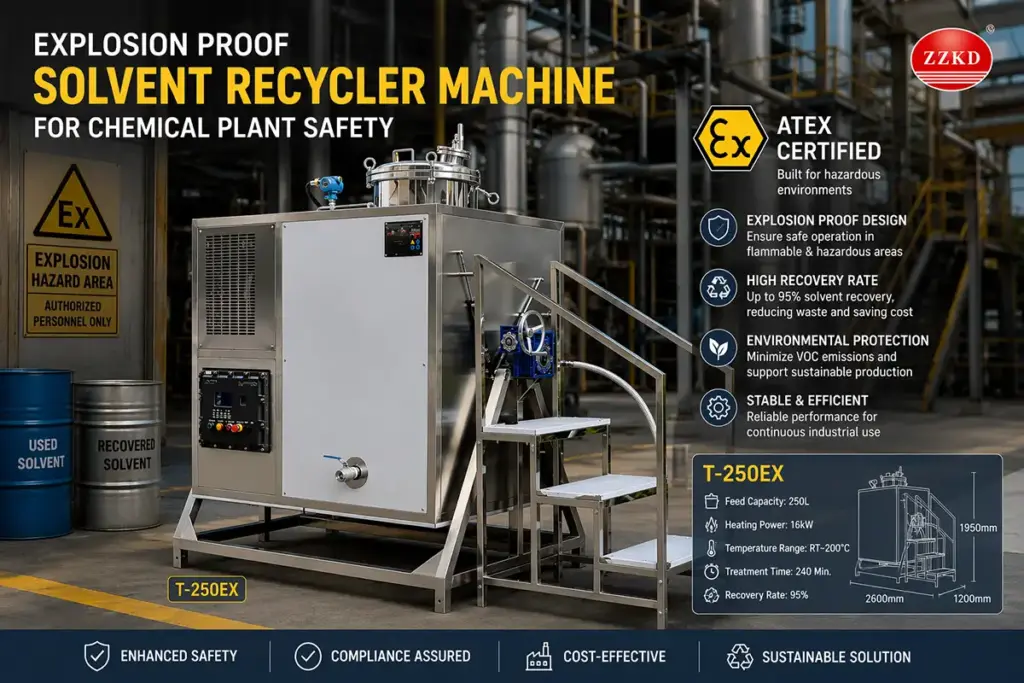
| T-250Ex | 250 L | 16 kW | RT-200°C | 240 min | 95% |
| T-400Ex | 400 L | 32 kW | RT-200°C | 270 min | 95% |
For a small workshop or pilot chemical line, a 20 L or 60 L model may be enough. For a production plant with daily solvent waste, 125 L, 250 L, or 400 L models are more practical. The best size depends on how much waste solvent is generated per shift, how many batches the plant wants to run per day, and how much space is available near the solvent collection area.
How to choose the right capacity
A good rule is to start from daily waste volume, not from the largest machine available. For example, if a plant produces about 100 L of waste solvent per day, it can use a 60 L unit for two batches or a 125 L unit for one larger batch with some margin. If the plant produces 300-500 L per day, a 250 L or 400 L machine is usually more efficient because it reduces manual loading and unloading time.
Also consider treatment time. According to the parameter table, ZZKD models generally take about 120 to 270 minutes per batch depending on capacity. A chemical plant should calculate how many batches are realistic in one shift. If operators only have time for one batch, choose a tank size close to the daily recovery target. If multiple batches are possible, a smaller model may still work well.
What solvents can be recovered?
Solvent recovery is commonly used for acetone, ethanol, methanol, IPA, ethyl acetate, toluene, xylene, cleaning thinner, and many mixed organic solvents. The key point is boiling behavior. If the solvent can evaporate under the machine’s temperature range and the impurities remain mostly in the tank, recovery is usually possible. If the solvent mixture contains water, corrosive acid, high polymer residue, or several close-boiling solvents, a technical check is recommended before purchase.
For buyers comparing different machines, ZZKD offers related solvent recovery equipment for different industrial uses. A plant can provide the solvent name, waste composition, approximate solid content, daily waste amount, and required recovered solvent quality so the supplier can recommend a suitable model.
How much does a solvent recovery system cost?
Price depends on capacity, explosion-proof design, materials, condenser configuration, control system, and customization. In the supplied ZZKD price list, many solvent recovery machine listings are shown in the range of $2,645-$9,690. When using a middle but still affordable planning value from that range, a practical reference price is about $6,168. Larger capacity equipment, such as a 450 L class solvent recovery unit, is listed around $10,691.
For budget planning, do not only compare the purchase price. Also calculate solvent saved per month, waste disposal cost reduced per month, labor time, electricity use, and expected recovery rate. In many plants, the total operating savings are more important than the initial equipment price.
Is an explosion-proof solvent recovery machine necessary?
For many chemical manufacturing plants, yes. Organic solvent vapor can be flammable, and the recovery process uses heat. Models marked with “Ex” are designed for safer operation in solvent recovery applications. However, equipment safety is only one part of the full system. The plant should also review ventilation, grounding, electrical area classification, solvent storage, operator training, and local safety rules.
A safer installation normally keeps the machine away from open flames, uses proper exhaust and cooling conditions, prevents overfilling, and follows the supplier’s operation manual. Operators should know the solvent flash point, boiling point, and whether any reaction residue may foam, bump, or decompose during heating.
What questions should buyers ask before ordering?
1. What is the solvent composition?
List the main solvent, water content, solid residue, resin, pigment, oil, or other contaminants. This helps confirm whether distillation recovery is suitable.
2. How clean must the recovered solvent be?
Recovered solvent for cleaning may not need the same purity as solvent used in a sensitive chemical reaction. Define the reuse purpose before choosing the machine.
3. How much waste solvent is produced each day?
Daily volume determines tank capacity. A machine that is too small may create extra labor, while a machine that is too large may increase cost and occupy more plant space.
4. Is the solvent flammable?
If the solvent is flammable, explosion-proof design and site safety review are very important. Most common organic solvent recovery projects should be treated with caution.
5. What support is available after purchase?
Ask about installation guidance, spare parts, operating instructions, troubleshooting, and recommended cleaning procedures. A solvent recycler machine works best when operators understand both the equipment and the solvent behavior.
Final recommendation
For a chemical manufacturing plant, a solvent recovery system is a practical investment when solvent consumption is regular, waste disposal cost is high, and the recovered solvent can be reused safely. ZZKD solvent recovery machines cover small to larger batch capacities from 20 L to 400 L, with RT-200°C temperature range and about 95% recovery rate under suitable conditions. For most buyers, the best choice is not simply the largest unit, but the model that matches daily waste volume, solvent type, batch schedule, safety requirements, and expected payback.
If your plant uses acetone, ethanol, IPA, ethyl acetate, toluene, xylene, thinner, or similar organic solvents, preparing a simple solvent sample report and daily waste volume estimate is the fastest way to choose the right ZZKD system. With the right capacity and safe operating process, solvent recovery can turn a costly waste stream into a reusable production resource.