
A jacketed glass reactor is one of the most useful pieces of equipment in a chemistry, pharmaceutical, material, cosmetic, botanical extraction, or university research lab. It lets you mix, heat, cool, reflux, crystallize, dissolve, extract, and run vacuum reactions in one visible vessel. The challenge is that many reactors look similar online, while the right choice depends on your actual experiment. This guide explains the key points in plain English, so you can choose a ZZKD jacketed glass reactor with more confidence.
1. Start with the Working Volume, Not Only the Total Volume
The first question is simple: how much material do you normally process in one batch? A reactor marked as 5L, 20L, or 50L refers to the kettle capacity, but in real lab operation you should leave enough headspace for stirring, foaming, reflux, and vapor movement. For many liquid reactions, a practical working volume is often around 60% to 80% of the full vessel, depending on viscosity and boiling behavior.
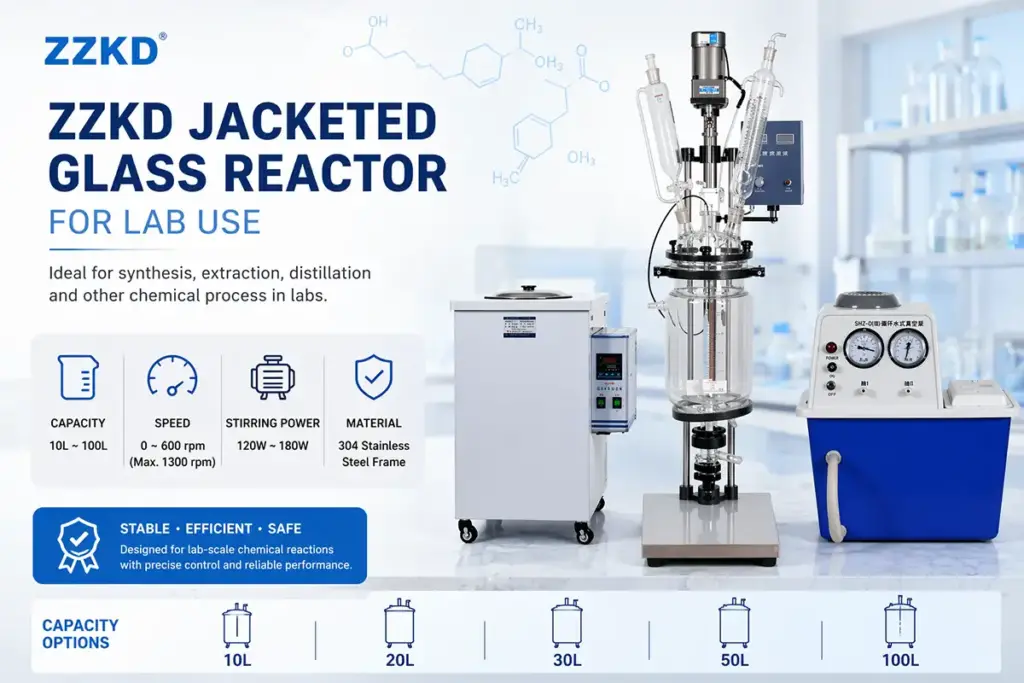
ZZKD laboratory jacketed glass reactors are available from small 1L, 2L, 3L, and 5L systems for method development to larger 10L, 20L, 30L, 50L, and 100L systems for scale-up and pilot use. If you are testing formulas, catalysts, or reaction conditions, a 1L to 5L reactor is usually easier to clean, faster to heat or cool, and more affordable. If your lab already has a stable process and needs larger batch output, 20L or 50L is often a better balance between capacity and manageability.
For more background on glass reactor applications, you can also read ZZKD’s guide to glass vessel chemical reactors.
2. Choose the Right Glass Material
For lab reactors, borosilicate glass is usually preferred because it combines chemical resistance, transparency, and good thermal shock performance. According to the ISO 3585 standard for borosilicate glass 3.3, this glass type is defined by a low mean linear thermal expansion coefficient of about 3.3 x 10^-6 K^-1. SCHOTT also lists BOROFLOAT 33 borosilicate glass with a thermal expansion coefficient around 3.25 x 10^-6 K^-1. In practical terms, lower thermal expansion helps the glass tolerate heating and cooling cycles better than ordinary soda-lime glass.
This does not mean glass is unbreakable. You should still avoid sudden extreme temperature changes, mechanical impact, over-tightened clamps, and operation outside the rated pressure range. But for visual observation and many corrosive chemical environments, a borosilicate glass reactor is a strong choice for laboratory work.
3. Match Stirring Power to Viscosity
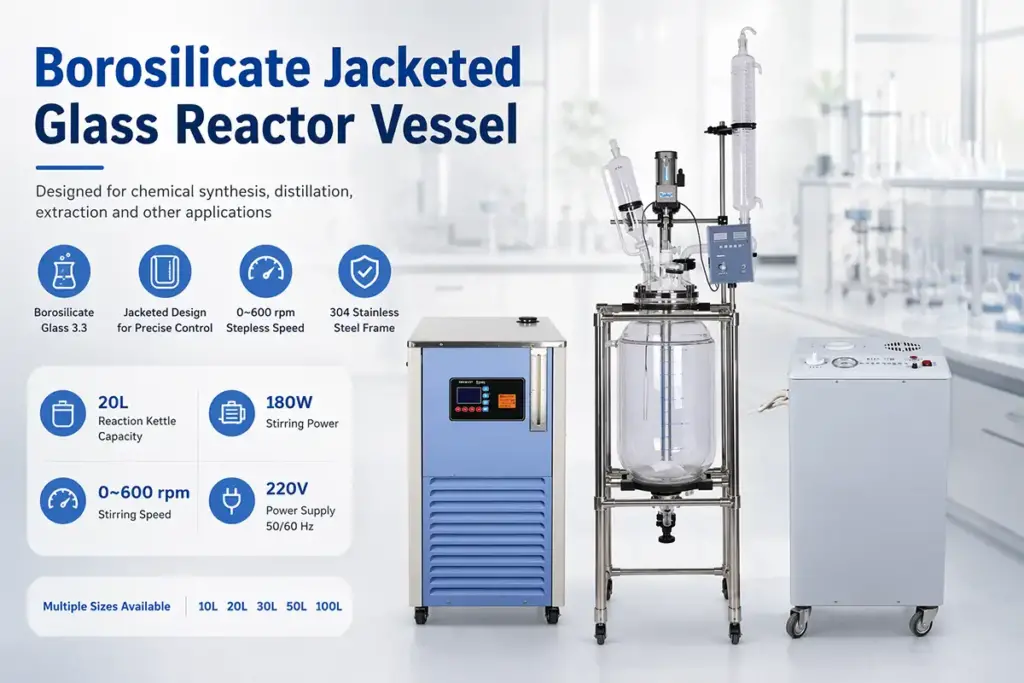
Stirring is not just a small accessory. It affects heat transfer, reaction uniformity, crystallization quality, gas-liquid contact, and overall repeatability. ZZKD small S-series reactors from 1L to 5L use a 12 mm stirring shaft and variable speed from 0 to 600 rpm, with a maximum speed up to 1300 rpm. Larger 10L to 100L systems also support 0 to 600 rpm, with shaft diameters increasing from 12 mm to 15 mm depending on the model.
If your material is close to water in viscosity, standard stirring is usually enough. If you work with polymers, resins, slurries, viscous extracts, or crystallization systems with solids, pay more attention to motor torque, impeller type, shaft stability, and whether the reactor can maintain smooth mixing at lower speed. For high-viscosity products, buying a larger reactor without enough mixing power can lead to poor temperature uniformity and inconsistent results.
4. Think About Temperature Control as a Complete System
A jacketed glass reactor works by circulating heating or cooling fluid through the outer jacket. The reactor itself is only one part of the temperature system. You also need a suitable circulating chiller, heater, or heating-cooling circulator. Before buying, check your target temperature range, ramp speed, solvent boiling point, and whether you need stable low-temperature operation.
For example, reflux and dissolution may only need heating and moderate cooling water. Crystallization, low-temperature synthesis, or exothermic reactions may require a refrigerated circulator with accurate temperature control. The larger the reactor volume, the more important heat-transfer capacity becomes. A 50L reactor connected to an undersized circulator will work slowly, even if the reactor vessel itself is high quality.
5. Decide Whether You Need Vacuum, Distillation, or Reflux Accessories
Many labs use jacketed reactors for more than simple mixing. If your process includes solvent removal, reflux, concentration, or vacuum reaction, choose the matching accessories at the beginning. Common options include a condenser, receiving flask, vacuum gauge, PTFE sealing system, dropping funnel, temperature probe, and vacuum pump connection.
If you plan to process volatile solvents, ask for a configuration designed for vacuum sealing and condensation. For crystallization and solvent recovery work, glass visibility is a major advantage because operators can see color change, precipitation, foaming, and phase separation in real time.
6. Do Not Ignore Lab Safety and Compliance
Safety should be part of the selection process, not an afterthought. In the United States, OSHA’s Laboratory Standard, 29 CFR 1910.1450, requires employers using hazardous chemicals in laboratories to develop and carry out a Chemical Hygiene Plan. That matters when choosing reactor equipment, because the reactor should fit the lab’s ventilation, chemical handling, pressure control, electrical safety, and emergency procedures.
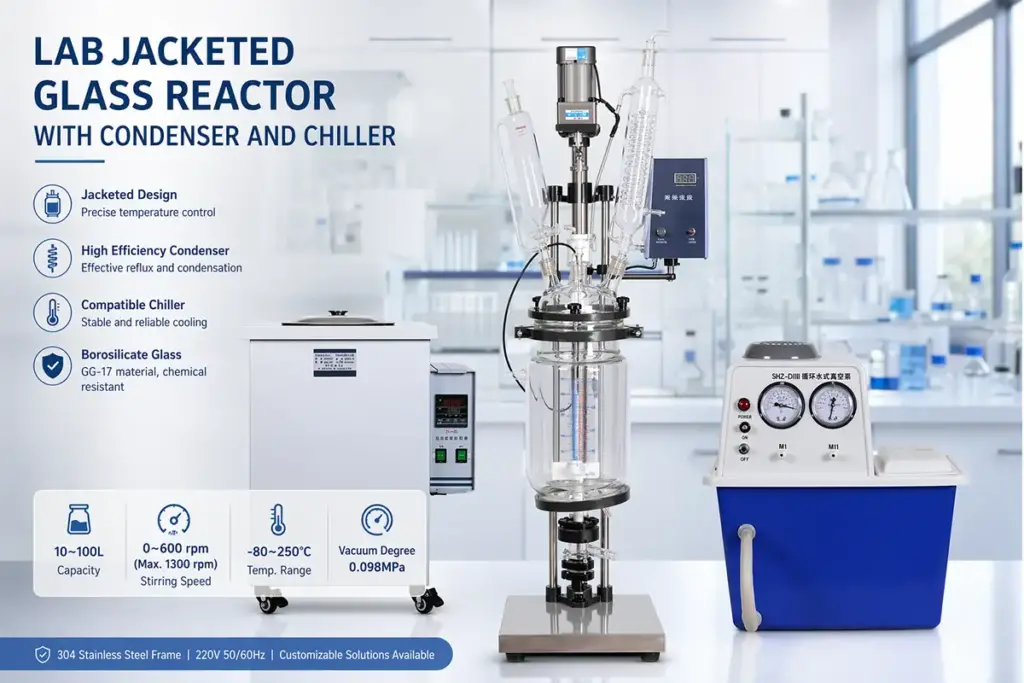
If you handle flammable solvents or operate in a hazardous environment, ask about explosion-proof motor options and proper electrical configuration. ZZKD reactor documents note explosion-proof options, 304 stainless steel frames for larger models, and power supply options including 220V 50/60Hz, with 110V/60Hz customization available. Also confirm that your lab bench or floor has enough space, the frame is stable, and the operator can safely reach valves, clamps, and the control panel.
7. Use Price as a Filter, Not the Only Decision
Price matters, especially for schools, start-up labs, and production teams comparing multiple sizes. Based on the provided ZZKD product price sheet, the following references can help with early budgeting. Exact pricing can change with configuration, accessories, shipping, voltage, explosion-proof design, and order quantity.
| Typical Capacity | Suggested Use | Reference Price |
|---|---|---|
| 1L | Small sample testing, teaching, early formulation | About $560 |
| 5L | Routine lab synthesis and small batch development | About $850 |
| 10L | Process optimization and moderate batch work | About $1,500 |
| 20L | Scale-up testing, distillation, extraction, pilot reaction | About $1,700 |
| 50L | Pilot production and larger lab processing | About $2,200 |
| 100L | Pilot plant, larger batch synthesis, production support | About $2,800 |
If your target is pilot-scale work, the 50L jacketed glass reactor is often a practical middle point. It gives much more process volume than a benchtop unit while staying easier to install and operate than a 100L system.
8. A Simple Selection Checklist
Before ordering, answer these questions. What is your normal batch volume? What is the maximum viscosity during the process? Do you need heating only, cooling only, or both? Will the system run under vacuum? Do you need reflux or distillation glassware? Are your solvents flammable? What voltage is available in your lab? Do you need a benchtop design, floor-standing frame, or explosion-proof configuration?
For most lab users, the best choice is not the largest or cheapest reactor. It is the reactor that gives enough working volume, stable stirring, suitable thermal control, safe sealing, and room to add the accessories your method needs. A 5L ZZKD reactor is a smart starting point for many research labs. A 20L or 50L model is better when the process has moved from discovery to repeated batch work. A 100L system is better for pilot plants that already understand their reaction behavior and need larger output.
Conclusion
To choose a jacketed glass reactor for lab use, begin with your real working volume, then check glass material, stirring ability, temperature control, vacuum and reflux needs, safety requirements, and accessory compatibility. ZZKD offers small 1L to 5L lab reactors and larger 10L to 100L jacketed glass reactors, with variable speed stirring, borosilicate glass vessels, stainless frame options, and customizable voltage. If you match the reactor to your process instead of choosing by size alone, you will get safer operation, better repeatability, and a more useful laboratory system.
References
Material and safety data points in this guide are based on public technical and regulatory sources, including ISO 3585 borosilicate glass 3.3, SCHOTT BOROFLOAT 33 technical information, and OSHA 29 CFR 1910.1450 Laboratory Standard.