
Glass vessel chemical reactors make reactions visible, controllable, and safer for labs and pilot plants. This guide explains how they work, how to read key parameters, and how to choose a suitable size.
According to a 2022 report from the American Chemical Society, over 60% of academic organic synthesis labs prefer glass reactors in their development stages because of visual monitoring and easier cleaning.
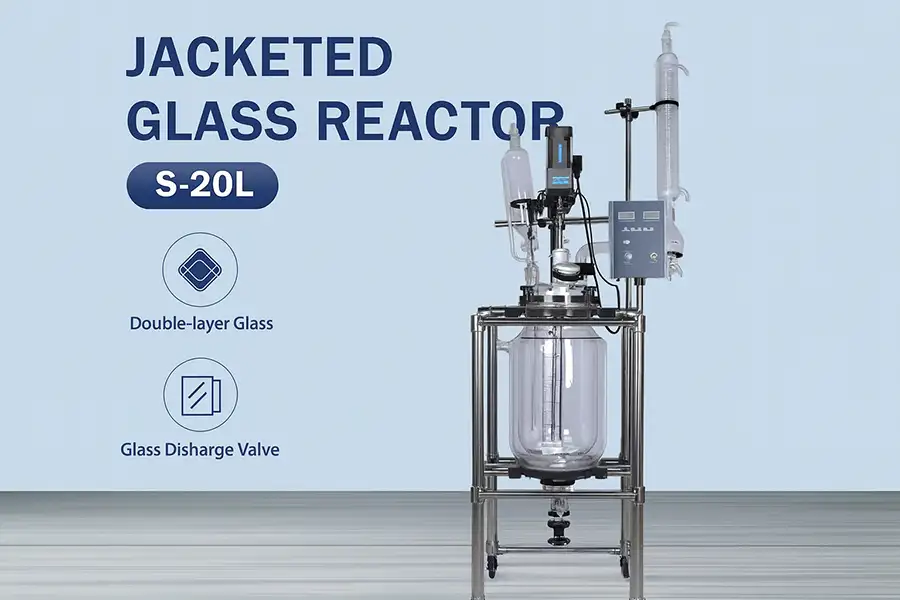
What Is a Glass Vessel Chemical Reactor?
A glass vessel chemical reactor is a sealed glass container equipped with a mechanical stirrer, support frame, and often a jacket for heating or cooling. It is used to carry out reactions such as synthesis, crystallization, mixing, or distillation under controlled conditions.
In practice, glass reactors are widely used in:
- Organic synthesis and fine chemicals
- Pharmaceutical R&D and scale-up
- University teaching laboratories
- Plant extract and natural product processing
Compared with opaque steel equipment, glass vessel chemical reactors allow direct observation of color change, phase separation, foaming, and crystallization. For development work, this visual feedback often saves time and reduces failed batches.
Is a glass vessel reactor only for low‑temperature experiments?
No. Modern borosilicate glass reactors can typically handle from about −80 °C to +200 °C with proper thermal fluid, as long as rapid temperature shocks are avoided. For very high pressure or temperatures above this range, stainless steel reactors are more suitable, but for most lab and pilot processes, glass vessels are sufficient.
Key Parameters Explained in Simple Terms
When comparing glass vessel chemical reactors, technical sheets can look confusing. Actually, only a few parameters decide whether a model fits a process:
1. Reaction Kettle Capacity (L)
Capacity is the total volume of the glass vessel. For the S-series glass reactors:
| Model | Capacity (L) | Stirring Power (W) | Stirring Speed (rpm) | Shaft Diameter (mm) | Motor Torque (g·cm) | Power Supply | Notes |
|---|---|---|---|---|---|---|---|
| S‑1L | 1 | 60 | 0–600 (max. 1300) | 12 | 2000 | 220 V 50/60 Hz | Floor type |
| S‑2L | 2 | 60 | 0–600 (max. 1300) | 12 | 2400 | 220 V 50/60 Hz | Floor type |
| S‑3L | 3 | 60 | 0–600 (max. 1300) | 12 | 4800 | 220 V 50/60 Hz | Floor type |
| S‑5L | 5 | 60 | 0–600 (max. 1300) | 12 | 4800 | 220 V 50/60 Hz | Floor type |
Note: Explosion‑proof versions are available. Stirring power can also be configured as 180 W, 250 W, or 370 W. 110 V/60 Hz motors are customizable for North American and Japanese labs.
As a rule of thumb, the actual working volume is often 50–70 % of the total capacity to allow space for foaming and reflux. That means an S‑5L reactor is comfortable for about 2.5–3.5 L of liquid.
2. Stirring Power and Motor Torque
Stirring power (W) tells how strong the motor is. Motor torque (g·cm) tells how much resistance can be handled before the stirrer slows down. For more viscous liquids, torque is more important than power alone.
For example, the S‑10L to S‑100L double reactors offer stronger motors and torque to handle larger volumes:
| Model | Capacity (L) | Stirring Power (W) | Stirring Speed (rpm) | Shaft Diameter (mm) | Motor Torque (g·cm) | Power Supply | Frame |
|---|---|---|---|---|---|---|---|
| S‑10L | 10 | 120 | 0–600 (max. 1300) | 12 | 1000 | 220 V 50/60 Hz | 304 stainless frame |
| S‑20L | 20 | 120 | 0–600 (max. 1300) | 12 | 1200 | 220 V 50/60 Hz | 304 stainless frame |
| S‑30L | 30 | 250 | 0–600 (max. 1300) | 15 | 1500 | 220 V 50/60 Hz | 304 stainless frame |
| S‑50L | 50 | 250 | 0–600 (max. 1300) | 15 | 3000 | 220 V 50/60 Hz | 304 stainless frame |
| S‑100L | 100 | 250 | 0–600 (max. 1300) | 15 | 3000 | 220 V 50/60 Hz | 304 stainless frame |
Note: Explosion‑proof options and alternative stirring power 180/250/370 W and 110 V / 60 Hz are available on request.
3. Stirring Speed (rpm)
Most S‑series glass vessel chemical reactors are designed for 0–600 rpm, with a maximum of about 1300 rpm. This range already covers:
- Gentle mixing of heat‑sensitive solutions
- Suspending solids during crystallization
- Emulsification and dispersion of two immiscible liquids
Does a higher rpm always mean better mixing?
Not necessarily. Effective mixing depends on reactor shape, impeller type, viscosity, and filling level. Often, 300–500 rpm with a suitable impeller already gives good circulation. Extremely high rpm can increase shear, cause vortexing, and even introduce air or risk splashing, so speed should be adjusted based on the actual process observation.
How to Choose the Right Glass Vessel Chemical Reactor
Selecting a reactor is not just about volume; it is about matching equipment to the real process. Several practical questions help narrow down the choice:
1. What Working Volume Is Needed?
For screening experiments and method development, 1–5 L models (S‑1L to S‑5L) are often sufficient. For pilot or small‑scale production, 10–100 L models (S‑10L to S‑100L) are more appropriate.
If 3 L of reaction solution is used frequently and strong foaming is expected, choosing at least an S‑5L is recommended to leave enough headspace for safety.
2. How Viscous or Difficult to Stir Is the Material?
For low‑viscosity solvents (similar to water), lower torque motors are adequate. For viscous polymer solutions or slurries, stronger torque and sometimes a larger shaft diameter (like 15 mm on S‑30L and above) give more reliable mixing.
3. What About Vacuum, Distillation and Solvent Recovery?
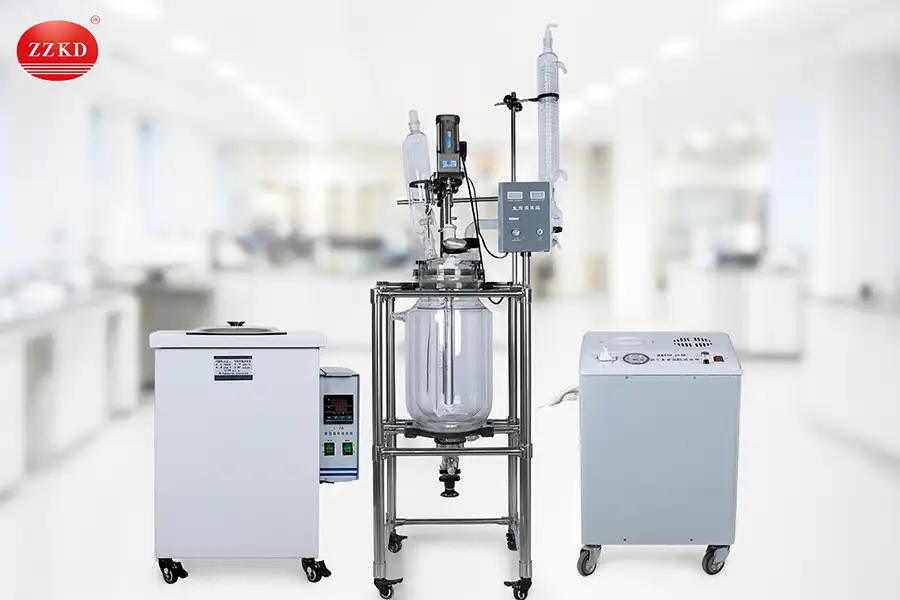
Many labs use glass vessel chemical reactors together with rotary evaporators and solvent distillation units to recover valuable solvents and reduce emissions.
According to a 2021 study published in the Journal of Cleaner Production, integrated solvent recovery systems can cut organic solvent purchase cost by 30–60 % in multipurpose plants. Glass reactors that can hold vacuum and connect to condensers support this kind of circular use.
4. Power Supply and Safety Requirements
If a lab is located in a region using 110 V / 60 Hz power, it is convenient that the S‑series can be customized for that standard. Where flammable solvents such as ethanol, acetone, or toluene are processed, explosion‑proof motors and switches are strongly recommended.
When is explosion‑proof configuration really necessary?
Explosion‑proof options are important when flammable vapors can accumulate, for example during solvent distillation or concentration at scale, or when local safety codes require it (such as ATEX‑classified zones in the EU). For very small‑volume research with good ventilation and strict handling, standard motors may be sufficient, but checking local regulations and safety guidelines is essential.
Glass vs. Stainless Steel Reactors: When to Use Each
Both glass and stainless steel reactors have their role. The choice depends on process stage and reaction conditions.
Advantages of Glass Vessel Chemical Reactors
Visual monitoring Corrosion resistance Easy cleaning
- Transparent: operators can see phase changes, crystallization, and emulsions in real time.
- Excellent chemical resistance to acids, many organics, and solvents.
- Smoother, easier to clean surface, suitable for frequent product changes.
- Ideal for R&D and teaching, where understanding behavior is as important as yield.
When to Consider Stainless Steel Reactors
- Very high pressure or temperature beyond the glass range.
- Large production volumes where mechanical impact risk is higher.
- Processes requiring integrated baffles or complex internal structures.
For such cases, a dedicated stainless steel chemical reactor is more suitable, often used after parameters have been optimized in glass.
According to data from the European Federation of Chemical Engineering, moving from lab to pilot scale typically reduces development time by 20–30 % when transparent reactors are used in early design phases, because problems such as poor mixing or unexpected phase behavior are caught earlier.
Practical Tips for Daily Use and Maintenance
A glass vessel chemical reactor, if handled properly, can serve reliably for many years. A few practical tips help prolong its life and keep experiments safe:
- Avoid thermal shock: do not pour very hot liquid into a very cold reactor (or the opposite). Change temperature gradually.
- Check clamps and joints: ensure all flanges and glass joints are evenly tightened and supported by the frame before starting.
- Start stirring slowly: increase rpm step by step, especially in viscous or solid‑containing systems.
- Use correct PTFE seals: the stirrer seal should match the shaft diameter (12 mm or 15 mm in the S‑series).
- Clean after each batch: rinse with suitable solvents and avoid scratching the glass with hard tools.
What is the most common reason for unexpected glass damage?
In daily practice, sudden mechanical impact (such as hitting the vessel with metal tools) and thermal shock are more frequent causes of breakage than pressure itself. Keeping the vessel protected during transport, using soft pads around metal clamps, and allowing gradual heating or cooling significantly reduce risk.
If processes involve frequent distillation or concentration, combining the glass reactor with a dedicated solvent recovery or solvent recycler machine can lower operating cost and improve sustainability.