
A high pressure lab reactor system is one of the most useful tools in pharmaceutical research because it lets scientists test reactions under controlled pressure, temperature, stirring, and material conditions. For a pharmaceutical lab, this is not just a pressure vessel. It is a small, repeatable reaction platform for screening catalysts, developing active pharmaceutical ingredient processes, improving yields, and preparing data before scale-up.
Why pharmaceutical researchers use high pressure reactors
Many important drug development reactions do not behave well at normal pressure. Hydrogenation, oxidation, carbonylation, hydrothermal synthesis, polymer modification, and some crystallization studies may require higher gas pressure, stable heating, and strong mixing. A high pressure reactor gives researchers a controlled space to study these conditions without jumping directly to pilot production.
In pharmaceutical development, understanding the process is as important as making the target compound. The FDA page for ICH Q8(R2) Pharmaceutical Development explains that the 2009 revision clarified key ideas around pharmaceutical development and quality by design. In simple terms, this means labs need reliable data about critical process parameters, such as temperature, pressure, reaction time, stirring speed, and material compatibility. A well-equipped lab reactor helps generate that data earlier and more consistently.
The FDA also supports modern process understanding through Process Analytical Technology. Its PAT guidance describes a framework for innovative pharmaceutical development, manufacturing, and quality assurance. For reactor work, that idea translates into better monitoring, cleaner records, and experiments that can be repeated by another scientist instead of depending only on experience.
What a ZZKD high pressure lab reactor can do
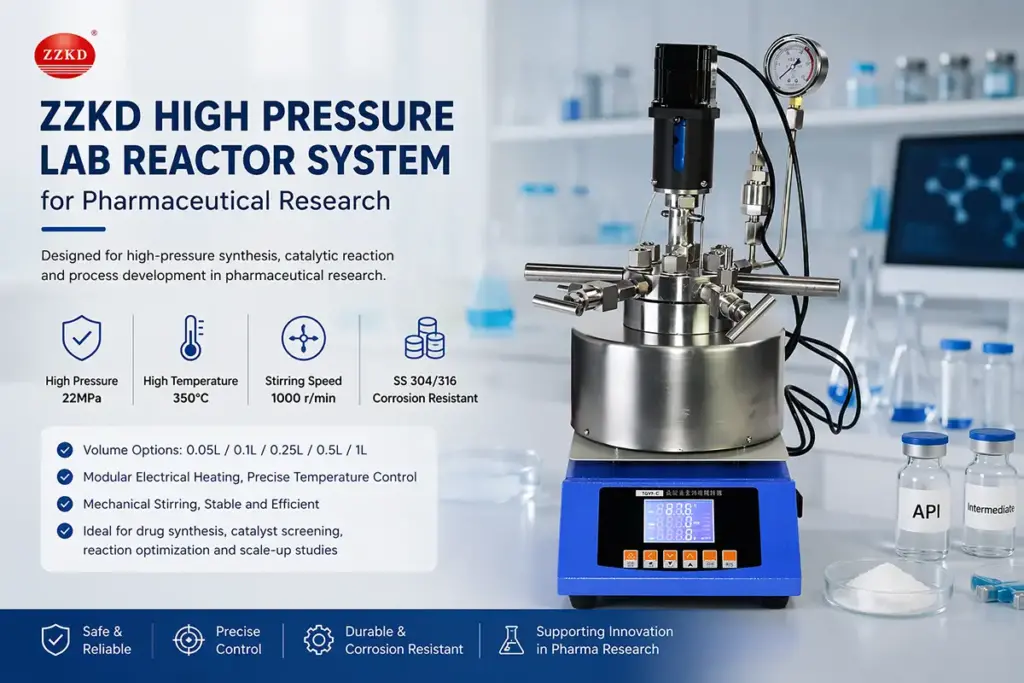
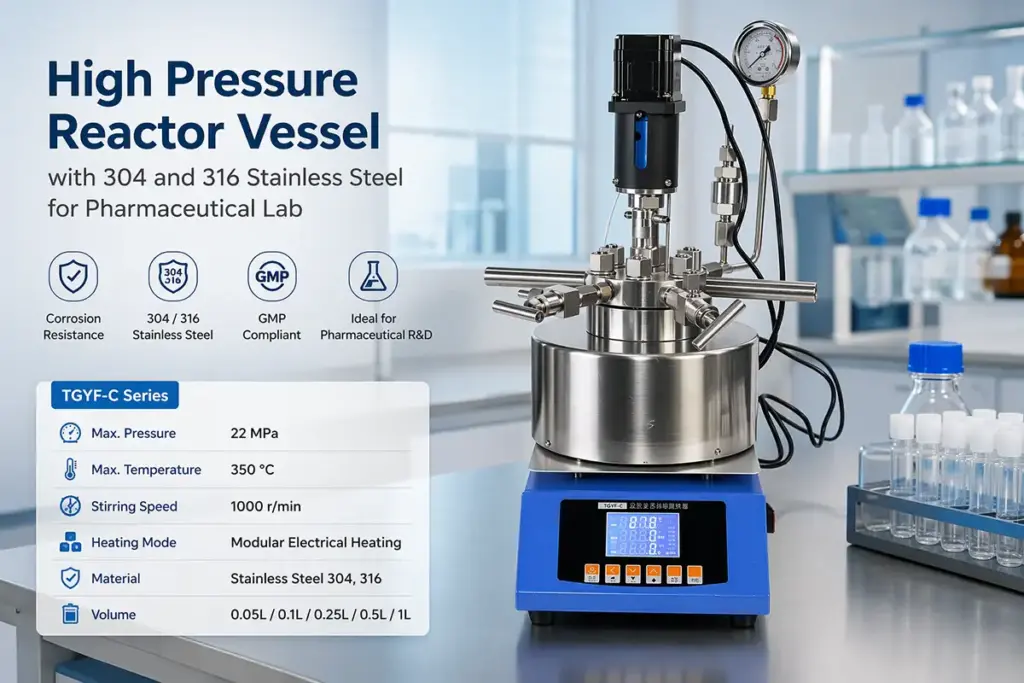
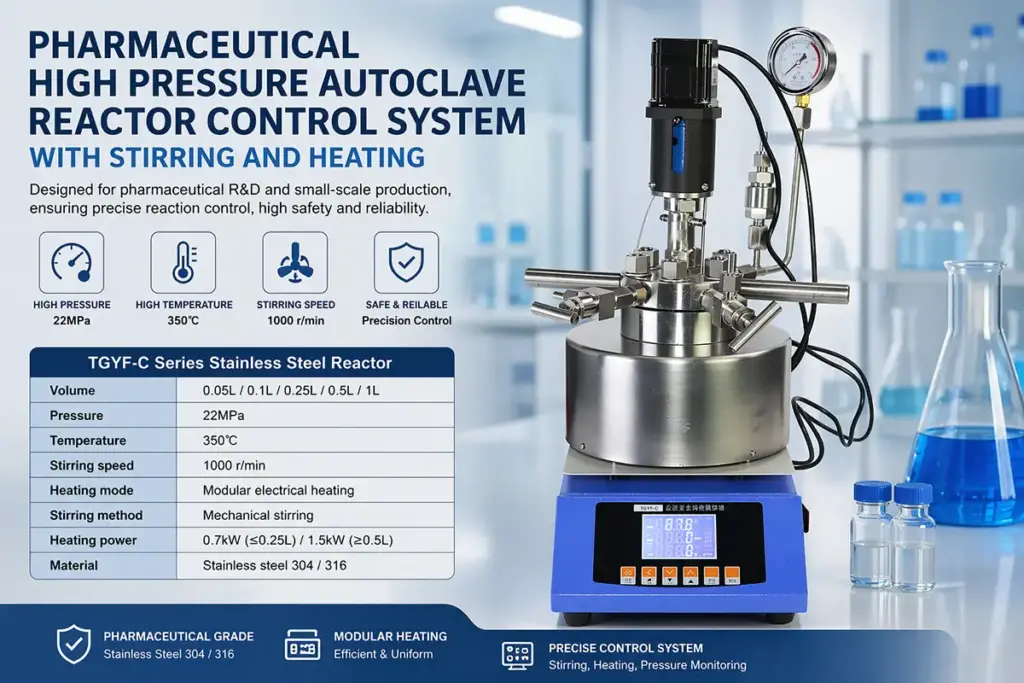
ZZKD high pressure reactor systems are designed for small-batch research where safety, material strength, and reaction control all matter. Based on the TGYF-C laboratory reactor parameters, available working volumes include 0.05 L, 0.1 L, 0.25 L, 0.5 L, and 1 L. This range is practical for pharmaceutical research because a team can begin with very small quantities of expensive intermediates, then move to larger batches when the reaction route becomes clearer.
The TGYF-C system supports pressure up to 22 MPa and temperature up to 350°C, with stirring speed up to 1000 r/min. Heating is provided by modular electric heating, and the reactor uses mechanical stirring to improve mass transfer between liquid, gas, and solid catalyst phases. Stainless steel 304 and 316 are available materials, with 316 often preferred when corrosion resistance is more important.
For readers comparing reactor categories, ZZKD also has related technical pages about high pressure reactor systems for chemical synthesis, lab scale high pressure reactors, and stainless steel chemical reactors. These pages are useful when deciding whether your application needs a compact lab autoclave, a stainless steel stirred vessel, or a larger chemical reactor system.
Common pharmaceutical applications
Hydrogenation: A high pressure lab reactor is often used for catalytic hydrogenation because gas-liquid mixing and pressure stability strongly affect conversion and selectivity. Researchers can test catalyst type, catalyst loading, solvent, hydrogen pressure, and reaction temperature in a controlled small-batch vessel.
API intermediate synthesis: During early route development, chemists need to know whether a reaction is robust enough for repeated batches. A small reactor helps compare reaction windows and identify conditions that reduce impurity formation.
Crystallization and solubility studies: Some pharmaceutical solids are sensitive to temperature, pressure, solvent composition, and agitation. A controlled reactor can help researchers explore how process conditions influence particle formation and purity.
Catalyst screening: A compact 50 ml, 100 ml, or 250 ml reactor is useful when catalyst samples are limited. The scientist can run multiple tests with lower material consumption and then scale the most promising result to 500 ml or 1 L.
Key specifications to check before buying
Volume: Choose a vessel that matches your normal sample size. For pharmaceutical research, 0.05 L to 1 L is often enough for screening and early optimization. If the lab often needs larger confirmation batches, a 2 L, 5 L, or 10 L system may be better.
Pressure rating: Do not choose a reactor only by the expected operating pressure. The design pressure should leave a proper safety margin, and all fittings, valves, gauges, seals, and gas lines must match the pressure class.
Temperature control: A reactor rated to 350°C gives researchers wide flexibility, but stable control is more important than a high number on paper. Ask about heating power, temperature sensor position, controller accuracy, and cooling options.
Stirring performance: Stirring affects reaction speed, heat transfer, catalyst suspension, and gas absorption. A 1000 r/min stirring capability is helpful for many lab studies, but the impeller type and liquid viscosity should also be considered.
Material compatibility: Stainless steel 304 is suitable for many general reactions, while 316 is commonly selected for better resistance to many corrosive media. For strong acids, halides, or special solvents, confirm compatibility before ordering.
Safety and compliance considerations
High pressure research should always be treated seriously. The OSHA pressure vessels overview highlights pressure vessel hazards and points users toward standards and hazard recognition resources. For a pharmaceutical lab, this means the reactor should be used with suitable pressure relief protection, written operating procedures, trained staff, shielding where required, and careful inspection before each run.
A practical safety checklist should include leak testing, pressure gauge inspection, valve function checks, correct tightening sequence, clean sealing surfaces, compatible gasket material, safe gas cylinder handling, and full depressurization before opening. The reactor should never be opened under pressure or while it is still hot. Good records also matter: note the batch, solvent, catalyst, gas, pressure, temperature, stirring speed, and any abnormal observation.
How much does a high pressure lab reactor cost?
Price depends on volume, pressure rating, material, control system, stirring method, sealing design, safety accessories, and customization. From the current ZZKD price reference, small high pressure reactor products start around US$1,100 to US$1,500 for basic small-capacity configurations. A ZZKD high pressure autoclave vessel with temperature control and mixing function is listed in a US$2,300 to US$3,200 range; using a mid-low selection point, a practical reference price is about US$2,650. Larger 50 L high pressure chemical reactors can reach US$10,500 or more, depending on configuration.
For pharmaceutical research, the cheapest reactor is not always the best value. A slightly higher budget may provide better stirring, better pressure control, stronger corrosion resistance, or a safer operating experience. These details can save time when repeated experiments are needed for process development.
Choosing the right reactor for your lab
If your team is mainly doing early screening, start with a compact 50 ml to 250 ml reactor. If you already have a stable route and need enough product for analysis, 500 ml or 1 L is often more useful. If your reaction uses hydrogen or another gas, focus on sealing quality, gas inlet design, pressure relief, and stirring efficiency. If the chemistry is corrosive, choose the material first and the volume second.
A high pressure lab reactor system for pharmaceutical research should help answer real questions: What pressure gives the best selectivity? Does higher temperature create impurities? Can the catalyst be reduced? Is the process repeatable? Can the same conditions be scaled safely? When the reactor gives clear answers to those questions, it becomes more than a piece of equipment. It becomes a dependable research platform.
ZZKD high pressure reactor systems are suitable for laboratories that need controlled pressure, high-temperature capability, stainless steel construction, and practical small-batch flexibility. For pharmaceutical R&D teams working on synthesis, hydrogenation, crystallization, or catalyst screening, a properly selected ZZKD reactor can make experiments easier to repeat, easier to document, and easier to scale.