
A rotary evaporator (often called a “rotovap”) is one of the most practical lab tools for concentrating samples. The reason it feels “magically fast” is not magic at all—it’s smart physics: vacuum + rotation + controlled heating + efficient condensation.
Lower boiling point under vacuumThin film = faster evaporationGentle temperatures help protect compounds
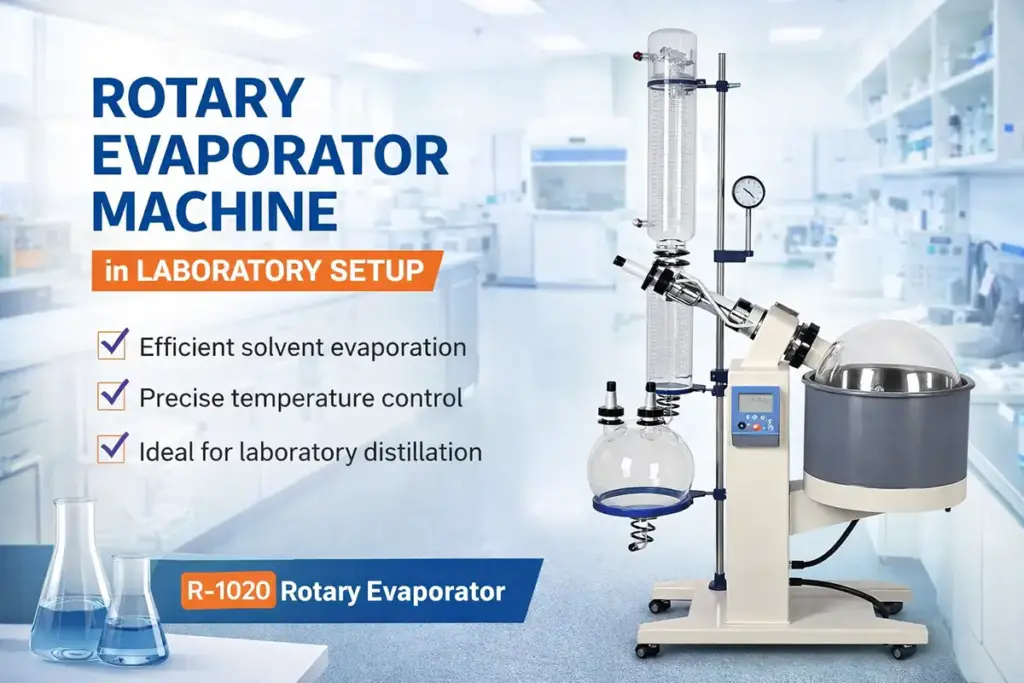
Typical rotary evaporator machine layout: rotating flask, heated bath, condenser, and receiving flask.
What is a rotary evaporator most commonly used for?
In everyday lab work, a rotary evaporator machine is most often used to remove a solvent from a sample so the dissolved material becomes more concentrated or fully dried. This happens constantly in chemistry, biotech, food and flavor testing, and materials R&D.
Common, real-world lab tasks
- Concentrating reaction mixtures after synthesis (e.g., removing ethyl acetate, acetone, methanol).
- Solvent swapping (remove one solvent and re-dissolve residue in another for the next step).
- Extract concentration after liquid-liquid extraction or solid-liquid extraction.
- Gentle pre-drying before final vacuum oven or lyophilization steps.
- Solvent recovery for reuse or safer waste handling (paired with proper traps and condensation).
If a sample is heat-sensitive, is solvent removal still possible without “cooking” it?
Yes—this is exactly why rotovaps are popular. The approach is to lower pressure so the solvent boils at a much lower temperature, then use a stable bath setpoint (often warm, not hot) and maintain efficient condensation to keep the system gentle.
The “why” behind fast + gentle evaporation
Why can a rotovap remove solvent so quickly at low temperature?
A rotary evaporator machine accelerates evaporation by combining four effects that reinforce each other: (1) vacuum lowers the boiling point, (2) rotation creates a thin film, (3) a controlled bath provides steady heat, and (4) a condenser immediately captures vapor.
1) Vacuum: the boiling point drops dramatically
Under reduced pressure, solvents boil at lower temperatures. This is why a rotovap can remove common solvents with a warm water bath instead of aggressive heating. Lower temperature generally means less thermal degradation, less bumping risk (when tuned correctly), and better preservation of volatiles.
Authority reference (data): According to NIST Chemistry WebBook data and standard vapor pressure relationships (e.g., Antoine equation), boiling points decrease significantly as pressure drops—this is the foundational principle that makes rotary evaporation gentle.
2) Rotation: thin film = bigger surface area
Rotating the evaporating flask spreads liquid into a thin film on the inner wall. More surface area means faster mass transfer (molecules escape the liquid more easily), and the film also heats evenly, reducing hot spots.
Why not just heat a beaker on a hotplate to evaporate faster?
A beaker on a hotplate relies mainly on temperature and surface area, often requiring higher heat and longer time. A rotovap adds vacuum (lower boiling point) and continuous film renewal (rotation), so solvent leaves faster at a gentler temperature, while vapors are condensed and collected instead of filling the fume hood.
3) Controlled bath: stable, repeatable conditions
Most lab rotovaps use a water (or oil) bath with digital temperature control. That stability matters: it helps maintain a consistent evaporation rate without overshooting temperatures. For example, many lab configurations support wide temperature ranges and fine stability suitable for routine solvent removal.
4) Condensation: keeping the vacuum “happy”
A well-sized condenser and adequate coolant flow rapidly liquefy the solvent vapor and send it to the receiving flask. Efficient condensation reduces vapor load to the pump, stabilizes pressure, and sustains faster evaporation.
For users comparing purchase options, see: rotary evaporator product page. If the main goal is solvent recovery at higher throughput, a dedicated solvent recovery machine may also be relevant.
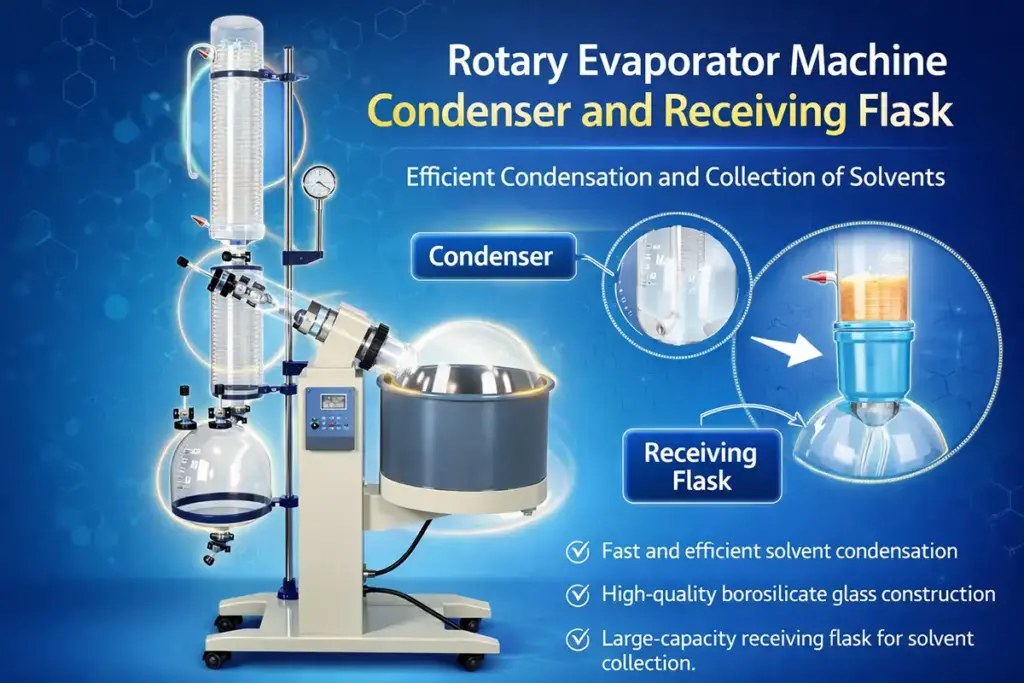
Condenser + receiving flask: the “collection” side that keeps evaporation efficient and clean.
Practical parameters (easy to interpret)
What performance numbers actually matter for solvent removal?
When evaluating a rotary evaporator machine, the most meaningful specs for day-to-day solvent removal are: evaporation rate, maximum vacuum level, bath heating power, rotation speed range, and flask capacity.
| Model | Evaporating Flask | Receiving Flask | Rotation Speed | Bath Power | Evaporation Rate (H₂O) | Max Vacuum |
|---|---|---|---|---|---|---|
| RE-201D | 2 L | 1 L | 0–120 rpm | 1200 W | > 1 L/h | < 133 Pa (≈1.33 mbar, 1 Torr) |
| RE-301 | 3 L | 2 L | 0–120 rpm | 1500 W | > 1.5 L/h | < 133 Pa (≈1.33 mbar, 1 Torr) |
| RE-501 | 5 L | 3 L | 0–120 rpm | 1500 W | > 1.5 L/h | < 133 Pa (≈1.33 mbar, 1 Torr) |
| RE-1002 | 10 L | 5 L | 0–120 rpm | 3000 W | > 3 L/h | — |
| RE-2002 | 20 L | 10 L | 0–90 rpm | 5000 W | > 5 L/h | — |
| RE-5002 | 50 L | 20 L | 0–90 rpm | 7000/9000 W | > 9 L/h | — |
Note: “Evaporation rate (H₂O)” is a standardized reference; real rates vary by solvent, pressure stability, condenser efficiency, and bath temperature. Still, it helps compare throughput across a rotary evaporator machine lineup.
Does “lower pressure” always mean “faster evaporation”?
Not always. In practice, the fastest stable setup is a balance: pressure low enough to boil gently, but not so low that the sample bumps, foams, or floods the condenser. The best results come from matching vacuum, rotation speed, and bath temperature to the solvent and mixture.
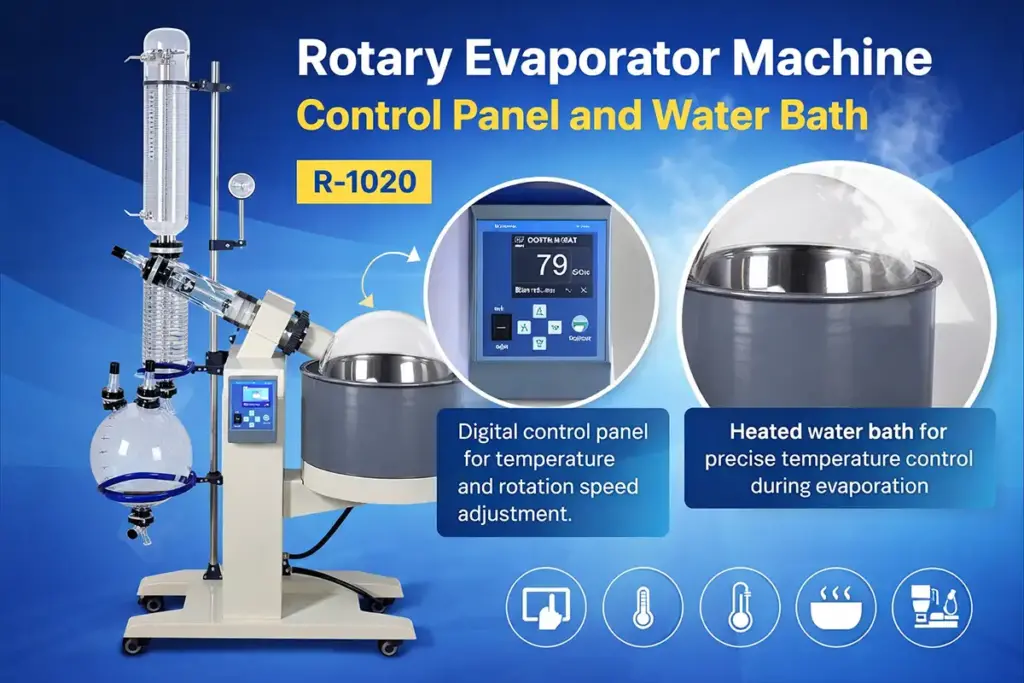
Digital bath control helps keep evaporation repeatable and gentle for routine workflows.
How to get “fast but gentle” results in daily use
Getting the best from a rotary evaporator machine is less about pushing maximum heat, and more about building a stable evaporation system: steady vacuum, a condenser that can keep up, and rotation that forms a smooth film.
Simple checklist (conceptual, not a procedure)
- Choose the right flask size: leave headspace to reduce bumping and carryover.
- Set a moderate bath temperature and rely on vacuum to do the heavy lifting.
- Use enough rotation to create a uniform film, especially for viscous mixtures.
- Prioritize condensation: adequate coolant temperature/flow keeps recovery high and vacuum stable.
- Maintain sealing quality (PTFE/fluoro rubber seals are common) to avoid leaks that slow evaporation.
Why labs keep buying rotovaps: They shorten concentration time, reduce thermal stress on valuable compounds, and turn solvent removal into a controllable, repeatable step—especially compared with open evaporation.
When the goal is routine solvent removal and concentration, a well-matched rotary evaporator machine remains one of the most efficient and sample-friendly choices on the bench.
Further reading (internal): solvent recovery & distillation units overview
Educational content only. Always follow institutional safety rules, SDS guidance, and appropriate vacuum/solvent handling practices.