
Temperature is not just a number on a controller—it is the “steering wheel” for solubility, mass transfer, and selectivity. This guide explains (in plain language) how a double jacketed glass reactor reaches and holds a target temperature, why that matters for crystallization and liquid–liquid extraction, and what specifications actually help in real lab work.
Practical setup tipsCrystallization/extraction stabilitySpecs from 1–100 L series
What “double jacketed” really changes in temperature control
A single-wall vessel mainly exchanges heat through its outside surface. In contrast, a double jacketed glass reactor adds a sealed “jacket layer” around the inner reaction vessel. A heating/cooling fluid (often called a heat-transfer medium) circulates through this jacket. That extra layer matters because it creates a controlled heat-exchange zone that is: more uniform (less hot/cold spots) and more responsive (faster correction when conditions drift).
Why it feels more precise: the jacket acts like a temperature “buffer” and “delivery channel” at the same time. Instead of relying on ambient air or an external bath touching only part of the glass, the circulating medium wraps the vessel more evenly.
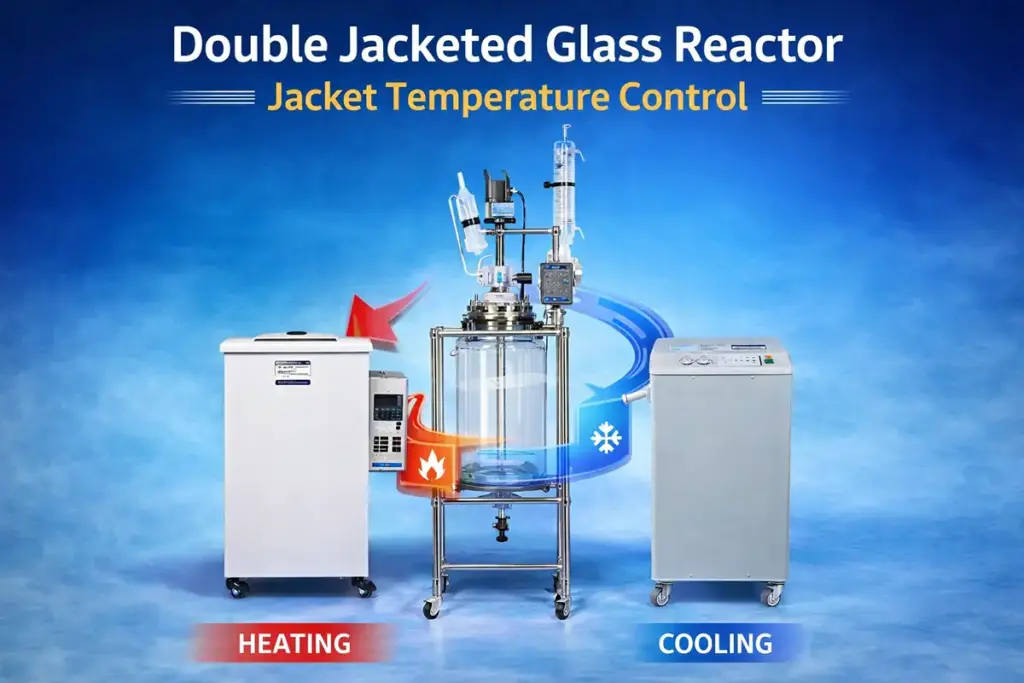
Jacket flow path and where temperature sensors are typically placed.
How precise control is achieved: the 3-part “control loop”
In practice, “precise temperature control” comes from a loop with three parts: energy delivery (the circulating medium), measurement (temperature probe position), and mixing (stirring that distributes heat). If one part is weak, the displayed temperature may look stable while the reaction zone is not.
A) Energy delivery: stable jacket circulation
The jacket needs continuous, stable flow. When the flow is weak, a temperature gradient forms: the inlet side “feels” the setpoint, while other regions lag behind. With good circulation, the jacket becomes a uniform thermal blanket. In a typical lab system, a recirculating chiller/heater feeds the jacket and continually corrects deviations.
B) Measurement: probe placement matters more than expected
Measuring jacket temperature is not the same as measuring product temperature. For crystallization/extraction, the key is: what temperature the liquid phase experiences near the impeller and bulk volume. A properly positioned probe (or thermowell) reduces “false stability,” where the controller holds the jacket setpoint but the reaction solution drifts.
C) Mixing: stirring is the hidden temperature equalizer
Stirring breaks up thermal layers and helps the whole volume reach the same temperature. From the provided specifications, many models support a wide stirring range of 0–600 rpm (max 1300), which is helpful because different viscosities and phase behaviors need different mixing intensity.
If the temperature display is stable, does that guarantee the solution is stable?
Answer: Not always. A stable display can reflect jacket stability, not bulk-liquid uniformity. Better probe placement and adequate stirring are what make the solution temperature truly stable.
Does it become “more stable” for crystallization and extraction?
For both crystallization and extraction, the short version is: a double jacketed glass reactor can be significantly more stable, but stability comes from uniform temperature + controlled ramps + repeatable mixing. The jacket design improves the first two, while the agitator system supports the third.
Crystallization: why tight control improves repeatability
Crystallization is extremely sensitive to temperature history. Small temperature overshoots can cause rapid nucleation, leading to fine crystals and broad particle-size distribution. Slow, controlled cooling promotes more predictable growth. This is why jacketed reactors are widely used when “cooling profile” matters (not just the final temperature).
Authoritative data point: According to the U.S. Food & Drug Administration (FDA), continuous manufacturing technologies can provide improved product quality and consistency compared with some traditional batch approaches, largely because critical process parameters (like temperature) are controlled more tightly. (Source: FDA guidance and public communications on pharmaceutical continuous manufacturing.)
Extraction: why uniform temperature reduces “mystery variability”
Liquid–liquid extraction depends on partition coefficients (which can be temperature-dependent), viscosity, and mass transfer at the interface. When temperature drifts, phase behavior can change: emulsions become harder to break, and settling times can become inconsistent. A jacketed reactor helps keep conditions steady, so extraction outcomes become easier to reproduce.
Is “lower temperature fluctuation” always better for crystallization?
Answer: Lower fluctuation is generally better, but the best outcome is really about the right temperature program (cooling rate, hold time, and mixing). Overly aggressive cooling can still create unstable nucleation—even if the controller is accurate.
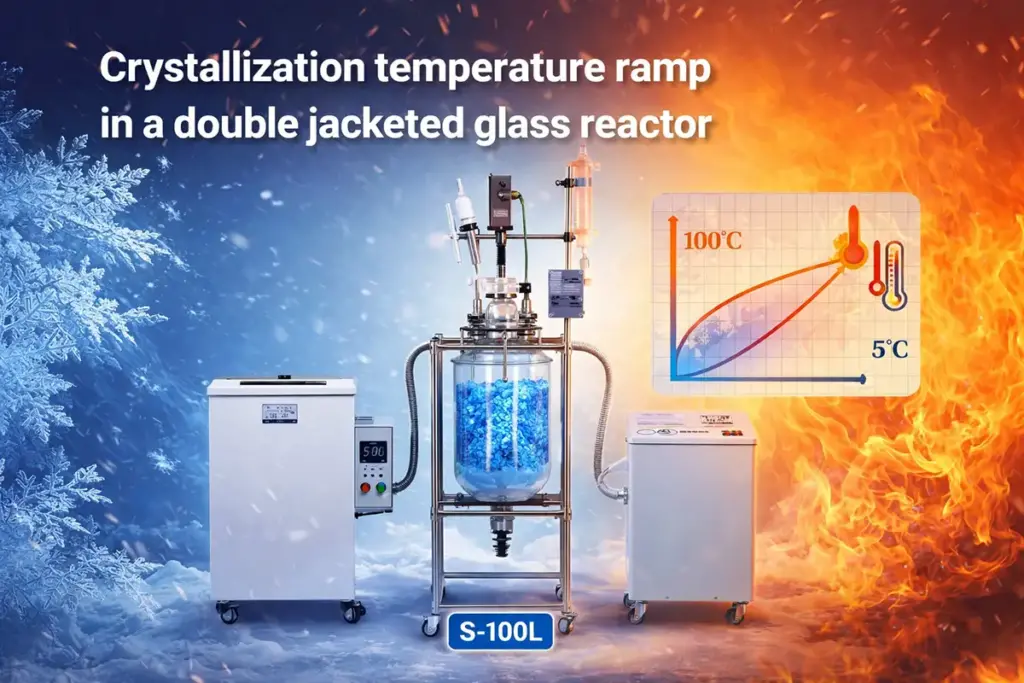
A simple temperature ramp curve (cooling + hold) used for crystallization.
Specs that affect temperature stability (using the provided parameter ranges)
A double jacket helps, but the hardware still determines how well the system holds setpoints during real processes (viscosity changes, exotherms, solvent additions, etc.). Based on the provided series specifications, here are the practical takeaways:
- Stirring speed range: 0–600 rpm (max 1300) supports both gentle crystal growth and higher-shear dispersion when needed.
- Shaft diameter: 12 mm (small reactors) and 12–15 mm (10–100 L) indicates stronger agitation capability as volume grows—helpful for uniform temperature.
- Motor torque (g·cm): listed up to 3000 g·cm (50 L) and 1500 g·cm (30 L) helps keep rpm stable when viscosity increases, reducing temperature gradients.
- Explosion-proof option: relevant when using volatile solvents in extraction—safer operation often enables more consistent runs.
| Model Range | Capacity (L) | Typical Stirring Speed | Shaft Diameter | Power Supply | Notes |
|---|---|---|---|---|---|
| S-1L to S-5L | 1 / 2 / 3 / 5 | 0–600 rpm (Max. 1300) | 12 mm | 220V 50/60 Hz (110V optional) | Floor type; explosion-proof option |
| S-10L to S-100L | 10 / 20 / 30 / 50 / 100 | 0–600 rpm (Max. 1300) | 12–15 mm | 220V 50/60 Hz | 304 stainless frame; explosion-proof option |
Common “precision” problems—and how to fix them quickly
Most temperature complaints are not caused by the glass reactor itself, but by system integration details. These are the issues that most often create instability in crystallization/extraction runs:
Problem: The jacket reaches setpoint, but the solution lags behind.
Fix: Increase stirring (within safe limits), confirm probe location is in the bulk liquid, and verify jacket flow rate is adequate.
Problem: Temperature overshoot during fast heating/cooling.
Fix: Use ramp/soak programming on the circulator; slow the setpoint step; ensure the circulator power matches reactor volume.
Problem: “Same recipe, different crystals” from run to run.
Fix: Standardize the cooling rate, agitation profile, and addition timing. In crystallization, the history is the process.
What is the simplest way to improve temperature uniformity without buying new equipment?
Answer: Stabilize mixing first—verify the impeller is appropriate, keep rpm consistent as viscosity changes, and avoid dead zones. Uniform mixing often solves “mysterious” temperature drift more effectively than changing setpoints.
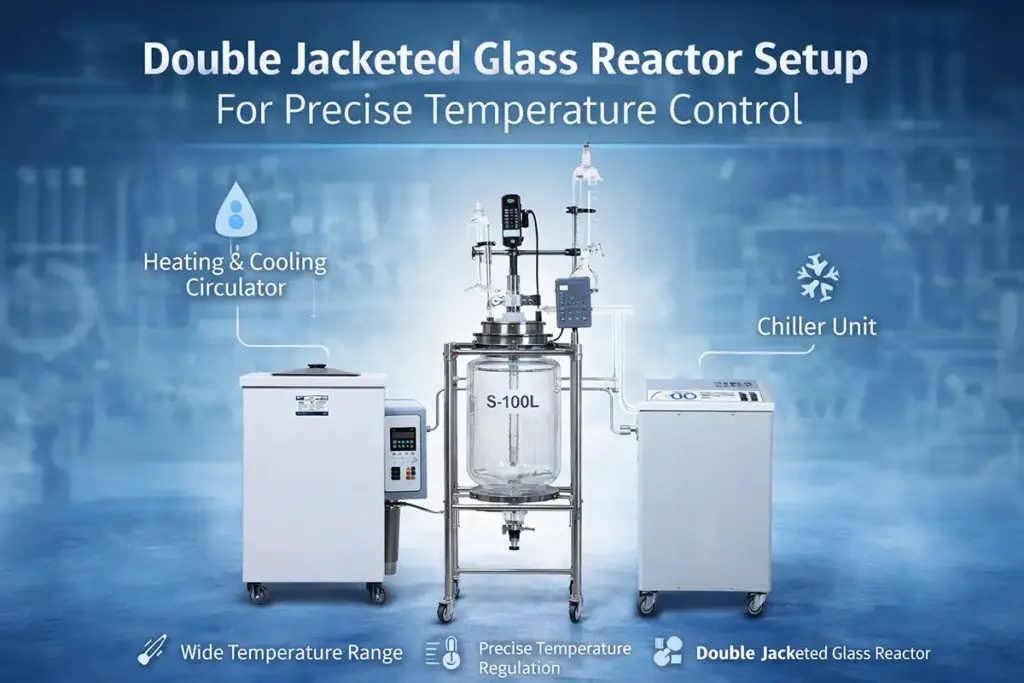
Image placeholder: typical lab setup (reactor + recirculating chiller/heater + temperature probe).
Where to go next (internal resources)
If a process involves solvent handling, post-processing, or scale-up planning, these related pages can help connect the workflow:
- Solvent handling after extraction: solvent recovery machine
- When higher temperature/pressure chemistry is required: high pressure autoclave reactor
- For robust metallic reactor alternatives: stainless steel chemical reactor
Bottom line: A double jacketed glass reactor can genuinely improve temperature precision and run-to-run stability for crystallization and extraction—mainly by enabling uniform heat transfer and controlled temperature ramps. For best results, treat temperature control as a system: jacket circulation, correct measurement, and consistent mixing all matter.