
Nano spray drying is attracting more attention because many laboratories and innovative manufacturers want better control over particle size, faster drying, and stronger product consistency. In simple words, the idea is to turn a small amount of liquid into a very fine dry powder with high efficiency and good repeatability. For pharmaceuticals, botanical extracts, food ingredients, advanced materials, and R&D samples, this matters a lot. A poorly controlled process can waste valuable raw material. A well-designed spray dryer can save time, protect product quality, and support future scale-up.What buyers usually want to know first
What does nano spray drying really mean in practical production?
In real purchasing conversations, the question is usually not about theory alone. The real concern is this: can the equipment create fine powder from a small feed volume while keeping temperature, droplet formation, and collection stable? From the author’s point of view, that is the most practical way to understand nano spray drying. It is about finer particle control, better use of valuable material, and dependable drying for products that cannot afford rough handling.
According to the U.S. Food and Drug Administration, particle size can strongly affect dissolution behavior, bioavailability, and product performance in drug-related applications. That is one reason why more laboratories are looking at advanced spray drying methods when working with sensitive or high-value compounds. For food and nutraceutical powders, particle size also influences flowability, solubility, and final texture.
A spray dryer does not dry one large pool of liquid. It breaks liquid into very small droplets, increases surface area, and removes moisture in seconds. That fast evaporation is the core advantage behind nano spray drying and other precision spray drying methods.
1.0–1.5 sAverage drying time on ZZKD compact models
±1℃Temperature control accuracy on LPG-3L
50 mLMinimum feed amount on SD-2L and LPG-3L
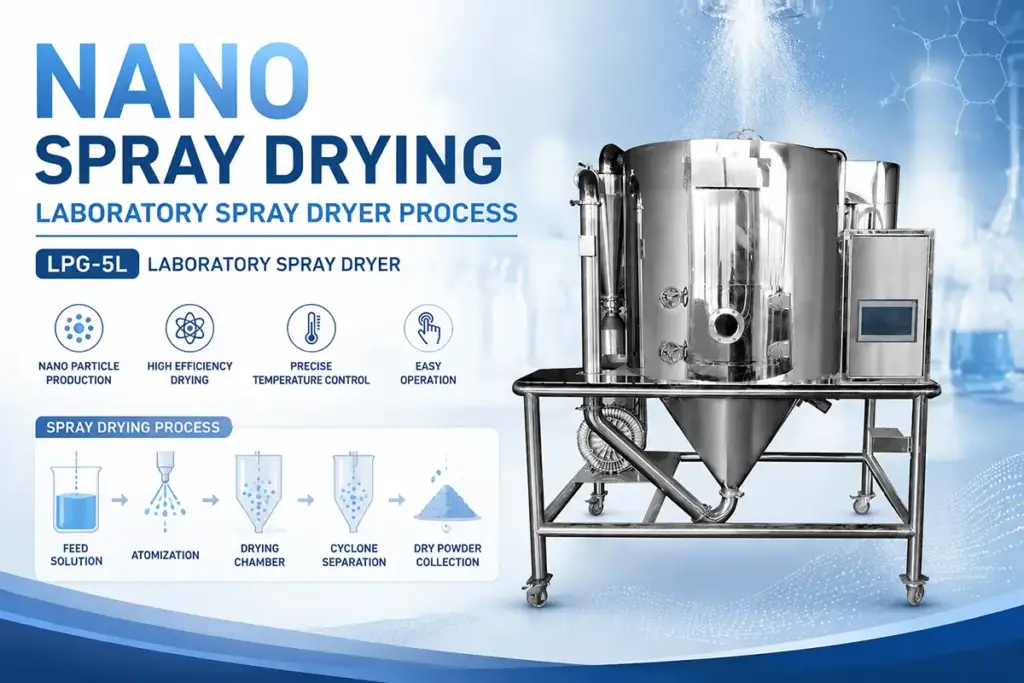
Process clarity
Why is spray drying still the smart choice for fine powder development?
Because it is fast, continuous, and easier to control than many traditional drying methods. According to the U.S. Department of Agriculture, spray drying has long been used for stable powder production such as milk powder because it removes moisture quickly and supports easier storage and handling. The same logic extends to plant extracts, proteins, flavors, ceramics, and specialty chemicals.
For labs that care about small-batch testing, another big advantage is low starting volume. ZZKD compact models such as the SD-2L and LPG-3L support a minimum feed amount of just 50 mL, which is very useful when raw material is expensive or limited. Buyers who want a broader understanding of powder formation can also review what a spray dried powder is and how different drying conditions affect results.
Could very hot inlet air damage fine powder products?
Not automatically. From the author’s perspective, the more useful value to watch is often the outlet temperature, not just the inlet setting. During evaporation, droplets cool themselves as moisture leaves. When feed rate, atomization, and airflow are balanced, even heat-sensitive materials can be dried effectively because residence time is very short.
That is why the parameter range matters more than a single number on a brochure. A practical lab spray dryer should allow meaningful testing, not just look impressive on paper.
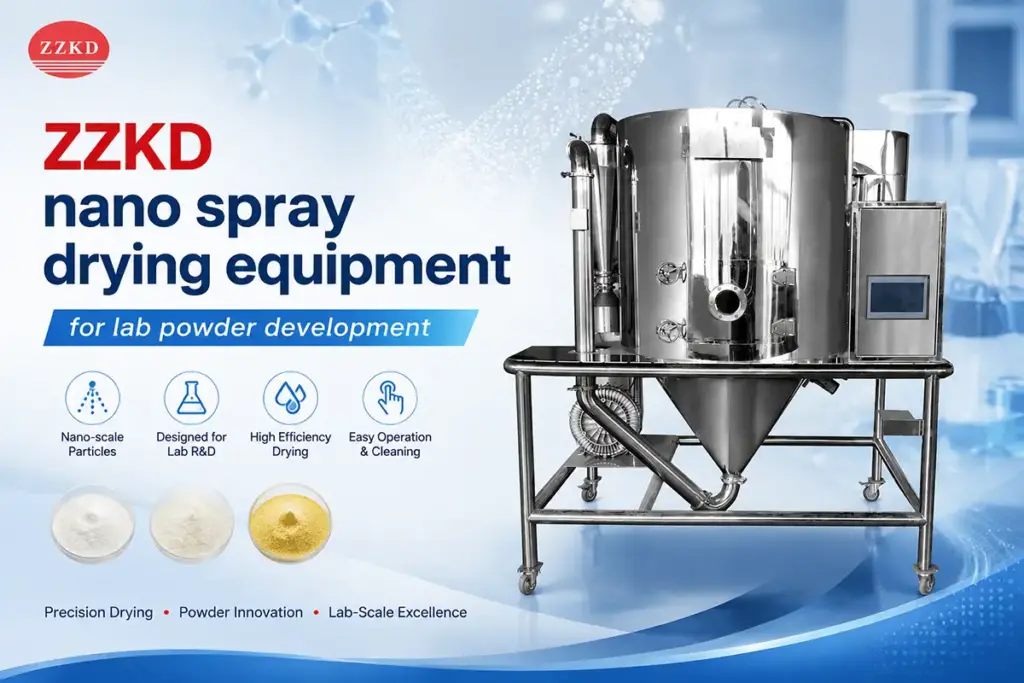
ZZKD equipment selection
Which ZZKD spray dryer fits small-scale and pilot-scale nano spray drying work?
Selection should start from real throughput, feed characteristics, and budget. Based on the provided parameters, ZZKD offers several clear options for users who need flexible testing and scale-up support.
| Model | Best for | Key parameters | Practical value |
|---|---|---|---|
| SD-2L | Early-stage trials, low sample consumption | Inlet 30–300℃, outlet 30–150℃, evaporation 1500–2000 mL/h, max feed 2000 mL/h | Good entry option for small sample development and routine lab powder screening |
| LPG-3L | Research with better temperature precision | Inlet 30–300℃, outlet 30–140℃, evaporation 1500–3000 mL/h, control accuracy ±1℃ | Better control for users who need more stable testing conditions |
| LPG-5L | Pilot verification and larger batches | Water evaporation about 6 L/h, inlet up to 330℃, outlet up to 140℃, 304 stainless steel | Stronger bridge from lab development to pilot production |
| LPG-10 | Expanded pilot and industrial preparation | Moisture evaporation up to 10 kg/h class data, centrifugal atomization category | Suitable when scale-up planning is already on the table |
For buyers comparing market prices, the supplied price sheet shows that a common 2L lab spray dryer market reference sits around $2,748. A 3L model often appears around $3,250. For 5L equipment with multiple prices, using the middle and relatively lower reference gives about $7,428. A 10L pilot spray dryer commonly appears around $9,000. These numbers are useful because they help separate serious equipment decisions from unrealistic offers.
If a more product-focused page is needed, related internal resources include the mini spray dryer, the lab spray dryer, and the broader process explanation on the spray drying process.Buying decision
What should be checked before choosing a nano spray drying system?
- Feed range: Is the liquid a solution, emulsion, or light suspension?
- Minimum sample size: Can expensive material be tested without wasting a large batch?
- Temperature range and control: Is the dryer flexible enough for sensitive products?
- Drying speed: Short drying time is important for many active ingredients.
- Atomization option: Nozzle or centrifugal style should match the material and target particle behavior.
- Scale-up path: Can the results from lab work move toward 5L or 10L production more smoothly?
Is the cheapest spray dryer always the best deal?
Usually not. From the author’s perspective, low price becomes expensive very quickly if powder yield is poor, cleaning is difficult, or testing data cannot be repeated. A better decision is to compare usable parameter range, stable control, support, and future scale-up value.
ZZKD stands out because the model range covers small lab work to pilot-scale verification, and the supplied specifications show practical operating windows rather than vague marketing language. That is important for buyers who need to answer real questions: how much feed can be handled, how fast can water be evaporated, and how precisely can temperature be controlled?
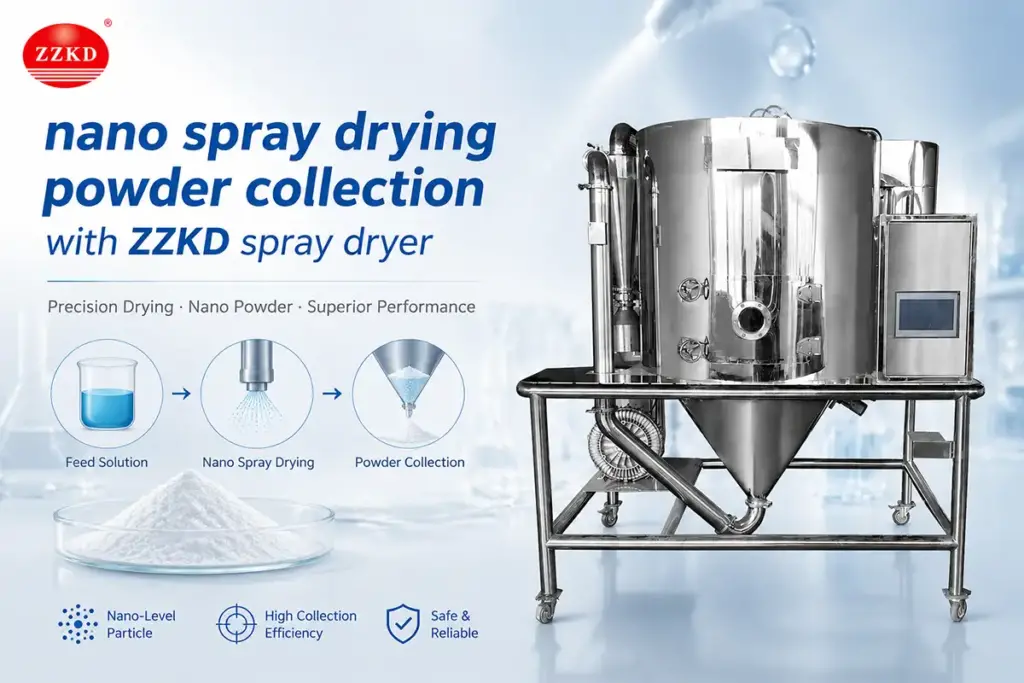
Final answer
Why choose ZZKD for nano spray drying promotion and purchasing?
Because buyers do not just want a machine name. They want a reliable path from liquid to powder, from small trial to pilot production, and from uncertain testing to repeatable results. ZZKD offers that path clearly. The SD-2L is suitable for early sample work. The LPG-3L adds tighter control. The LPG-5L supports larger pilot testing with about 6 L/h evaporation capacity. The 10L class supports the next step when development starts moving toward real production.
For labs, startups, universities, and manufacturers developing fine powders, nano spray drying is not just a technical phrase. It is a commercial advantage. Better particle control can improve solubility, product handling, and consistency. Lower sample consumption reduces development cost. Faster drying improves workflow. And a well-matched ZZKD spray dryer can help turn these benefits into measurable output.
If the goal is to buy equipment that is practical, scalable, and easier to justify internally, ZZKD is a strong choice. The data supports it, the model range supports it, and the cost references show it competes well in the market.
Nano spray drying becomes valuable when a machine gives precise control, low sample waste, stable operation, and a realistic scale-up path. That is exactly where ZZKD spray dryers create sales value and real processing value.