
A rotary evaporator (often called a “rotovap”) is one of the most efficient tools for gentle solvent removal and recovery in the lab and pilot plant.
Anyone working with organic synthesis, plant extraction, or solvent recycling will sooner or later ask: what is a rotary evaporator and why is it used so widely? This article explains the principle in plain language, shows real technical parameters, and helps decide which type of rotary evaporator fits a particular process.
In one sentence: a rotary evaporator is a device that uses vacuum, rotation, and controlled heating to rapidly and gently evaporate solvents, while allowing those solvents to be condensed and collected for reuse.
How a Rotary Evaporator Works – Without the Jargon
A complete answer to “what is a rotary evaporator” must start from the working principle. The core idea is to lower the boiling point of the solvent under vacuum and to increase evaporation surface area by rotating the flask.
The basic components are:
- Rotating evaporating flask – holds the solution and spins to form a thin film.
- Water or oil bath – gently heats the flask.
- Condenser – cools and condenses the solvent vapor.
- Receiving flask – collects the condensed solvent.
- Vacuum system – reduces pressure so the solvent boils at lower temperature.
- Lifting mechanism – moves the flask in and out of the heating bath.
When the vacuum is applied, the solvent in the rotating flask boils at a much lower temperature than at atmospheric pressure. This protects heat‑sensitive compounds while still removing large volumes of solvent quickly. According to a study by the University of Leeds on solvent evaporation in chemical laboratories, low‑pressure evaporation can shorten solvent removal time by more than 60% compared with open‑flask heating, while significantly reducing thermal degradation of target products.
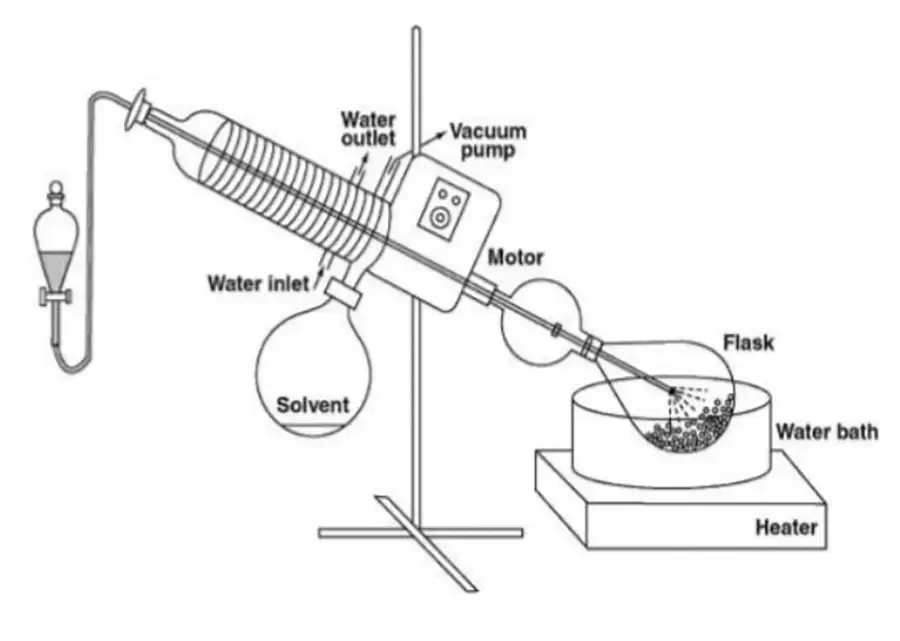
Typical layout of a rotary evaporator: rotating flask, heated bath, vertical condenser, and receiving flask under vacuum.
Can a rotary evaporator be used only for small laboratory samples?
Answer (author’s view): no. While benchtop models are common in research labs, industrial and pilot‑scale rotary evaporators can handle tens of liters per batch. For example, there are models with 10 L, 20 L, or even 50 L evaporating flasks designed for process scale‑up and solvent recovery in production environments.
Main Applications of a Rotary Evaporator
Understanding what a rotary evaporator is also means understanding where it is used. The most common applications include:
- Concentrating reaction mixtures after synthesis or work‑up.
- Solvent exchange – for example, switching from ethanol to hexane or water.
- Drying crude extracts in natural product or plant extraction workflows.
- Recycling organic solvents to reduce waste and cost.
- Preparing samples for chromatography, crystallization, or further purification.
According to an industry survey by the European Fine Chemicals Group, solvent use can account for up to 80–90% of total mass input in typical pharmaceutical synthesis steps. Efficient evaporation and solvent recovery using rotary evaporators and related solvent distillation units can therefore have a major impact on both environmental footprint and operating cost.
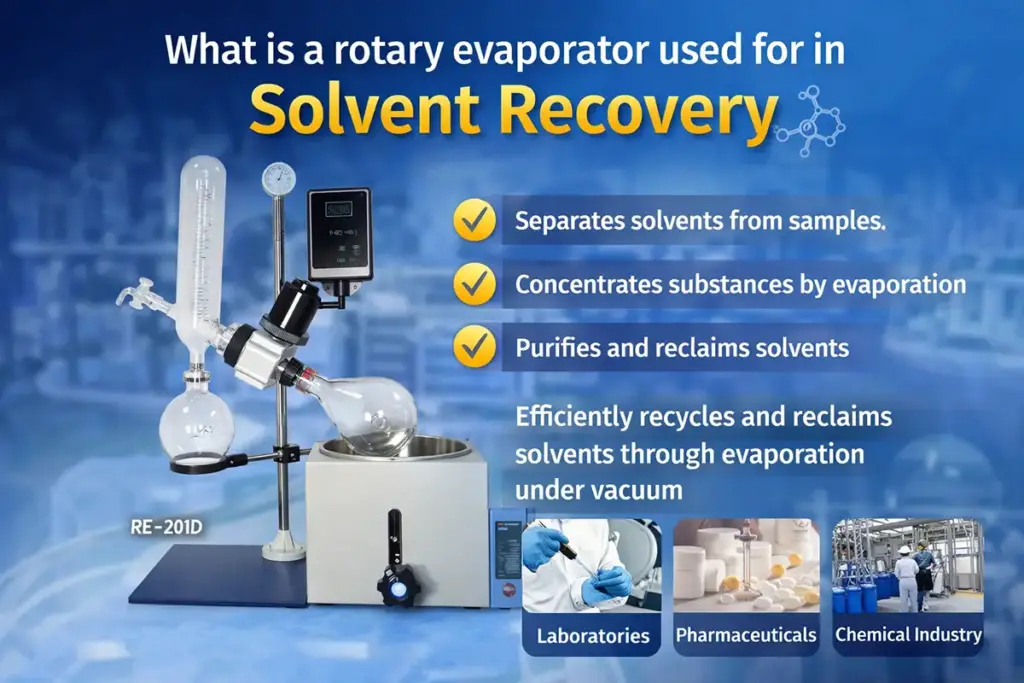
Rotary evaporators are widely used in chemical, pharmaceutical, food, and botanical extraction labs for solvent removal and reuse.
Key Technical Parameters – What Actually Matters
When deciding what rotary evaporator is suitable for a particular process, a few technical parameters are much more important than others. Below is a compact comparison of several representative models to illustrate the main factors.
| Model | Evap. Flask (L) | Receiving Flask (L) | Rotating Speed (rpm) | Bath Power (W) | Evap. Rate (H₂O) | Max Vacuum |
|---|---|---|---|---|---|---|
| RE‑201D | 2 | 1 | 0–120 | 1200 | > 1 L/h | < 133 Pa |
| RE‑301 | 3 | 2 | 0–120 | 1500 | > 1.5 L/h | < 133 Pa |
| RE‑501 | 5 | 3 | 0–120 | 1500 | > 1.5 L/h | < 133 Pa |
| RE‑1002 | 10 | 5 | 0–120 | 3000 | > 3 L/h | < 133 Pa |
| RE‑2002 | 20 | 10 | 0–90 | 5000 | > 5 L/h | < 133 Pa |
| RE‑5002 | 50 | 20 | 0–90 | 7000–9000 | > 9 L/h | < 133 Pa |
These values show how capacity and heating power scale up as moving from a benchtop 2 L unit to a 50 L pilot or production system. Several points are particularly important:
- Evaporating flask size – determines batch volume and is the first parameter to match with process scale.
- Evaporation rate – often given for water; organic solvents (like ethanol or acetone) can evaporate even faster under similar conditions.
- Maximum vacuum degree – values below 133 Pa (approx. 1.33 mbar) enable very low boiling temperatures, crucial for heat‑sensitive products.
- Temperature control range – many models offer room temperature to about 99–250 °C with ±1–2 °C stability.
For example, RE‑1002 and RE‑2002 systems combine large evaporating flasks (10–20 L) with evaporation rates above 3–5 L/h for water, making them suitable for pilot plant solvent recovery or for larger botanical extraction lines where throughput and stability are critical.
Is a stronger vacuum always better for rotary evaporation?
Not always. Stronger vacuum lowers the boiling point, but if the pressure is too low, some solvents may bump or freeze in the condenser. In practice, it is better to choose a system that can reach deep vacuum (for flexibility) and then adjust the working pressure to match the solvent and product stability. A controllable vacuum closer to the solvent’s optimal range is more important than simply chasing the lowest possible pressure.
From 5 L to 50 L and Beyond – Example R Series Layout
For users wondering what a rotary evaporator looks like at larger scale, the R‑series models provide a good reference, with capacities from 5 L to 50 L and features designed for more continuous and ergonomic operation.
- 5–50 L flask
- Electric lift
- Brushless motors (large models)
- Vertical double‑coil condenser
- Stainless steel water bath
| Model | Flask (L) | Speed (rpm) | Motor | Bath Size (mm) | Lift Type | Total Power (kW) |
|---|---|---|---|---|---|---|
| R1005 | 5 | 10–140 | 40 W | Φ300 × 170 | Electric | 2 |
| R1010 | 10 | 20–120 | 250 W (brush‑less) | Φ350 × 220 | Electric + hand | 3 |
| R1020 | 20 | 20–120 | 250 W (brush‑less) | Φ450 × 260 | Electric + hand | 4 |
| R1050 | 50 | 20–120 | 250 W (brush‑less) | Φ550 × 320 | Electric + hand | 4 (220–240 V) |
Image a long‑running extraction process where hundreds of liters of ethanol must be recovered every day. A 50 L R1050 rotary evaporator with high‑efficiency reflux condenser and electric lift offers a practical combination of throughput, energy efficiency, and safe operation. For users interested in continuous recovery from mixed solvent streams, it may be useful to combine such rotovaps with a dedicated short path distillation unit for final purification of high‑value fractions.
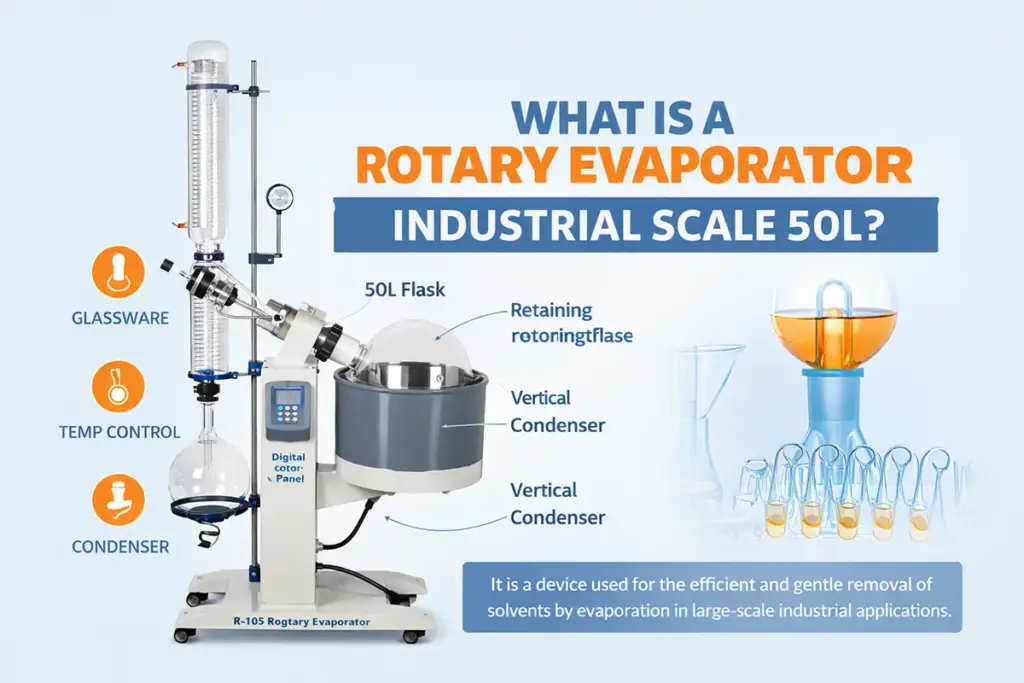
Large‑capacity rotary evaporator with electric lift and vertical reflux condenser for industrial and pilot plant use.
How to Choose the Right Rotary Evaporator
Having defined what a rotary evaporator is and seen some concrete parameters, the next step is choosing a model that fits a real‑world process. The following checklist summarizes the main decision points.
1. Required Batch Size and Evaporation Rate
Estimate the typical solvent volume per batch and desired turnaround time. For small R&D labs, a 2–5 L system is usually enough. For pilot and small production, 10–50 L is more common. Higher evaporation rates (L/h) translate directly into shorter cycle times.
2. Solvent Type and Boiling Point
Low‑boiling solvents like acetone or dichloromethane require less heating but careful vacuum control to avoid freezing in the condenser. High‑boiling or viscous mixtures can benefit from higher bath temperatures (for example, up to 180–200 °C in oil baths) and strong agitation. For large‑volume solvent recovery, it may be useful to look at dedicated solvent recycling machines working alongside rotary evaporators to reduce overall solvent consumption.
3. Temperature Control and Stability
Many modern rotary evaporators provide intelligent digital control from room temperature up to around 99 °C (water) or 250 °C (oil) with ±1–2 °C precision. For heat‑sensitive pharmaceuticals, natural products, or flavor/fragrance compounds, stable temperature control is critical to preserve product quality.
4. Vacuum Level and Control Strategy
Look not only at the maximum vacuum but at how easy it is to set and maintain a stable working pressure. A well‑designed system with PTFE and fluoro rubber sealing, as specified in many of the models above, helps sustain deep vacuum while resisting chemical attack from a wide range of solvents.
5. Safety and Ergonomics
Features such as electric lift, vertical condensers, and stainless‑steel guarded baths can significantly improve operator safety and reduce fatigue. For larger systems, consider whether the frame design allows easy access to glassware, valves, and receiving flasks for daily operation and cleaning.
For a new lab, is it better to start with a small rotary evaporator and later upgrade, or to buy a larger system from the beginning?
Answer (author’s view): if budget allows, it can save time and cost to choose a model slightly larger than the immediate need (for example, 5 L instead of 2 L). In practice, solvent volumes often grow as projects scale up. However, for teaching labs or very small‑scale work, a compact unit is more economical and easier to operate, and additional capacity can be added later with larger rotovaps or complementary solvent recovery equipment.
Summary: What Is a Rotary Evaporator in One Practical View?
A rotary evaporator is a vacuum‑assisted solvent removal and recovery tool that combines a rotating flask, heated bath, condenser, and receiving flask to evaporate solvents efficiently at low temperature. In everyday use it:
- Concentrates reaction mixtures and extracts gently.
- Removes and recovers large volumes of solvent with reduced energy use.
- Protects heat‑sensitive products by lowering boiling points under vacuum.
- Scales from small 2–5 L benchtop setups to 50 L pilot and industrial systems.
The specific choice of model depends mainly on batch size, solvent properties, desired evaporation rate, and the level of temperature and vacuum control needed. By matching these factors with the parameters discussed above, it becomes much easier to select a rotary evaporator that is safe, efficient, and ready for future scale‑up.
This article has focused on explaining what a rotary evaporator is in practical terms rather than theoretical detail. For processes where solvent purity, energy efficiency, or continuous operation are critical, rotary evaporators can be integrated with other technologies such as short path distillation units and dedicated solvent recyclers to build a complete, flexible solvent management system.