
Choosing the right spray drying equipment is not simply a matter of picking the highest temperature or the biggest evaporation number. For most buyers, the real question is much more practical: which machine can turn a liquid feed into stable powder with the right particle size, acceptable powder yield, and reasonable operating cost? That is exactly where many selection mistakes begin. A unit may look powerful on paper, but if the atomization method does not match the material, or if the powder collection system loses too much fine product, the final result can be disappointing.
Spray drying is widely used in pharmaceuticals, food, chemicals, ceramics, and research laboratories because it can dry liquids very quickly. According to the U.S. Department of Energy, industrial drying can account for around 10% to 15% of industrial energy use in developed economies, which shows why energy efficiency matters when selecting drying equipment. At the same time, powder quality and recovery rate are equally important, especially in laboratories and pilot production where feed materials may be expensive.
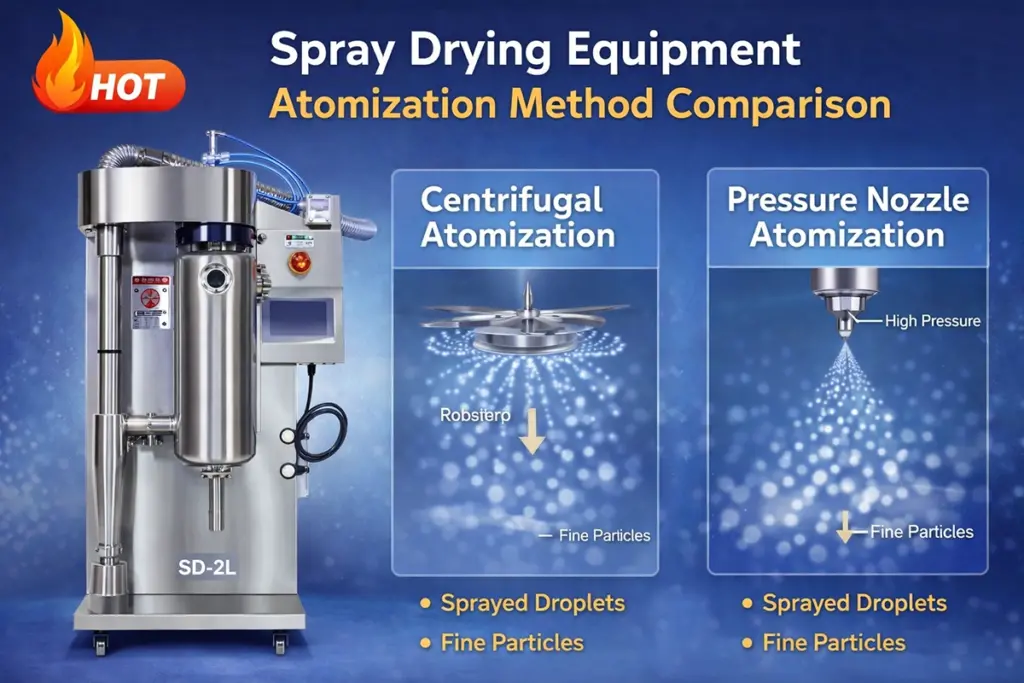
Start with the Atomization Method
The atomization system is the heart of spray drying equipment. It decides how the liquid is broken into droplets, and droplet size strongly affects drying speed, powder size, and flow behavior. In simple terms, smaller and more uniform droplets usually dry faster and produce more consistent powder.
There are two common choices in the provided equipment data: two-fluid nozzle atomization and centrifugal atomization.
For example, compact lab units such as the SD-2L and LPG-3L use nozzle-based atomization, with a standard nozzle diameter of 1.00 mm and optional sizes such as 0.7 mm, 1.5 mm, and 2.0 mm. This design is often suitable for lab testing, small-batch trials, and formula development because feed rate is easy to control with a peristaltic pump. The SD-2L supports feed up to 2000 mL/h, while the LPG-3L reaches up to 3000 mL/h. Both show an average drying time of 1.0 to 1.5 seconds, which is typical for fast evaporation in small spray dryers.
By comparison, the LPG-5L model uses centrifugal atomization, and the larger LPG-5 and LPG-10 data also point to centrifugal spray heads. This approach is often better for higher throughput, wider particle size adjustment, and some materials that need strong atomization under continuous operating conditions.
Which atomization method is better?
From the author’s point of view, there is no single best answer. Nozzle atomization is usually easier for laboratory work, small sample volumes, and flexible testing. Centrifugal atomization is often more suitable when larger evaporation capacity, stable continuous operation, or different particle structures are required. The best choice depends on viscosity, solids content, target particle size, and production scale.
If a better basic understanding of dried particles is needed before comparing machines, this related article may help: what is a spray dried powder.
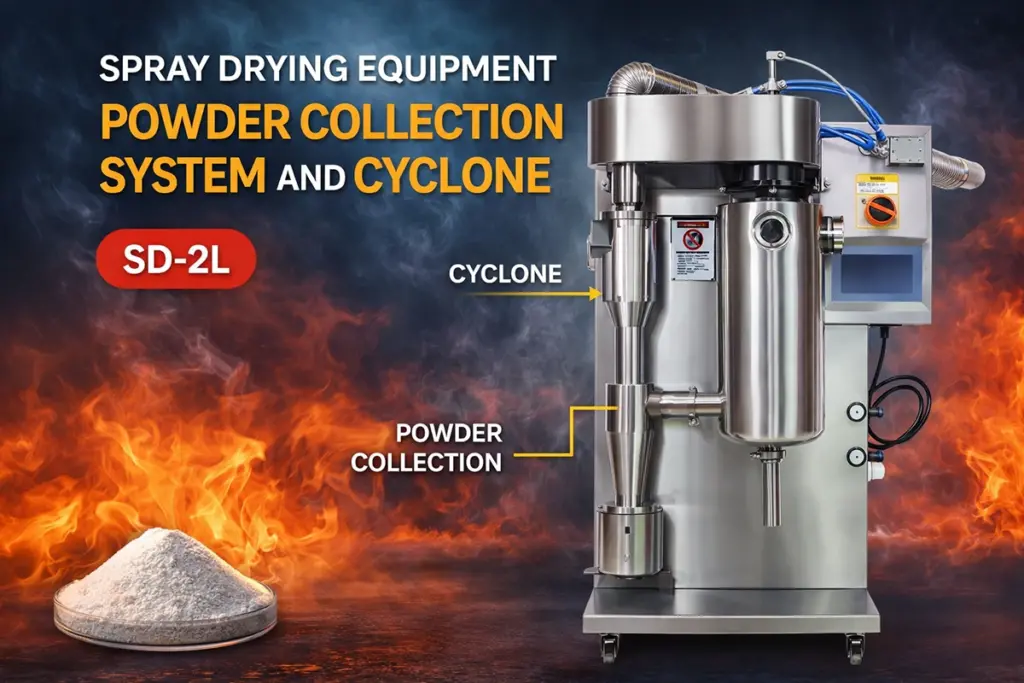
Do Not Ignore the Powder Collection System
Many buyers focus on inlet temperature and evaporation rate, but in real operation, powder collection can decide whether a project succeeds or fails. Fine powders are easy to lose if the collection system is poorly matched to the material. Sticky products may also adhere to the chamber wall, cyclone, or receiving bottle, which lowers yield and complicates cleaning.
A good collection system should help with three things: recovering as much powder as possible, separating fine particles efficiently, and making cleaning easy after each batch. In small spray drying equipment, cyclone separation is common because it is compact and practical. However, very fine or low-density powders may still escape, especially if the airflow is not well balanced.
Why does the same feed sometimes produce very different powder yields on two different machines?
The answer, in the author’s view, is usually a combination of droplet size, wall sticking, cyclone efficiency, and exhaust airflow. A machine with good atomization but weak collection design may still waste valuable product. That is why powder recovery should be discussed together with atomization, not separately.
For users handling heat-sensitive materials or small high-value samples, it is worth checking whether the equipment supports stable outlet temperature control and smooth powder discharge. For example, the LPG-3L lists outlet temperature control from 30°C to 140°C with ±1°C temperature accuracy. The SD-2L offers outlet control up to 150°C. Stable control helps reduce sticking caused by partly wet particles.
How to Compare Energy Use in a Practical Way
Energy consumption is one of the most misunderstood parts of buying spray drying equipment. Some buyers only compare total power, but that is not enough. A better way is to compare energy used per amount of evaporated water, while also considering the target process temperature and final powder quality.
Take the examples provided. The LPG-3L has a total power of 5 kW and an evaporated water capacity of 1500 to 3000 mL/h. The SD-2L uses a 3.5 kW electric heater, plus a 0.55 kW fan and a 1.2 kW air compressor, with evaporated water of 1500 to 2000 mL/h. This means buyers should not just ask which machine has lower installed power. The more useful question is which unit delivers the required evaporation and powder quality with the least wasted energy.
Research published by the International Energy Agency has repeatedly emphasized that thermal process efficiency depends not only on heater size but also on airflow control, insulation, heat transfer efficiency, and process matching. In spray dryers, poor matching between feed rate and hot air flow can waste energy very quickly.
The fan and compressor data are also important. The LPG-3L uses a 0.55 kW fan with 100 m³/h air volume and a 1.2 kW air compressor with 108 L/min gas production. The SD-2L lists a fan with 5.6 m³/min maximum air volume and compressed air pressure of 2 to 3 bar. These figures affect droplet formation, drying speed, and powder transport. A machine that looks efficient on heating power alone may still consume more overall energy if airflow or atomization is unstable.
Should the lowest-power spray dryer always be chosen to save cost?
The author’s answer is no. If lower power leads to slower drying, poor powder yield, or repeated trial failures, the real operating cost may be higher. A slightly more powerful but better-matched machine often gives better value over time.
Temperature Range Matters, but Only in Context
Inlet temperature range is often used as a headline specification, but it should be interpreted carefully. The LPG-3L and SD-2L both offer inlet air temperature control from 30°C to 300°C, while the LPG-5L reaches up to 330°C, and the LPG-5/LPG-10 sheet shows inlet temperatures up to 350°C. These numbers suggest flexibility, but a higher maximum temperature is not automatically better.
What matters is whether the machine can keep a stable outlet temperature and whether the material can tolerate the thermal conditions. Many heat-sensitive products are not exposed to high temperature for long because spray drying is very fast, but that does not mean every feed can safely use the same settings. Sensitive extracts, enzymes, flavors, or pharmaceutical ingredients still require careful testing.
Those wanting a broader process overview can also read understanding the spray drying process or explore common uses in different industries through application of spray dryer.
Capacity, Material Compatibility, and Cleaning
Another smart way to compare spray drying equipment is to look at whether the machine actually fits the material and site conditions. The LPG-5L is designed for solutions and some suspension liquids, with a host evaporation capacity of about 6 L/h, electrical heating, and 304 stainless steel construction. Stainless steel is a practical choice for many laboratory and pilot uses because it supports hygiene, corrosion resistance, and easier cleaning.
Physical size also matters. The SD-2L is relatively compact at 600 × 700 × 1200 mm, while the LPG-3L measures 800 × 800 × 1350 mm. The LPG-5L requires a larger indoor footprint of about 2.0 × 1.3 × 2.15 m. For some laboratories, installation space, power supply, and ceiling height are just as important as process specs.
A Simple Buying Logic for Better Decisions
To make the selection process easier, it helps to follow a clear order:
- Define the feed material: solution, suspension, viscosity, solids content, and heat sensitivity.
- Set the powder goal: particle size, moisture level, flowability, and yield.
- Match the atomization method: nozzle for flexible lab trials, centrifugal for larger and more continuous needs.
- Check the collection system: especially for sticky or fine powders.
- Compare real energy efficiency: not just total power, but evaporation performance and stability.
- Confirm practical conditions: voltage, footprint, cleaning, and maintenance.
In the end, good spray drying equipment is the equipment that fits the process, not just the brochure. Atomization determines droplet quality, the powder collection system influences actual recovery, and energy use affects long-term cost. When these three points are compared together, equipment selection becomes much clearer and much more reliable.
For laboratories, pilot plants, and production users alike, the most effective decision is usually not the most extreme machine, but the one that offers stable atomization, dependable powder collection, and sensible energy performance for the intended material. That is the combination that turns specifications into real results.