
Acetone is one of the most widely used organic solvents in industries such as electronics, coatings, pharmaceuticals, printing, laboratories, and metal cleaning. It evaporates quickly, dissolves many substances efficiently, and is often chosen for washing, degreasing, and process cleaning. But after use, acetone is rarely still clean. It may contain water, oil, resin, pigments, particles, or other mixed contaminants. This is why many companies start asking an important practical question: how can acetone recovery be made purer, and how much do those contaminants really change the final recycling result?
The short answer is simple. In solvent recycling acetone, purity depends not only on the machine itself, but also on what is inside the waste acetone before recovery begins. A good solvent recovery machine can recover a large portion of usable acetone, but water, oil, and other impurities can lower purity, slow down recovery, and reduce how well the recycled solvent performs in the next use cycle.
From the author’s perspective, this is the key point many buyers want clarified first: acetone can often be recycled very effectively, but not all waste acetone streams are equally easy to purify. Understanding the contamination type is what makes recovery results more predictable.
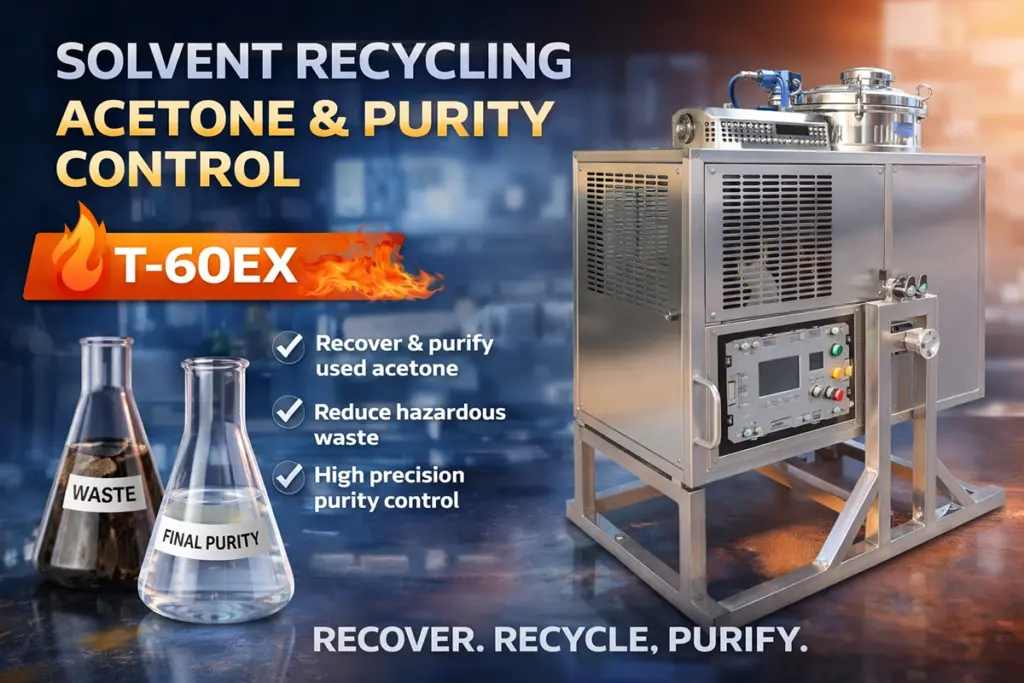
Why acetone purity matters after recovery
Not every recycled solvent must be laboratory-grade pure. In many factories, recovered acetone is reused for rough cleaning, pre-washing, equipment flushing, or similar process steps. In those cases, “clean enough for reuse” may be more important than “chemically perfect.” However, if recycled acetone is going back into precision cleaning, electronics, coatings, or sensitive chemical production, then purity matters much more.
According to the U.S. Environmental Protection Agency, solvent recovery can reduce hazardous waste generation and support source reduction strategies when reusable solvent is separated from contaminants before disposal. That means better recovery is not only about saving money on fresh solvent; it is also about reducing waste burden in a more controlled way.
Acetone has a boiling point of about 56°C, which makes it relatively easy to separate by distillation compared with heavier contaminants. According to the National Institute of Standards and Technology (NIST), acetone is a highly volatile solvent with well-documented physical properties, which is one reason it is so suitable for recovery by heating and condensation. But “easy to boil” does not automatically mean “easy to purify.” The challenge comes from the contamination.
How much does water affect acetone recovery?
Water is often one of the biggest reasons recovered acetone is less pure than expected. In real production environments, water may enter waste acetone from air humidity, washed parts, wet containers, process residues, or cleaning operations. Because acetone and water can mix, water does not simply stay at the bottom and wait to be removed easily in every case.
Does a small amount of water really matter that much? In the author’s view, yes—sometimes more than expected. If the recycled acetone is only being reused for basic cleaning, a small amount of water may be acceptable. But if the solvent is needed for fast drying, strong solvency, or moisture-sensitive work, even limited water content can noticeably reduce performance.
Water affects acetone recovery in several ways:
- It lowers the practical purity of the recovered solvent.
- It may change evaporation and drying behavior during reuse.
- It can reduce cleaning efficiency for oils, resins, or coatings.
- It may make the recovered acetone unsuitable for moisture-sensitive applications.
For example, in electronics or precision cleaning, excess water can leave slower-drying surfaces and inconsistent cleaning results. In coating-related processes, moisture may interfere with surface preparation or finish quality. So when people ask why recovered acetone is “not as strong as new solvent,” water contamination is often one of the first things worth checking.
How much does oil affect acetone recycling?
Oil is another very common contaminant, especially in metal cleaning, machinery maintenance, automotive parts washing, and industrial degreasing. Compared with acetone, oils usually have much higher boiling points, so they tend to remain in the residue during solvent distillation. This is actually good news, because it means a solvent recovery machine can often separate acetone from oil effectively.
However, that does not mean oil causes no problems. Heavy oil contamination can still influence the recovery process by increasing residue volume, slowing heat transfer, creating sticky deposits, and making the cleaning cycle inside the machine more demanding. If the waste acetone is loaded with grease, sludge, or tar-like material, the final acetone may recover in high percentage but the system will need better maintenance and more careful operating control.
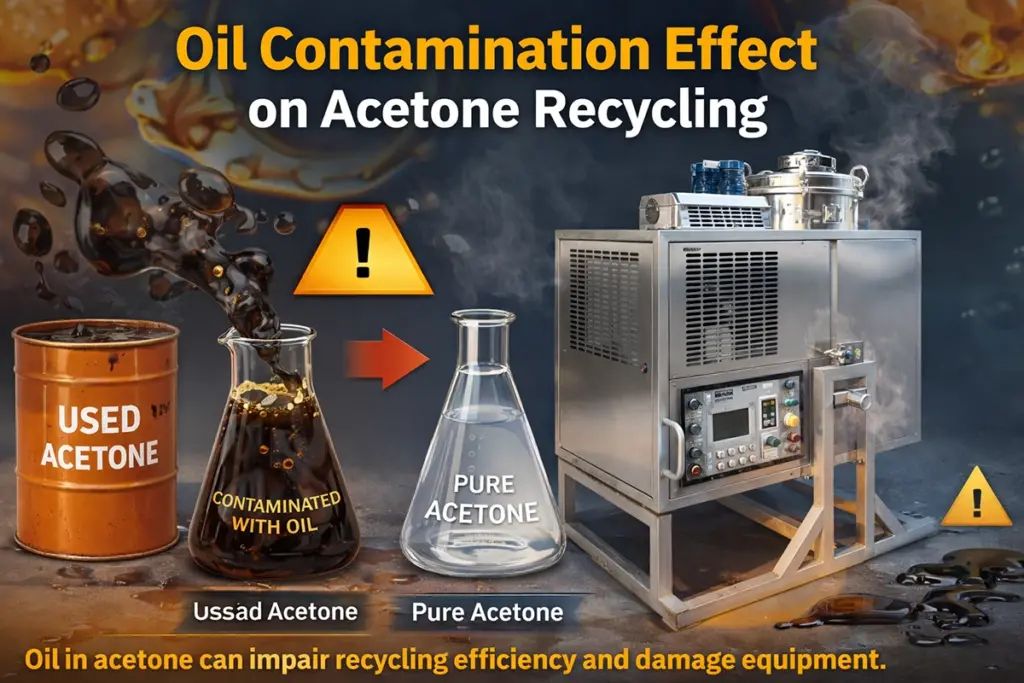
According to guidance from the Occupational Safety and Health Administration (OSHA), acetone is highly flammable and must be handled in properly designed systems with good safety controls. This is one reason explosion-proof solvent recovery equipment is so important when recycling acetone in industrial settings. When oil residues build up, safe and stable operation becomes just as important as solvent purity.
In the supplied equipment data, the explosion-proof solvent recovery machine series offers capacities from 20 L to 400 L, a temperature range from room temperature to 200°C, and a listed recovery rate of 95%. Models such as the T-20Ex, T-60Ex, T-80Ex, T-125Ex, T-250Ex, and T-400Ex allow users to match batch size to actual waste solvent volume. Treatment time ranges from 120 minutes to 270 minutes, depending on capacity. For acetone streams with oil contamination, choosing the right size helps keep operation efficient instead of overloading the unit.
What about solid particles, resin, and other impurities?
Besides water and oil, waste acetone often contains suspended solids, pigments, dust, adhesives, resin, ink, polymers, and process by-products. These materials usually do not distill with the acetone. Instead, they stay behind in the boiling tank as residue. In many cases, this is exactly how the purification works: acetone vapor leaves, heavy contaminants remain.
Still, the amount and type of impurity strongly affect the practical result. Fine solids may cause fouling. Resins may become sticky when heated. Some mixed contaminants may foam or produce unstable boiling behavior. If the waste stream is highly complex, the recovered acetone may still be reusable, but perhaps for lower-grade cleaning rather than sensitive production.
Can a solvent recovery machine remove every impurity completely? The author’s answer is no, not always. Distillation is very effective for separating acetone from many high-boiling contaminants, but it is not magic. If contaminants have similar volatility, if water content is high, or if the waste solvent mixture is chemically complex, purity may improve greatly without becoming perfect. The real goal should be matching recovered solvent quality to the intended reuse standard.
This is also why some users compare solvent recovery with other evaporation tools. In laboratory-scale solvent handling, a rotary evaporator is useful for controlled evaporation and solvent removal, but for industrial batches of contaminated waste acetone, a dedicated solvent recovery machine for sale is usually the more practical choice because it is built for repeated waste solvent processing and safer handling.
How to make acetone recovery purer in practice
If the goal is higher purity in solvent recycling acetone, several practical steps make a real difference:
1. Separate different waste streams
Do not mix lightly contaminated acetone with heavily polluted solvent if it can be avoided. A relatively clean waste stream is much easier to recover into a higher-purity product than a mixed stream full of water, oil, and solids.
2. Reduce water entry before recycling
Store waste acetone in sealed containers, avoid mixing with water-based cleaning residue, and keep wet parts from dripping into the solvent collection tank. Preventing water contamination is usually easier than removing it later.
3. Pre-filter large particles and sludge
Simple filtration before distillation can reduce fouling and improve operating stability. It will not remove dissolved water, but it can reduce sediment, paint particles, and solid debris that make recovery less efficient.
4. Match the machine capacity to the real workload
If a factory produces a moderate amount of waste acetone each day, a properly sized machine often works better than a very large unit running half empty. Capacity options such as 20 L, 60 L, 80 L, 125 L, 250 L, and 400 L make it easier to fit the process to actual solvent generation. Users looking at complete solvent recovery equipment options should compare not only size, but also contamination level, cycle frequency, and safety needs.
5. Know the reuse requirement before setting the purity target
If the recovered acetone will only be used for first-stage rough cleaning, a little residual impurity may be acceptable. If it must return to precision production, then tighter quality control is needed. This avoids unrealistic expectations and helps determine whether one recovery stage is enough.
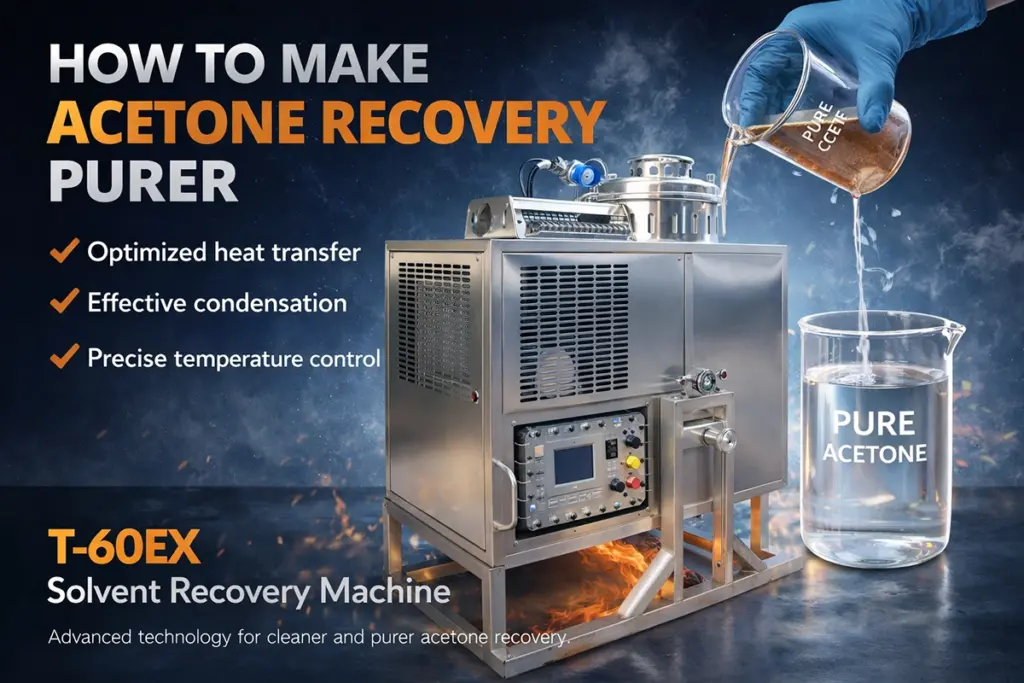
What results can users realistically expect?
For many common industrial applications, acetone contaminated mainly with oil, resin, paint solids, ink residue, or particles can be recovered successfully and reused. When contamination is dominated by high-boiling impurities, distillation works especially well. The more difficult case is acetone with significant water or mixed volatile contaminants, because these can reduce purity more directly.
In other words, the answer most users want is this: water usually has the strongest direct effect on recovered acetone purity, oil mainly affects residue load and process cleanliness, and solid impurities mostly affect maintenance and residue handling. Each matters, but they do not affect recovery in exactly the same way.
According to the supplied machine parameters, the listed solvent recovery systems are designed for 95% recovery, with explosion-proof configurations suitable for demanding industrial environments. That does not mean every recovered acetone batch will have the same final purity, but it does show that a large proportion of usable solvent can be brought back into the production cycle when the waste stream is managed well.
Final answer: what most buyers really want to know
If the main question is whether acetone can be recycled into a purer, reusable solvent, the answer is yes in many cases. If the real question is what most strongly reduces recovery quality, then the answer is usually water first, then mixed volatile contamination, while oil and solids are often easier to leave behind through distillation.
From the author’s point of view, the smartest approach is not to expect the machine alone to solve every purity issue. Better results come from combining the right solvent recovery machine with better waste stream separation, lower water contamination, routine residue cleaning, and a clear reuse standard. That is how solvent recycling acetone becomes not just possible, but practical, economical, and reliable.