
If the goal is to learn how to use a rotovap in a simple and practical way, the good news is that the process is not as complicated as it may seem at first. A rotovap, also called a rotary evaporator, is one of the most common pieces of equipment used in chemical laboratories, pharmaceutical labs, botanical extraction, and solvent recovery systems. Its job is to remove solvents quickly and gently under reduced pressure, which helps protect heat-sensitive materials and improve recovery efficiency.
At ZZKD, rotary evaporators are designed for both lab-scale and pilot-scale applications. Small models such as the RE-201D, RE-301, and RE-501 are suitable for routine laboratory work, while larger systems such as RE-1002, RE-2002, RE-5002, and the R series are better for higher processing volumes. Based on the provided price list, entry-level small rotary evaporator options can start at about $500, 5L models are commonly around $920, 10L units around $1,818, 20L units around $2,200, and 50L models around $2,800, depending on the configuration.
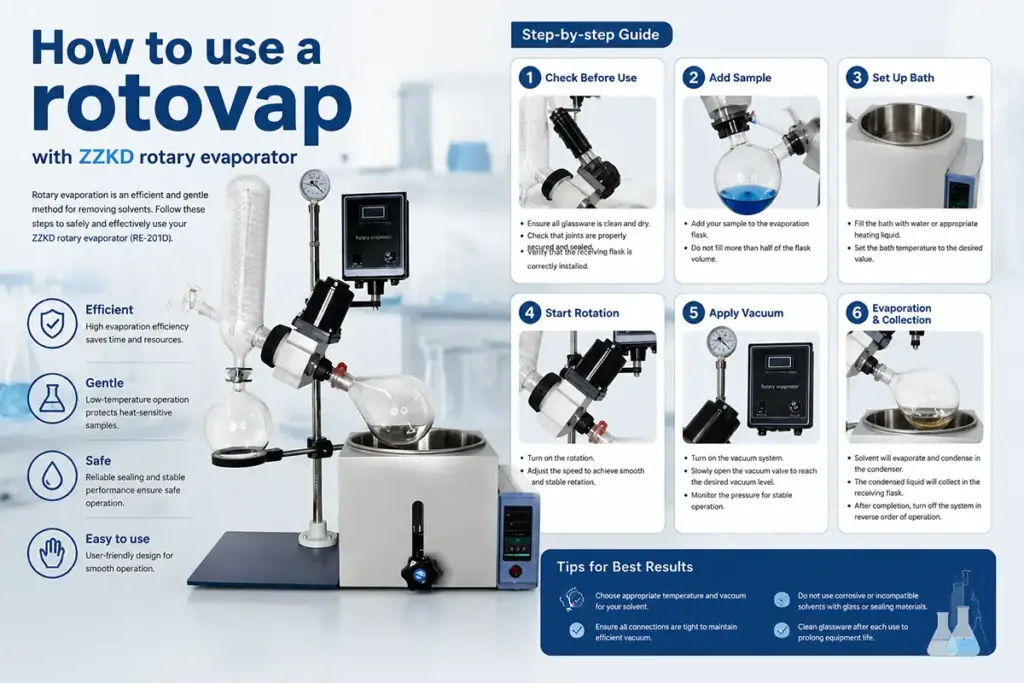
What Does a Rotovap Actually Do?
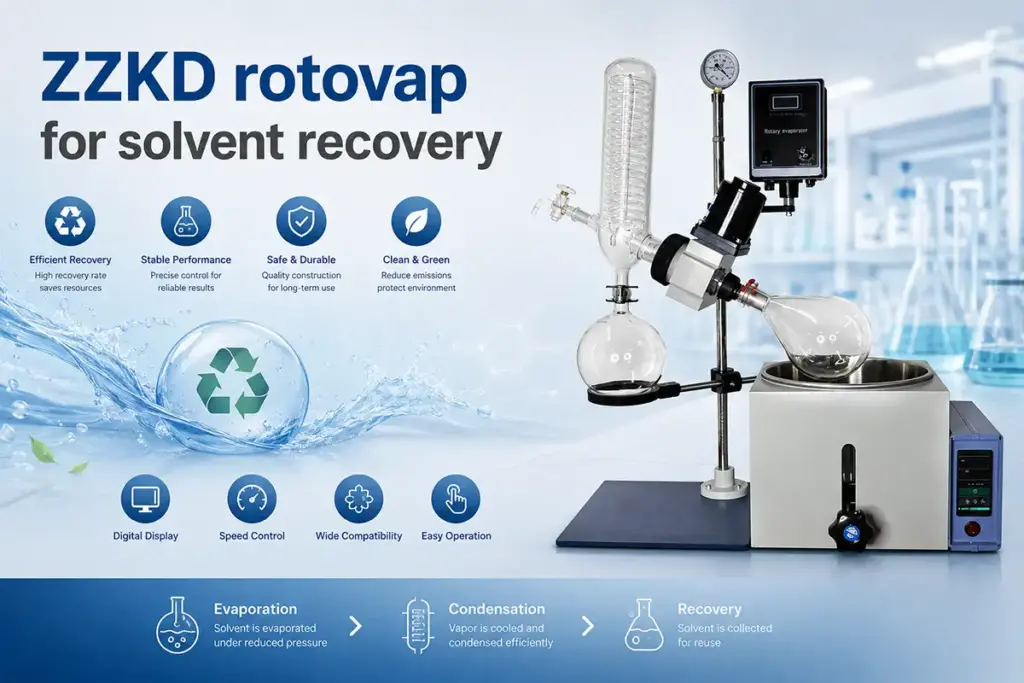
A rotovap works by combining four important factors: rotation, heating, vacuum, and condensation. The sample flask rotates to create a thin film of liquid, which increases surface area and speeds up evaporation. The heating bath gently warms the flask. The vacuum lowers the boiling point of the solvent. Then the vapor travels to the condenser, where it cools and collects in the receiving flask.
According to the National Center for Biotechnology Information (NCBI), vacuum evaporation is widely used in laboratories because lowering pressure can significantly reduce solvent boiling temperatures, which helps preserve heat-sensitive compounds during concentration and solvent recovery. This is one reason why the rotary evaporator has become a standard tool across modern laboratories.
Why is vacuum so important in a rotary evaporator?
Vacuum reduces the boiling point of the solvent, so evaporation can happen at a lower temperature. From the author’s point of view, this is one of the biggest advantages of a rotovap because it improves efficiency while reducing thermal damage to valuable samples.
Step-by-Step: How to Use a Rotovap
1. Check the Equipment Before Starting
Before operation, confirm that the glassware is clean, dry, and free from cracks. Make sure the evaporating flask, receiving flask, condenser, and sealing parts are installed correctly. Check whether cooling water or a recirculating chiller is connected and flowing properly. Also verify that the vacuum pump is working normally.
If a complete system is being selected, it is helpful to review a full rotary evaporator machine setup to understand the relationship between the main unit, condenser, vacuum source, and temperature control accessories.
2. Fill the Heating Bath
Fill the water bath or oil bath to the recommended level. For most common solvents, a water bath is enough. For higher temperature applications, an oil bath may be needed. ZZKD small models such as RE-201D, RE-301, and RE-501 offer intelligent digital temperature control up to 399℃, while larger RE-1002, RE-2002, and RE-5002 systems support stable temperature operation with low fluctuation.
Do not overheat the bath. The correct temperature depends on the solvent. A lower temperature combined with proper vacuum usually gives the best result.
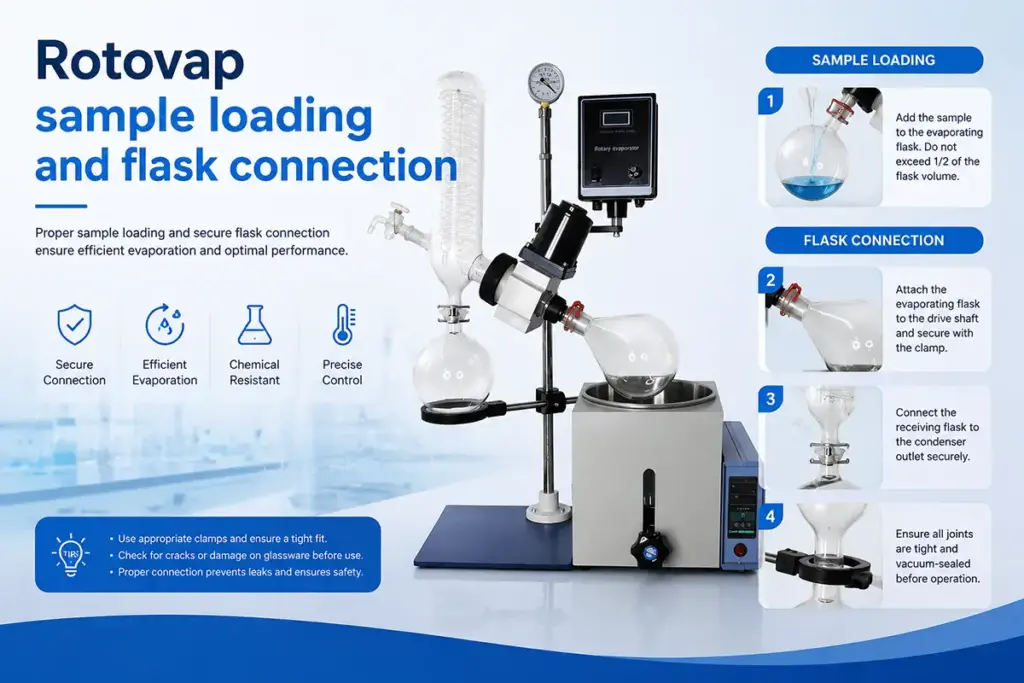
3. Load the Sample Correctly
Pour the sample into the evaporating flask, but never fill it too full. A good rule is to keep the flask below half full to reduce bumping and splashing. Then attach the flask securely to the vapor tube.
4. Start Rotation First
Turn on the motor and begin rotation before applying strong vacuum. Rotation spreads the liquid into a thin film and improves heat transfer. For small ZZKD units like RE-201D, RE-301, and RE-501, the rotating speed is typically 0–120 rpm. R-series equipment can reach 10–140 rpm depending on model.
5. Apply Vacuum Slowly
Lower the pressure gradually rather than all at once. This helps prevent sudden boiling, bumping, or sample loss. Once evaporation begins smoothly, adjust the vacuum until the solvent distills at a controlled rate.
What is one of the most common mistakes when learning how to use a rotovap?
Applying vacuum too quickly is a very common mistake. In the author’s experience, slow vacuum adjustment is one of the easiest ways to protect the sample, reduce bumping, and keep the operation stable.
6. Lower the Flask Into the Bath
Once rotation and vacuum are stable, lower the evaporating flask into the heated bath. Small ZZKD models provide lifting ranges up to 150 mm, while larger systems offer lifting heights up to 220 mm. This allows smooth positioning during operation.
7. Watch the Condensation and Collection
The solvent vapor should condense efficiently and drip into the receiving flask. If condensation looks weak, cooling may be insufficient. In that case, a suitable recirculating chiller heater can improve condensation efficiency and overall solvent recovery, especially in high-throughput or low-boiling solvent applications.
8. Finish the Run Safely
When evaporation is complete, remove the flask from the bath first, then slowly release the vacuum, and only after that stop rotation. This order matters. It reduces the risk of backflow, pressure shock, or sample contamination.
How to Choose the Right Rotovap Size
Choosing the correct equipment depends on flask volume, expected evaporation rate, and daily throughput. For example:
- RE-201D (2L): compact lab work, evaporation rate >1 L/h water, economical option around $500 to $600.
- RE-301 (3L) and RE-501 (5L): small-scale research and sample prep, with up to 120 rpm rotation.
- RE-1002 (10L): evaporation rate >3 L/h, a practical pilot-scale step, commonly around $1,818.
- RE-2002 (20L): evaporation rate >5 L/h, suitable for larger solvent recovery workloads, commonly around $2,200.
- RE-5002 (50L): evaporation rate >9 L/h, ideal for pilot production or industrial-scale lab processing, often around $2,800.
For users handling larger solvent volumes, it may also be useful to compare related solvent recovery equipment when planning a complete evaporation and recycling line.
How Efficient Is a Modern Rotary Evaporator?
Efficiency depends on solvent type, vacuum stability, condenser performance, bath temperature, and flask size. Based on the technical parameters provided, ZZKD systems cover a broad operating range from small 2L units to 50L production-capable models. Maximum vacuum performance on several models reaches below 133 Pa, which is equivalent to about 1.33 mbar or 1 Torr. This deep vacuum capability can greatly improve low-temperature evaporation efficiency.
According to the U.S. Environmental Protection Agency (EPA), solvent recovery and reuse can help reduce hazardous waste generation and lower raw material consumption in industrial and laboratory processes. That is exactly why many labs invest in dependable rotary evaporator systems: faster concentration is important, but solvent savings and waste reduction are equally valuable.
Practical Tips for Better Rotovap Results
- Use the right bath temperature for the solvent instead of simply choosing the highest temperature.
- Apply vacuum gradually to avoid bumping.
- Do not overfill the flask.
- Make sure cooling is strong enough for the solvent being removed.
- Keep seals clean and in good condition to maintain vacuum performance.
- Choose the correct flask volume based on batch size and expected evaporation rate.
Is a larger rotary evaporator always the better choice?
Not always. From the author’s perspective, the best choice is the model that matches actual batch volume and workflow. A unit that is too large may waste space and energy, while a unit that is too small may slow production.
Why Many Buyers Choose ZZKD Rotary Evaporators
ZZKD offers a broad range of rotary evaporators for education, research, extraction, distillation, and solvent recovery. The product range includes economical bench-top models, electric lift configurations, vertical double condensers, and large-capacity systems for pilot operations. Key features across the lineup include digital temperature control, stable rotation, PTFE and fluoro rubber sealing, and practical lift functions for easy operation.
For buyers searching online for how to use a rotovap, the real intention is usually not just learning the steps. The deeper question is often this: which equipment is easy to operate, stable under vacuum, and suitable for the real workload? That is exactly where ZZKD rotary evaporators provide value—practical design, multiple capacity options, and competitive pricing for both laboratory and pilot-scale use.
Conclusion
Understanding how to use a rotovap becomes much easier once the operating logic is clear: rotate the flask, apply gentle heat, reduce pressure, condense the solvent, and collect it safely. With correct setup and careful adjustment, a rotary evaporator can deliver fast, gentle, and repeatable solvent removal. Whether the need is a compact 2L unit for routine lab work or a 50L system for larger-scale recovery, ZZKD offers reliable rotary evaporator solutions to support efficient evaporation and better process control.