
Finding the right spray drying manufacturer is not only about comparing prices or checking basic brochures. For many buyers, the real concern is simple: can the equipment deliver the required output, recover enough powder to avoid waste, and meet the hygiene standard needed for food, pharmaceutical, chemical, or research use? These three points directly affect product quality, operating cost, and long-term reliability.
In practical purchasing decisions, many problems appear after installation rather than before purchase. A machine may look powerful on paper, but if evaporation capacity is too low, the feed rate becomes unstable, or powder sticks to the chamber walls, actual production performance can fall short. That is why it is important to evaluate a supplier with clear technical questions instead of general promises.
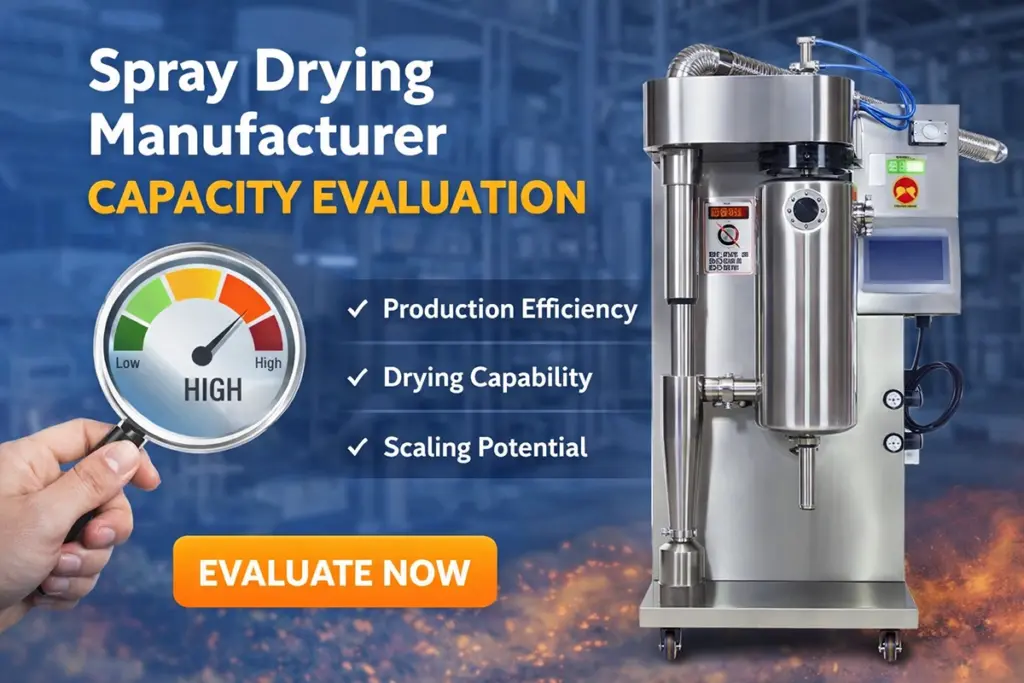
1. Start with Actual Capacity, Not Just Model Size
When discussing capacity, the first number to examine is water evaporation rate, because this is one of the clearest indicators of how much liquid feed a spray dryer can handle. For example, the provided lab-scale models show different working ranges:
- SD-2L: evaporated water 1500mL/h to 2000mL/h
- LPG-3L: evaporated water 1500mL/h to 3000mL/h
- LPG-5L: max water evaporation capacity about 6L/h
These figures show that capacity should be matched to the real feed characteristics, not only to the product name. A solution with low solids and high moisture load needs more evaporation ability than a denser formulation. If a project requires stable continuous testing or pilot-scale verification, a larger model with stronger evaporation performance will usually provide more safety margin.
Is a higher feed rate always better?
Not necessarily. A high feed rate only works well when the heater, airflow, atomization system, and outlet temperature control can keep up. If feed enters faster than moisture can be removed, powder may become sticky, wet, or inconsistent. In real evaluation, balanced drying performance matters more than an aggressive feed number.
Temperature range is another key part of capacity assessment. The machines listed here offer inlet air temperature control from 30°C to 300°C for SD-2L and LPG-3L, and up to 330°C for LPG-5L. This matters because a wider inlet temperature range gives more flexibility for drying heat-sensitive extracts, food ingredients, ceramics, or chemical solutions. Outlet temperature control also matters because it reflects actual thermal conditions at the end of drying. Stable outlet control helps indicate whether the system is truly removing moisture effectively.
According to the U.S. Department of Energy, drying operations can account for as much as 10% to 15% of industrial energy use in some sectors, which means inefficient drying capacity does not just slow production; it can also increase long-term operating cost. For that reason, a reliable spray drying manufacturer should explain how heater power, fan performance, atomization method, and evaporation rate work together.
For readers who want a basic introduction to the material form produced by this process, this page about what spray dried powder is is a helpful reference.
2. Powder Yield Is the Real Test of Process Efficiency
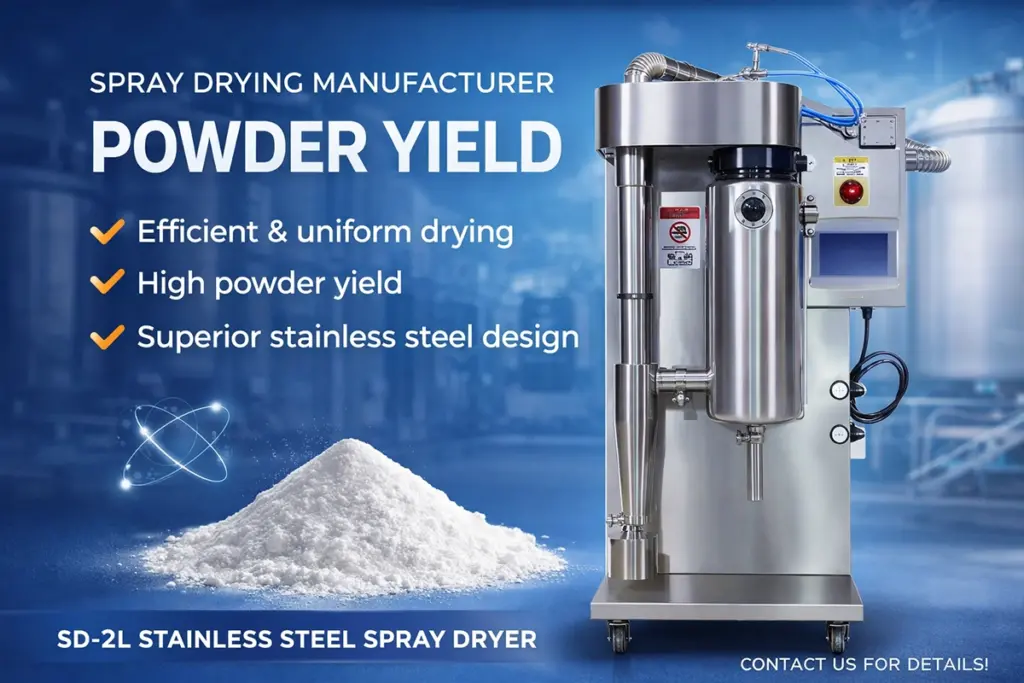
Many buyers focus on temperature and feed rate, but powder yield often has a stronger effect on cost. Powder yield refers to how much dried powder is actually collected compared with how much solid material entered the system. A dryer can operate normally and still have poor yield if powder sticks to the drying chamber, cyclone separator, or pipeline.
In lab and pilot applications, yield is closely linked to atomization quality and drying time. The data provided for SD-2L and LPG-3L show an average drying time of 1.0 to 1.5 seconds. This fast drying speed is one of the main advantages of spray drying, because it reduces heat exposure while helping droplets turn into powder quickly. However, quick drying alone does not guarantee good collection. The nozzle design, chamber geometry, airflow, and cyclone efficiency must also be properly matched.
When evaluating a supplier, it is useful to ask for test data on materials similar to the planned product. Sticky products such as plant extracts, sugars, proteins, or some ceramic slurries often behave very differently from simple water-based solutions. If a manufacturer cannot explain likely yield ranges for different materials, the risk of trial-and-error after purchase becomes much higher.
What usually causes low powder yield in a spray dryer?
In most cases, the main reasons are incomplete drying, poor atomization, wall sticking, or inefficient cyclone separation. Sometimes the machine is not the only issue; the feed formulation may also need adjustment. But a capable manufacturer should be able to identify whether the problem comes from the process settings or the equipment design.
Nozzle options are also worth reviewing. For example, LPG-3L offers a standard 1.00mm nozzle with optional 0.7, 1.5, and 2.0mm sizes. This is important because droplet size strongly influences drying behavior and final powder characteristics. A supplier that offers adjustable nozzle choices and explains how they affect yield usually has stronger technical support ability.
The atomization method also matters. LPG-5L is described as using centrifugal atomization, while smaller units rely on nozzle-based feeding with peristaltic pump adjustment. Different materials may perform better with one method than another. This is exactly why a good spray drying manufacturer should not recommend the same configuration for every project.
If a broader overview of working principles is needed, readers can also visit this explanation of the spray drying process.
3. Hygiene Level Should Be Judged by Design Details
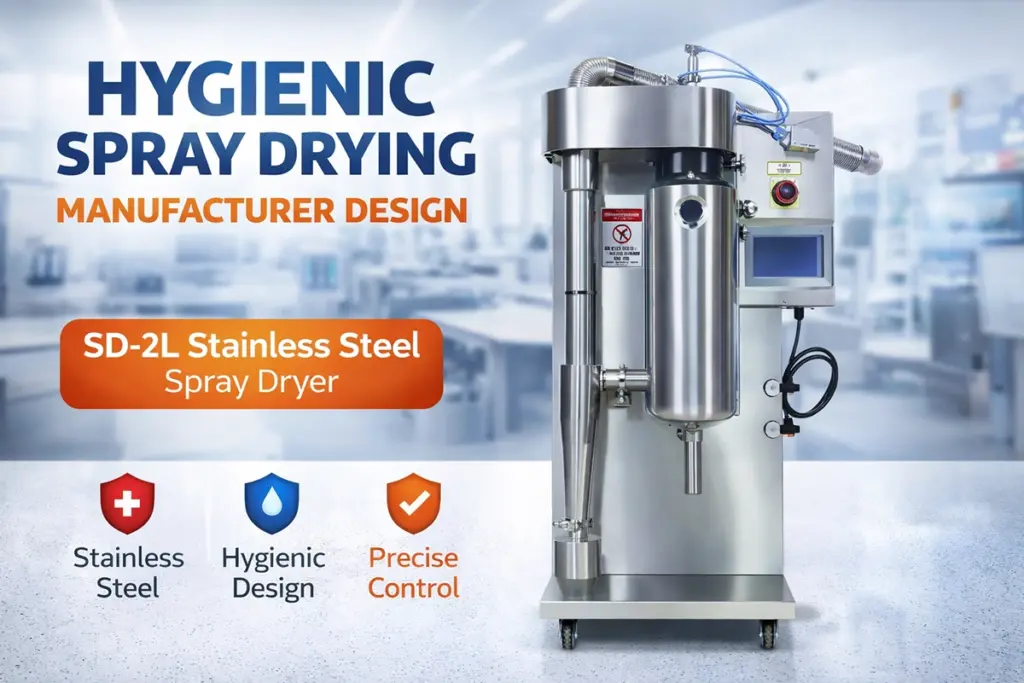
For food, pharmaceutical, nutraceutical, and some fine chemical applications, hygiene level is not a minor detail. It directly affects contamination risk, cleaning difficulty, and validation workload. The material listed for LPG-5L is 304 stainless steel, which is a common and practical choice for hygienic equipment. Stainless steel surfaces are easier to clean and more resistant to corrosion than many ordinary materials.
But hygiene is not determined by stainless steel alone. A real assessment should also include:
- Whether product-contact parts are smooth and easy to clean
- Whether dead corners are minimized
- Whether the feed line and atomization section can be disassembled easily
- Whether seals, joints, and collection bottles prevent leakage and contamination
- Whether the system supports quick cleaning between batches
According to the U.S. Food and Drug Administration, sanitary equipment design should reduce contamination risk by allowing effective cleaning and minimizing product hold-up areas. In simple terms, even a powerful dryer can become a poor choice if residue remains in hidden corners and affects the next batch.
If a machine is made of stainless steel, does that automatically mean it meets a hygienic standard?
No. Stainless steel is only the starting point. Hygienic performance depends on the whole structure, including weld quality, internal surface finish, sealing, drainage, and cleanability. A machine can use stainless steel and still be difficult to clean well.
For example, a compact lab unit with a small footprint may be attractive, but if disassembly is inconvenient, cleaning time may become a hidden cost. The right supplier should be willing to show chamber layout, collection design, and cleaning steps clearly.
4. Look at Supporting Parameters That Affect Daily Use
Several other details in the provided specifications help buyers judge whether a machine will be practical in daily operation. For example:
- LPG-3L temperature control accuracy: ±1°C
- SD-2L heater power: 3.5KW AC220V
- LPG-3L total power: 5KW / 220V
- LPG-5L working voltage: 380V, 50–60Hz
- Feed method on smaller models: peristaltic pump adjustment
These numbers may seem secondary, but they influence installation and operating stability. A machine that matches local power conditions and allows accurate temperature control is easier to integrate into a lab or pilot environment. Fan air volume, compressor output, and pressure also affect droplet drying and collection efficiency.
Buyers who are comparing equipment applications may also benefit from reading common uses of spray dryer systems to better match machine size with expected production tasks.
5. What Should Be Asked Before Choosing a Spray Drying Manufacturer?
To make a practical decision, the following questions are more useful than asking only for a quotation:
- What is the actual evaporation capacity under working conditions similar to the intended material?
- What powder recovery rate has been achieved with similar products?
- What material is used for product-contact parts, and how is cleaning handled?
- What atomization method is recommended and why?
- Can the supplier provide test support, sample trials, or parameter recommendations?
A trustworthy spray drying manufacturer should answer these clearly and with technical logic. Good cooperation usually begins when the supplier understands the product itself, not just the machine model.
Conclusion
When choosing a spray drying partner, the key points are not complicated, but they must be checked carefully. Capacity should be judged by evaporation ability, temperature range, and system balance. Powder yield should be evaluated through real collection performance, atomization quality, and suitability for the specific material. Hygiene level should be examined through stainless steel construction, cleanable design, and contamination control details.
In short, a good machine is not simply the one with the largest number on a brochure. The better choice is the one that can dry the intended feed stably, recover powder efficiently, and keep the process clean and reliable. That is the standard worth using when selecting a long-term spray drying manufacturer.