
Centrifugal spray drying is one of the fastest and most practical ways to turn liquid materials into uniform powder. For laboratories, pilot plants, food developers, pharmaceutical researchers, and chemical manufacturers, the real question is not only how the process works, but which machine can deliver stable powder quality, easy operation, and a reasonable return on investment. That is where ZZKD spray dryers stand out.
Instead of looking at confusing technical terms only, this page focuses on the answers buyers usually want first: what centrifugal spray drying does, what capacity is suitable, what price range is realistic, and how to pick a model without wasting budget.
What Is Centrifugal Spray Drying and Why Is It So Popular?
Centrifugal spray drying is a drying process that uses a high-speed rotating atomizer or centrifugal spray head to break liquid feed into tiny droplets. These droplets meet hot air inside the drying chamber and lose moisture almost instantly, leaving dry powder behind. Because the droplets are very small and the contact time is short, the whole process is efficient and suitable for many heat-sensitive materials.
This is why centrifugal spray drying is widely used for milk powder, coffee extract, plant extract, ceramic slurry, protein solution, pharmaceutical intermediates, and specialty chemicals. According to the International Energy Agency, thermal processing and drying remain major energy users in industry, so selecting a dryer with proper process matching is important for both quality and cost control. In addition, the U.S. Department of Energy has noted that drying operations can account for roughly 10% to 15% of industrial energy use in developed manufacturing systems, which shows why efficient spray drying equipment matters in real production decisions.
Centrifugal spray drying is popular because it combines speed, stable particle formation, and scale-up potential. It is especially attractive when liquid materials must become free-flowing powder in a short time.
Which Problems Does a Buyer Usually Want Solved First?
Most buyers do not want a long list of random spray dryer terms. They want direct answers. Here are the issues that matter most before placing an order for a centrifugal spray drying system:
- Can the machine handle the required feed volume?
- Can it dry quickly without damaging the material?
- Will the powder be uniform and easy to collect?
- Is the equipment size suitable for the lab or workshop?
- What is the realistic budget?
ZZKD offers compact and pilot-scale spray dryers that answer these questions clearly. If basic spray drying knowledge is needed first, see understanding the spray drying process. For users comparing smaller systems, small spray dryer options can also help narrow the choice.
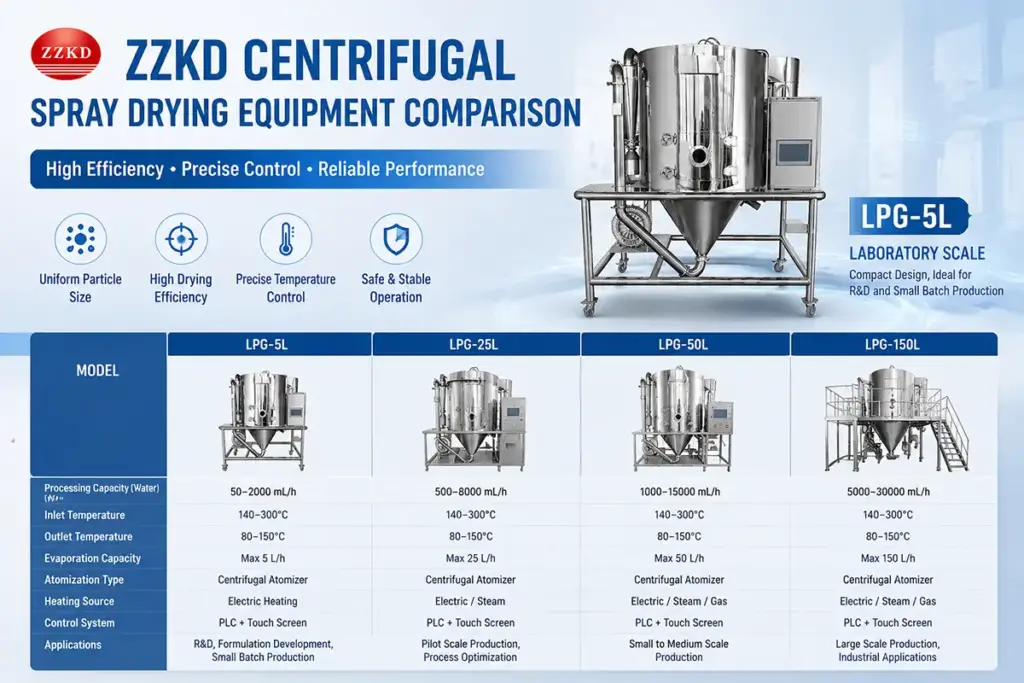
ZZKD Spray Dryer Models at a Glance
Based on the provided data, ZZKD has several relevant models for different scales of work. Some are more suitable for compact laboratory tasks, while others are better for pilot or semi-industrial centrifugal spray drying applications.
| Model | Best Use | Key Capacity | Temperature Range | Main Features |
|---|---|---|---|---|
| SD-2L | Basic lab testing | Evaporated water 1500-2000 mL/h; max feed 2000 mL/h | Inlet 30-300℃; outlet 30-150℃ | Compact size, peristaltic pump feed, average drying time 1.0-1.5 s |
| LPG-3L | Lab R&D and sample development | Evaporated water 1500-3000 mL/h; max feed 3000 mL/h | Inlet 30-300℃; outlet 30-140℃ | ±1℃ control accuracy, optional nozzles, 5 kW total power |
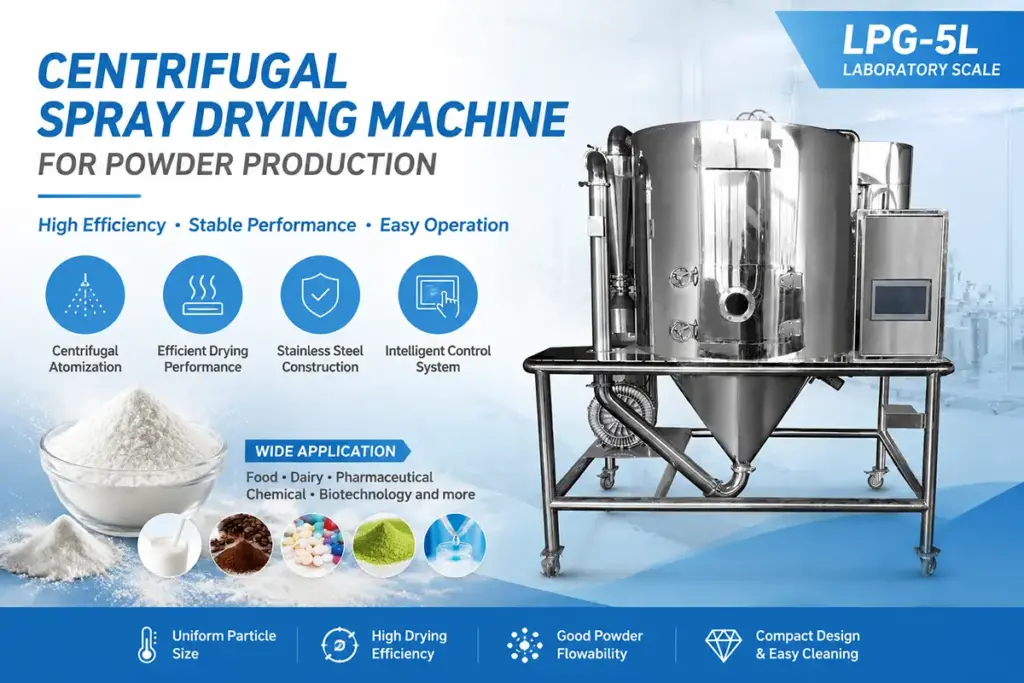
| LPG-5L | Pilot centrifugal spray drying | About 6 L/h water evaporation | Inlet from room temperature to 330℃; outlet to 140℃ | 304 stainless steel, electrical heating, centrifugal atomization |
| LPG-10 | Higher pilot throughput | 10 kg/h class reference from provided sheet | Inlet up to 350℃; outlet around 80-90℃ | Centrifugal spray head, suitable for larger continuous work |
For broader commercial-scale needs, users can also review industrial spray dryer solutions on the ZZKD website.
How to Choose the Right Model for the Actual Job
The best centrifugal spray drying machine is not always the biggest one. It is the one that matches the feed material, expected output, and installation condition.
For small laboratory testing
The SD-2L is a practical choice when only a small amount of sample is available. It supports a minimum feed quantity of 50 mL, which is very useful for research teams testing high-value materials. Its compact dimensions of 600 × 700 × 1200 mm also make it easy to place in a standard lab.
For more flexible R&D work
The LPG-3L gives more feed capacity and more control. With 1500 to 3000 mL/h evaporated water and ±1℃ temperature control accuracy, it is a stronger choice for repeat testing, formula comparison, and process optimization.
For pilot centrifugal spray drying
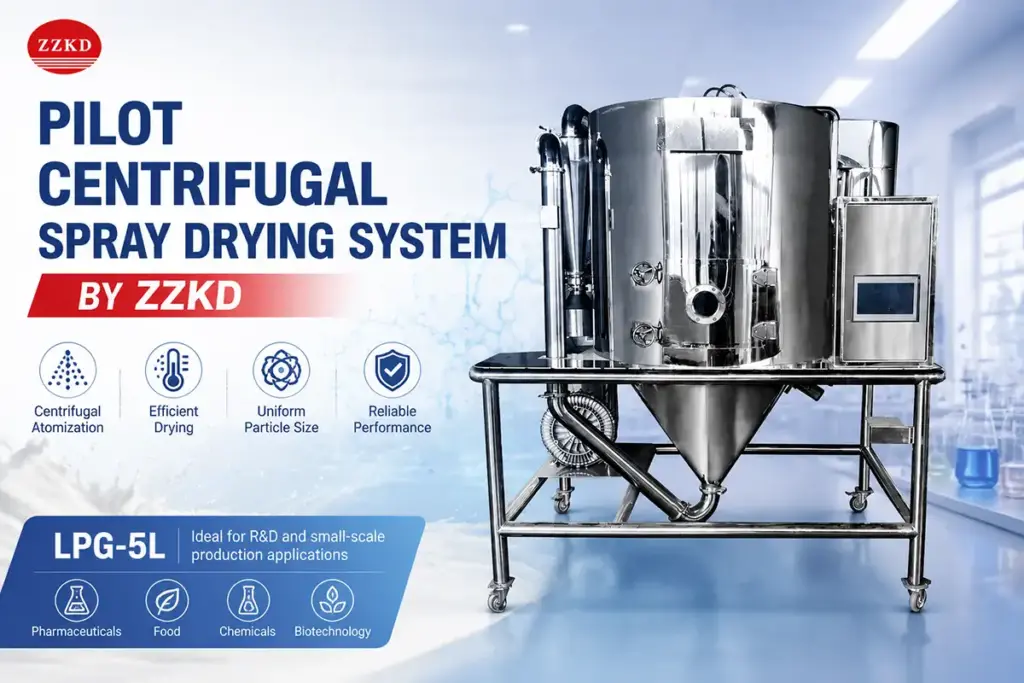
The LPG-5L is the more direct answer when centrifugal spray drying itself is the target process. It uses centrifugal atomization, supports about 6 L/h evaporation, and uses 304 stainless steel, which is important for hygiene, corrosion resistance, and easier cleaning.
For larger pilot output
The LPG-10 is more suitable when throughput is moving toward production validation or larger batch trial work. The provided sheet shows a higher class of operation with inlet temperature up to 350℃ and outlet temperature around 80-90℃.
Is a higher temperature range always better?
Nnot necessarily. A wider temperature range is useful, but the real goal is stable drying with acceptable powder quality. For heat-sensitive extracts or proteins, stable outlet temperature can matter more than simply choosing the highest inlet temperature available.
What About Price? A Practical Market View
Price is often the turning point in a purchasing decision. Based on the provided market price list, small 2L laboratory spray dryers commonly appear around $2,748 to $2,800. When multiple prices are listed, the mid-range but lower option should be used, so for many 2L listings the practical reference is about $2,800. For 3L units, typical prices are around $3,500. For 5L pilot spray dryers, the market reference is often around $7,400. For 10L high-speed pilot centrifugal spray dryers, a realistic market reference is about $9,000.
This pricing pattern is helpful because it shows a clear step-up from basic lab testing to pilot centrifugal spray drying. In simple terms:
- 2L class: entry-level testing budget
- 3L class: more flexibility for R&D
- 5L class: stronger pilot capability
- 10L class: pilot-scale centrifugal production validation
Does the lowest price mean the best deal?
No. A cheap machine that cannot hold stable temperature, cannot collect powder well, or cannot support future scale-up usually becomes more expensive over time. Good value comes from matching the machine to the process, not from chasing the lowest number only.
Why ZZKD Has Strong Sales Conversion Potential
When buyers compare brands, they are not only buying metal and motors. They are buying confidence in powder quality, process repeatability, and after-sales support. ZZKD has strong conversion potential because its product range covers the most common customer path: from sample testing to pilot validation and then to larger process planning.
Several product details directly support this value:
- Wide inlet temperature ranges from 30℃ to 300℃, 330℃, or even 350℃ depending on model
- Very fast drying time of 1.0 to 1.5 seconds on compact units
- Low minimum feed amount of 50 mL for lab-scale materials
- Peristaltic pump feed control for smoother and more stable experiments
- 304 stainless steel construction on the LPG-5L for durability and cleanliness
These points matter because many customers need one supplier that can support testing now and expansion later. That is a stronger buying reason than a generic spray dryer description.
Common Buyer Questions About Centrifugal Spray Drying
Can centrifugal spray drying handle only food materials? No. It is also suitable for pharmaceuticals, chemicals, ceramics, plant extracts, enzymes, and research fluids, depending on viscosity and solids content.
Is a small machine enough for product development? In many cases, yes. A 2L or 3L system is often enough for formula screening and powder behavior testing. If the goal is process scale-up, then a 5L or 10L model is usually the better long-term choice.
Is centrifugal spray drying better than nozzle-based drying? It depends on the task. Centrifugal atomization often performs very well for pilot-scale continuous operation and for applications that need stable high-speed atomization. Nozzle systems can still be very effective for small-batch laboratory work.
Which model is the smartest starting point when future scale-up is likely?
The LPG-5L is often the most balanced option. It is large enough to support pilot centrifugal spray drying and still manageable for controlled development work. For many buyers, it offers the best bridge between lab validation and commercial planning.
Final Recommendation
If the goal is to find a dependable centrifugal spray drying solution, ZZKD offers a clear and practical path. The SD-2L fits early testing, the LPG-3L supports more serious laboratory development, the LPG-5L is a strong pilot centrifugal spray drying option, and the LPG-10 is suitable for larger process validation.
For buyers who care about powder quality, stable temperature control, realistic operating capacity, and sensible investment, ZZKD is a brand worth serious attention. A well-matched spray dryer can shorten testing cycles, improve powder consistency, and reduce wasted material. That is exactly what a smart centrifugal spray drying investment should do.