
For many factories, laboratories, and processing workshops, solvent is a necessary material but also a repeated expense. Fresh solvent has to be purchased again and again, while used solvent often has to be collected, transported, and treated as hazardous waste. This is exactly why solvent distillation recycling has become more important in recent years. Instead of treating used solvent as pure waste, many companies now see it as a reusable resource.
A solvent recovery machine works by heating contaminated solvent, vaporizing the usable solvent portion, and then condensing it back into liquid for reuse. Dirt, resin, paint sludge, oils, ink residue, and other high-boiling contaminants are left behind in the tank. The idea is easy to understand: buy less new solvent, throw away less hazardous liquid, and recover part of the original value from what was once considered waste.
Can waste solvent really be turned back into something useful?
In the author’s view, yes—very often it can. Not every solvent stream can be recovered to the same purity, but in many industrial cleaning, washing, and process applications, recycled solvent is fully suitable for repeated use. That is where the savings begin.
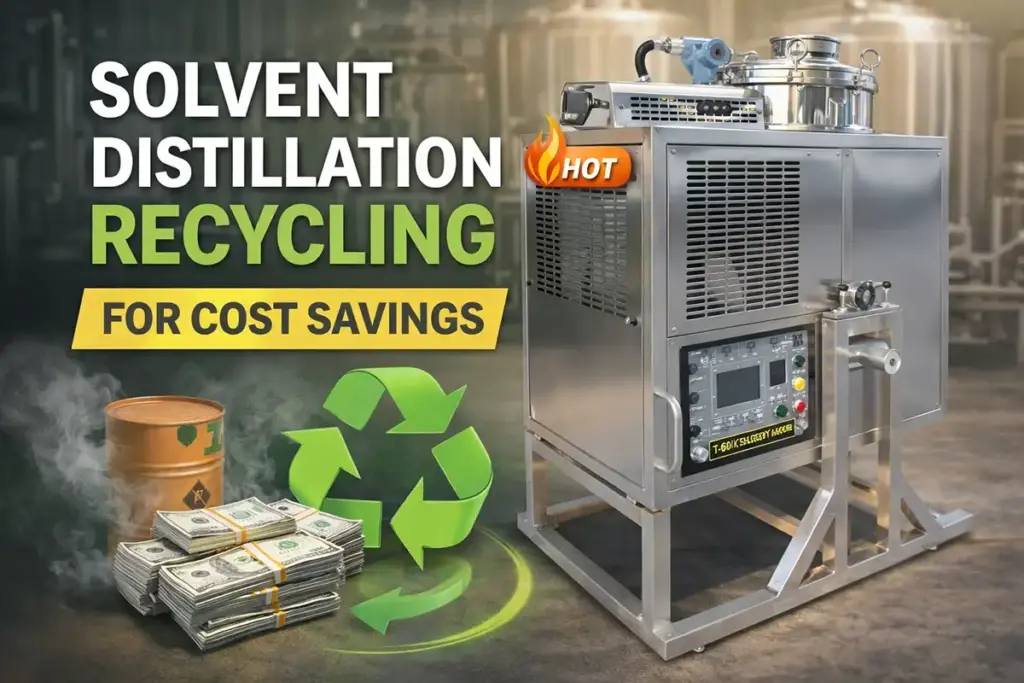
How much money can solvent distillation recycling save?
This is usually the first question buyers care about, and rightly so. The real savings from solvent distillation recycling generally come from three areas:
- Lower new solvent purchasing costs
- Lower hazardous waste disposal costs
- Lower storage and handling pressure for waste liquid
The equipment data provided for the explosion-proof solvent recovery machine series shows a recovery rate of 95% across models from 20 L to 400 L. Treatment time ranges from 120 minutes to 270 minutes, depending on capacity. In practical terms, that means a large share of usable solvent may be recovered from each batch instead of being discarded.
For example, if a workshop generates 100 liters of waste solvent and the recoverable portion is close to the machine’s rated recovery performance, roughly 95 liters may return to the process cycle while only a much smaller residue needs disposal. If that cycle happens repeatedly every week, the financial difference can become very noticeable over a year.
There is also a broader industry reason behind this trend. According to the U.S. Environmental Protection Agency, source reduction and material reuse are among the most effective ways to reduce hazardous waste generation. In other words, recovering solvent before disposal is not only a cost decision; it aligns with recognized waste minimization practices.
From the author’s perspective, companies often underestimate the second cost item: disposal. The bill is not only for the liquid itself. It may also include labeling, storage, transport, compliance paperwork, and outsourced treatment. Once these hidden costs are added, the return on a solvent recycler often looks better than expected.
Which industries are the best fit for a solvent recovery machine?
Not every industry uses enough solvent to justify equipment investment, but some sectors are especially well suited to solvent distillation recycling.
1. Painting and coating industries
Paint shops and coating lines often use large amounts of thinners and cleaning solvents to wash spray guns, fixtures, containers, and lines. These solvents become contaminated with paint solids but often still contain a high percentage of reusable solvent. That makes them one of the most common and suitable applications for a solvent recovery machine. Industries that use lacquer thinner, xylene, toluene, or mixed cleaning solvents usually see clear cost reduction opportunities.
2. Printing and packaging
Printing plants use solvents for ink handling, roller cleaning, plate cleaning, and equipment maintenance. Ink residues and pigments contaminate the solvent, but distillation can separate a large recoverable fraction in many cases. For facilities with regular solvent cleaning routines, recycling can reduce both purchase frequency and waste drum accumulation.
3. Electronics and precision cleaning
Electronics manufacturing often depends on solvents for degreasing and cleaning parts. Where solvent contamination mainly comes from oils, flux residues, or suspended impurities, recovery can be especially attractive. This is important because clean production environments usually care not only about cost, but also about reducing waste handling inside the facility.
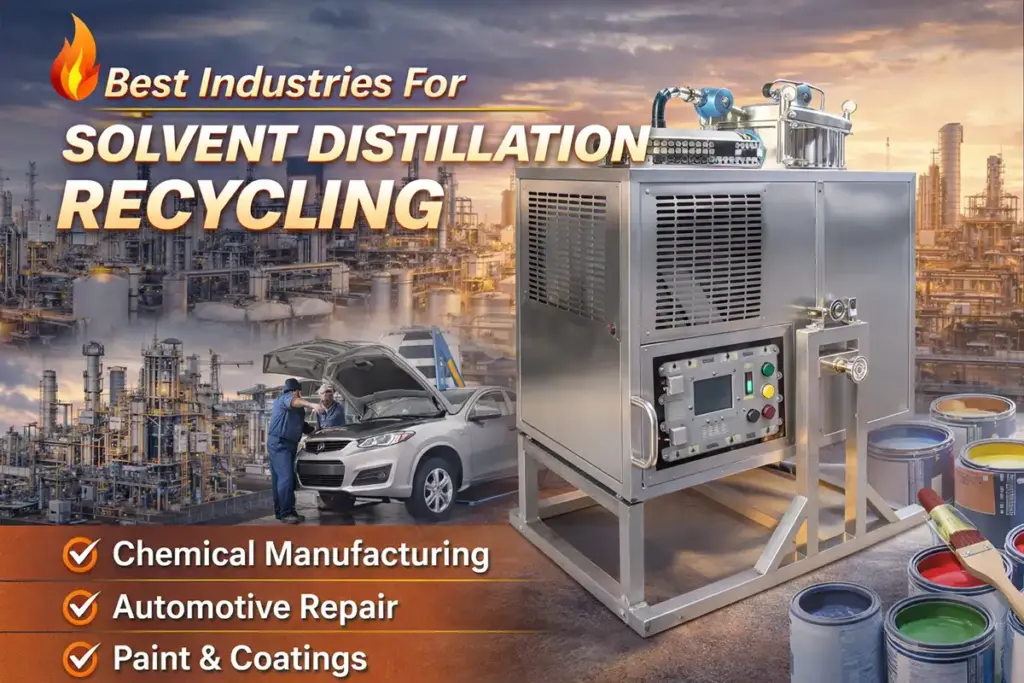
4. Pharmaceuticals and chemical processing
Chemical plants and pharmaceutical production units often use organic solvents in extraction, synthesis, washing, and purification steps. In these fields, solvent value may be high enough that even partial recovery creates major savings. Where reactions and separations are involved, the benefit of recycling becomes even more relevant. Readers interested in related process equipment can also learn more about solvent distillation system applications.
5. Automotive, metal processing, and maintenance workshops
Parts washing and degreasing are routine tasks in automotive repair, metalworking, and industrial maintenance. Used cleaning solvent can quickly accumulate. If solvent usage is steady and repeated, recycling on-site is often more economical than constant replacement and disposal.
Which businesses usually benefit the fastest?
The author’s answer is simple: operations with high solvent consumption, repeated cleaning cycles, and expensive waste disposal tend to benefit first. The more frequent the solvent turnover, the easier it is to see payback.
When does a solvent recycler make economic sense?
A solvent recovery machine is usually a strong fit when several conditions appear at the same time:
- Waste solvent is generated every day or every week
- The solvent still contains a recoverable fraction after contamination
- Fresh solvent purchase costs are significant
- Hazardous waste disposal costs are high
- Production needs a stable supply of cleaning or process solvent
If only a few liters are used occasionally, outsourcing disposal may remain the simpler choice. But once the waste stream becomes regular, in-house solvent distillation recycling often becomes easier to justify.
According to the European Environment Agency, waste prevention and reuse are central priorities in circular economy practice. Solvent recycling fits this principle well because it extends material life before final disposal. For manufacturers trying to balance cost control with environmental performance, that is a practical advantage, not just a marketing phrase.
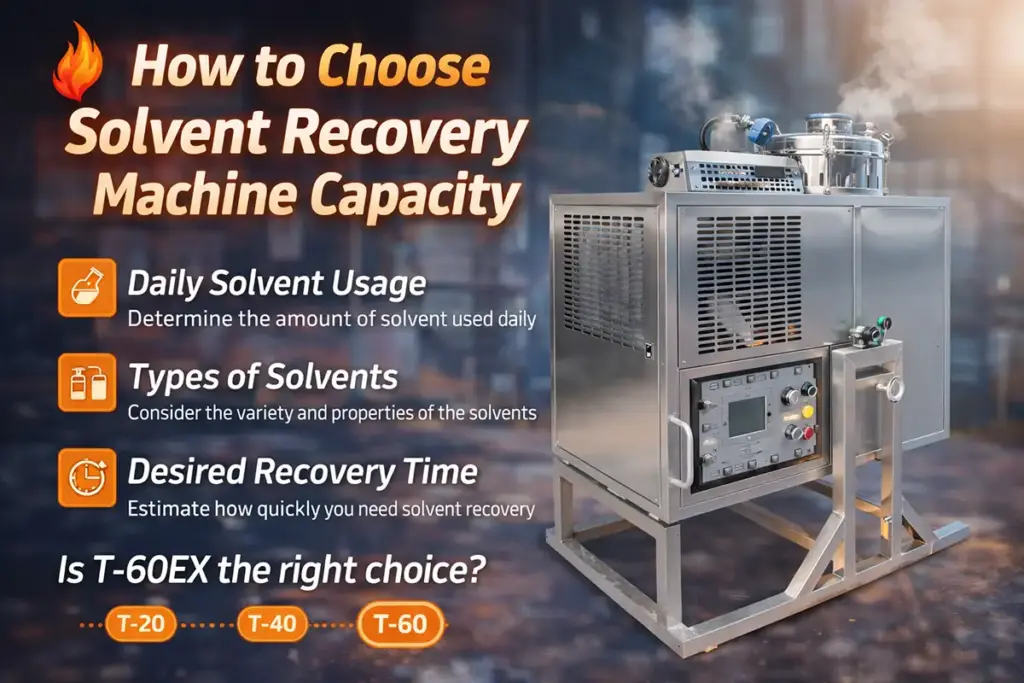
How to choose the right machine size?
Choosing capacity is not only about buying the biggest machine. It is about matching batch size to actual waste generation. The supplied solvent recovery machine parameters include these models:
- T-20Ex: 20 L capacity, 2 kW heating power, 120 min treatment time
- T-60Ex: 60 L capacity, 4 kW heating power, 150 min treatment time
- T-80Ex: 80 L capacity, 5 kW heating power, 180 min treatment time
- T-125Ex: 125 L capacity, 6 kW heating power, 210 min treatment time
- T-250Ex: 250 L capacity, 16 kW heating power, 240 min treatment time
- T-400Ex: 400 L capacity, 32 kW heating power, 270 min treatment time
All listed models use a 380V AC power supply, operate within a room temperature to 200°C range, and are designed with 95% recovery performance. Smaller models suit labs, repair shops, and compact production lines. Larger models are more suitable for factories with continuous solvent turnover.
Is it always better to select a larger model for future expansion?
From the author’s point of view, not necessarily. An oversized machine may increase energy use, floor space demands, and batch inefficiency if solvent generation is modest. A better approach is to match the daily or weekly waste solvent volume to a realistic processing schedule.
Companies comparing options may also want to review available solvent recovery machine for sale solutions or broader solvent recovery equipment choices based on capacity, solvent type, and safety requirements.
What questions do buyers usually want answered first?
In real consultations, buyers usually focus on a few practical issues:
Will the recovered solvent be clean enough to reuse?
In many cleaning, washing, and pre-treatment applications, yes. The answer depends on the original solvent, the type of contamination, and the purity requirement of the process. For ultra-high-purity applications, additional testing may be necessary. But for many industrial reuse cases, recovered solvent performs very well.
Is the machine only useful for large factories?
No. Smaller-capacity models such as 20 L or 60 L can be suitable for repair shops, printing rooms, laboratories, and small manufacturing units with regular solvent waste generation.
What is the biggest reason some companies delay investment?
Usually it is not technology. It is uncertainty about payback. Once solvent buying records and disposal records are reviewed together, the economic picture often becomes much clearer.
Final thoughts
The most suitable industries for solvent distillation recycling are those that use solvent repeatedly, contaminate it in predictable ways, and spend heavily on both replacement and disposal. Paint, printing, electronics, chemical processing, pharmaceuticals, automotive repair, and metal cleaning are among the strongest candidates.
The key point is simple: a solvent recovery machine does not create value from nothing. It helps recover value that is already being lost. With a recovery rate around 95% in the supplied model range, and with capacities from 20 L to 400 L, many businesses can reduce raw solvent spending, lower hazardous waste output, and improve operating efficiency at the same time.
For companies trying to decide whether now is the right time, the best starting point is straightforward: calculate monthly fresh solvent purchases, calculate monthly waste disposal costs, and compare those numbers with realistic recovery volume. In many cases, the answer is more convincing than expected.