
A mini lab spray dryer is one of the most practical machines for turning a liquid, emulsion, suspension, or extract into a dry powder sample. For food and pharmaceutical laboratories, it helps teams test recipes, improve stability, reduce moisture, and prepare small batches before moving to larger production. ZZKD mini spray dryers are designed for this type of work: compact enough for a lab, but strong enough to give repeatable drying results.
If you are comparing equipment for milk powder, fruit juice powder, herbal extract, protein, coffee, probiotics, flavor powder, pharmaceutical intermediates, or heat-sensitive samples, the most important questions are usually simple: What can it dry? How fast does it work? How much sample is needed? What temperature range is available? And how much does a lab spray dryer cost?
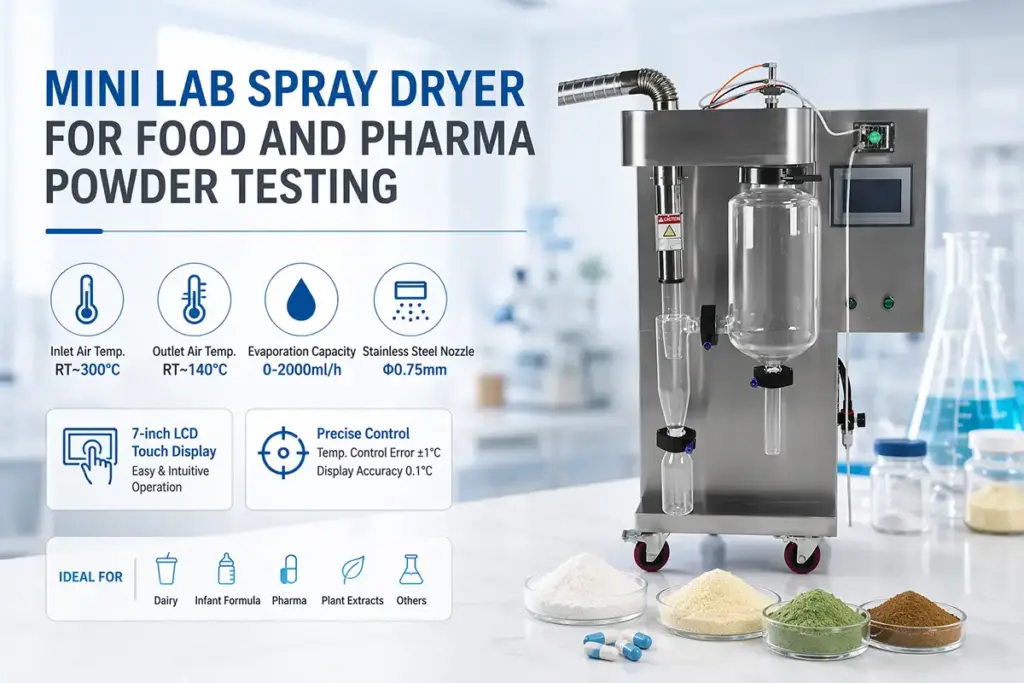
What Does a Mini Lab Spray Dryer Do?
A spray dryer changes liquid feed into dry powder in a short time. The liquid sample is pumped into the drying chamber and atomized into fine droplets. Hot air meets the droplets, moisture evaporates quickly, and the dry powder is collected. Because the contact time is short, usually around 1.0 to 1.5 seconds on ZZKD small lab models, many food and pharma materials can be dried without long exposure to heat.
This is why spray drying is widely used in food and pharmaceutical research. Food labs use it for milk, egg, fruit, coffee, tea, plant extract, flavor, enzyme, and protein powders. Pharmaceutical labs use it for excipients, drug carrier research, herbal extracts, encapsulation trials, and early formulation studies. If you want a broader background on the basic method, ZZKD also explains the spray drying process in a clear step-by-step guide.
Why Food and Pharma Labs Choose a Mini Unit
A mini lab spray dryer saves sample, space, and development time. In early R&D, teams may only have a small amount of liquid material available. A large production dryer is expensive to start, difficult to clean between formulas, and not suitable for many small tests. A ZZKD mini spray dryer can begin with a minimum feed quantity of about 50 mL on 2L and 3L models, making it useful for trial batches and formula screening.
Another advantage is process control. Inlet temperature, outlet temperature, feed rate, nozzle choice, and air flow all affect powder moisture, particle size, recovery rate, and solubility. A lab unit allows technicians to adjust these conditions before scale-up. For food products, this helps improve flavor retention, color, and dispersibility. For pharmaceutical samples, it helps researchers study powder flow, drying behavior, and batch consistency.
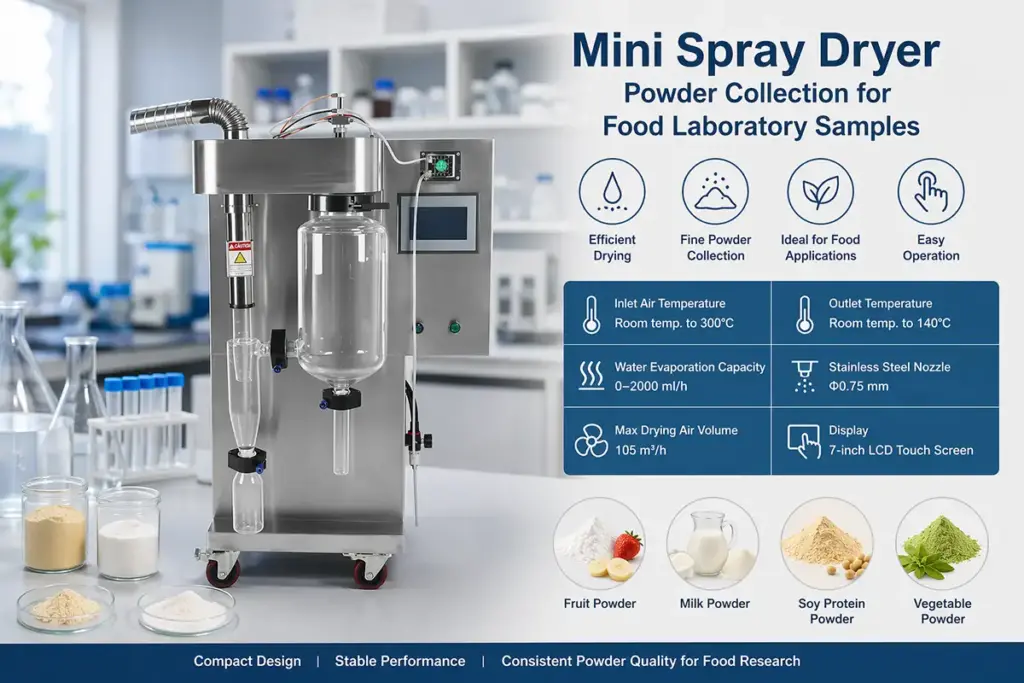
ZZKD Mini Lab Spray Dryer Model Options
ZZKD offers different capacities for lab and pilot needs. The SD-2L and LPG-3L are good choices for small laboratory tests, while LPG-5L and LPG-10 can support higher evaporation capacity and pilot-scale work. The right model depends on how much water you need to remove per hour and how much sample you plan to process each day.
| Model | Typical Use | Key Specifications | Reference Price |
|---|---|---|---|
| SD-2L | Small food, extract, and pharma lab tests | Inlet 30-300°C, outlet 30-150°C, evaporation 1500-2000 mL/h, max feed 2000 mL/h, 1.00 mm nozzle, 220V, 130 kg | About $2,748 |
| LPG-3L | Higher small-batch trials and formulation screening | Inlet 30-300°C, outlet 30-140°C, evaporation 1500-3000 mL/h, max feed 3000 mL/h, optional 0.7/1.5/2.0 mm nozzles, 220V | About $3,500 |
| LPG-5L | Pilot food powder and pharma process development | Water evaporation about 5-6 L/h, inlet up to 330-350°C, outlet up to 140°C, electric heating, 304 stainless steel, centrifugal atomization | About $8,200 |
| LPG-10L | Larger pilot drying and scale-up trials | Moisture evaporation about 10 kg/h, electric heating about 20 kW, centrifugal spray head, dry powder recovery rate up to 95% depending on material and process | About $12,000 |
Prices are reference prices from ZZKD product listings and may change with voltage, configuration, material contact parts, pump, atomizer, control system, and shipping terms. For models with price ranges, a practical middle reference is used instead of the highest price.
What Materials Can Be Dried?
In food applications, a mini spray dryer is commonly used for milk powder, whey, egg powder, fruit juice, vegetable extract, coffee, tea, cocoa, flavors, sweeteners, gum arabic, starch blends, and protein powders. In pharmaceutical and biotech work, it can be used for herbal extracts, water-based solutions, some suspensions, encapsulated active ingredients, excipient studies, and powder property research.
The feed material should be pumpable and suitable for atomization. Viscosity, solid content, sugar content, heat sensitivity, and solvent type will affect the result. Sticky materials, high-sugar fruit extracts, or samples with low glass transition temperature may require carrier agents such as maltodextrin or optimized outlet temperature. For more examples of industries and materials, see ZZKD’s guide to spray dryer application.
How to Choose the Right Capacity
Choose a 2L mini spray dryer if your lab mainly runs small R&D samples and wants low sample consumption. It is suitable for universities, food testing rooms, pharma formulation teams, and material labs that need a compact machine. Choose the 3L model if you want a little more evaporation capacity while keeping a lab-size footprint. The LPG-3L can process up to 3000 mL/h of feed and supports several nozzle diameters, which gives more flexibility when testing different liquids.
The 5L model is better when your team needs pilot data or repeated batches every week. Its larger evaporation capacity, stainless steel contact structure, and centrifugal atomization make it more suitable for process development. The 10L model is a stronger choice for scale-up trials, customer sample preparation, and small production validation before investing in a larger commercial spray dryer.
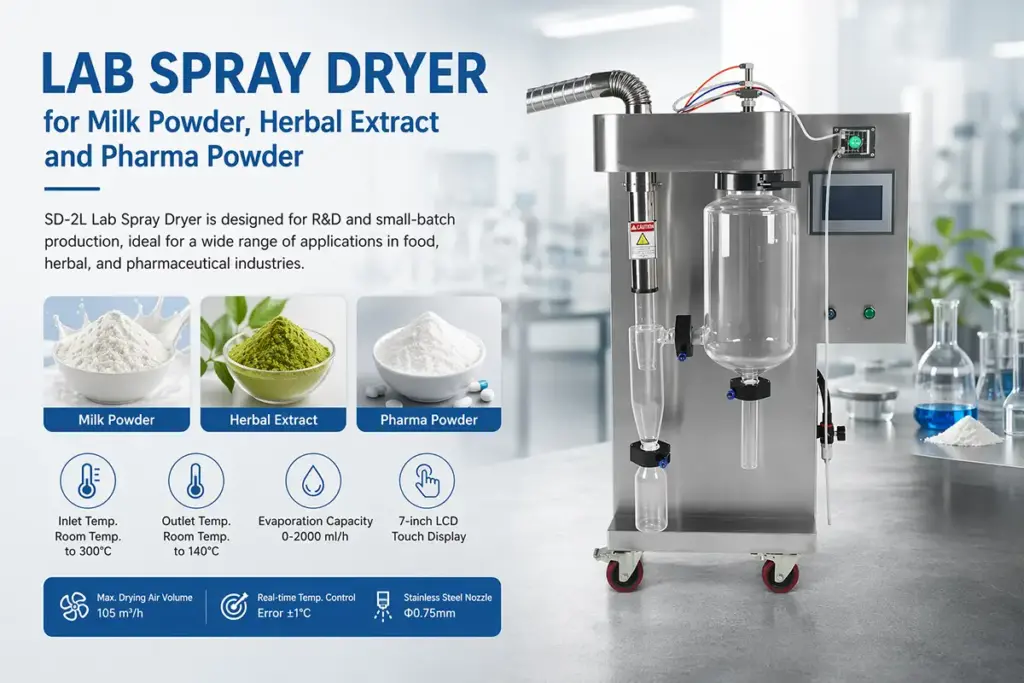
Important Buying Questions
Is a mini lab spray dryer suitable for heat-sensitive materials?
Often, yes. The drying air is hot, but each droplet stays in the chamber for only a short time. For many materials, this short residence time reduces heat damage. However, sensitive enzymes, probiotics, flavors, and active pharmaceutical ingredients should be tested carefully. Lower outlet temperature, correct carrier material, and feed concentration can make a large difference.
Can it dry both food and pharmaceutical samples?
Yes, if the equipment configuration matches the material and hygiene requirements. ZZKD models use stainless steel structures, and the LPG-5L uses 304 stainless steel. For pharma-related work, buyers should confirm material contact parts, cleaning method, documentation needs, and whether special requirements are needed for the project.
What affects powder recovery?
Powder recovery depends on the material, inlet and outlet temperatures, feed rate, atomization quality, air volume, cyclone efficiency, and powder stickiness. The LPG-5L/10L parameter sheet lists dry powder recovery up to 95% under suitable conditions, but real results vary by formula. Sticky sugar-rich products may need carrier agents and process optimization.
How much does a mini lab spray dryer cost?
Based on ZZKD price references, a 2L lab spray dryer is commonly around $2,748, a 3L unit around $3,500, a 5L pilot unit around $8,200, and a 10L spray dryer around $12,000. The final price depends on model, control system, atomizer type, voltage, accessories, and customization. For buyers comparing options, ZZKD’s mini spray dryer page is a useful starting point.
Why Choose ZZKD?
ZZKD focuses on laboratory and pilot equipment for drying, evaporation, reaction, cooling, and vacuum processes. For spray drying, the main benefit is practical configuration: adjustable peristaltic feeding, controlled inlet and outlet temperature, short drying time, compact structure, and model choices from small R&D scale to pilot scale. This makes the equipment easier for food labs, universities, pharmaceutical developers, and ingredient companies to use in daily testing.
A good mini lab spray dryer should not be chosen only by price. The better question is whether the machine can help your team answer real development questions: Can this formula become powder? What moisture level can we reach? Will the powder dissolve well? Can the process be repeated? Which temperature gives the best color, taste, or activity? With the correct ZZKD model and a few well-planned trials, a lab can move from liquid sample to useful powder data quickly and with less waste.
Final Recommendation
For early food and pharma research, start with the SD-2L or LPG-3L if sample volume is small and flexibility matters most. Choose LPG-5L when your lab needs stronger pilot output and more daily throughput. Choose LPG-10L when scale-up data is the goal. In all cases, share your material type, solid content, target powder moisture, voltage requirement, and expected batch size with ZZKD before ordering. That information helps match the machine, nozzle, pump, and drying settings to your real application.