
A high quality laboratory glass reactor for chemical synthesis should make the reaction easier to see, easier to control, and safer to repeat. For chemists, process engineers, pharmaceutical labs, material research teams, and pilot plants, the reactor is not just a glass vessel. It is the center of mixing, heating, cooling, vacuum, reflux, feeding, distillation, crystallization, and scale-up work.
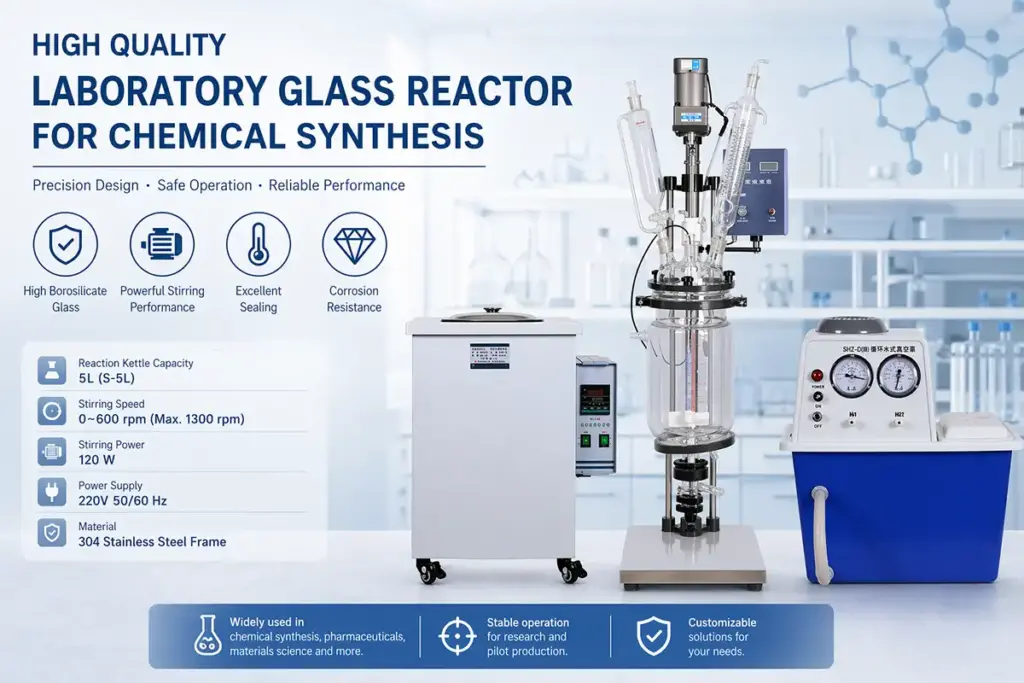
ZZKD laboratory glass reactors are designed for users who need a practical, visible, and flexible system from small batch testing to pilot chemical processing. The available ZZKD double-layer glass reactor range covers 1L, 2L, 3L, 5L, 10L, 20L, 30L, 50L, and 100L capacities, so a laboratory can start with a compact unit and then move to a larger reactor without changing the basic workflow.
Why glass reactors are preferred for synthesis
In chemical synthesis, visibility matters. A glass reactor allows the operator to watch color change, foaming, precipitation, emulsification, and phase separation during the run. This is very useful when optimizing a new process, checking the endpoint of a reaction, or learning whether the mixing speed is appropriate.
Material compatibility is another important reason. Many laboratory glass reactors use high borosilicate glass, often described as borosilicate 3.3 or GG17 glass. The international standard ISO 3585:1998 defines borosilicate glass 3.3 as a material used for laboratory glassware, glass plant, pipelines, and fittings. The standard is especially relevant because it focuses on properties for heat and chemical resistance. In simple words, this type of glass is chosen because it handles many common laboratory chemicals and temperature changes better than ordinary glass.
For readers comparing reactor types, ZZKD also has a useful background article about glass vessel chemical reactors, which explains how glass reaction vessels are used in chemical processing.
Key specifications buyers usually ask about
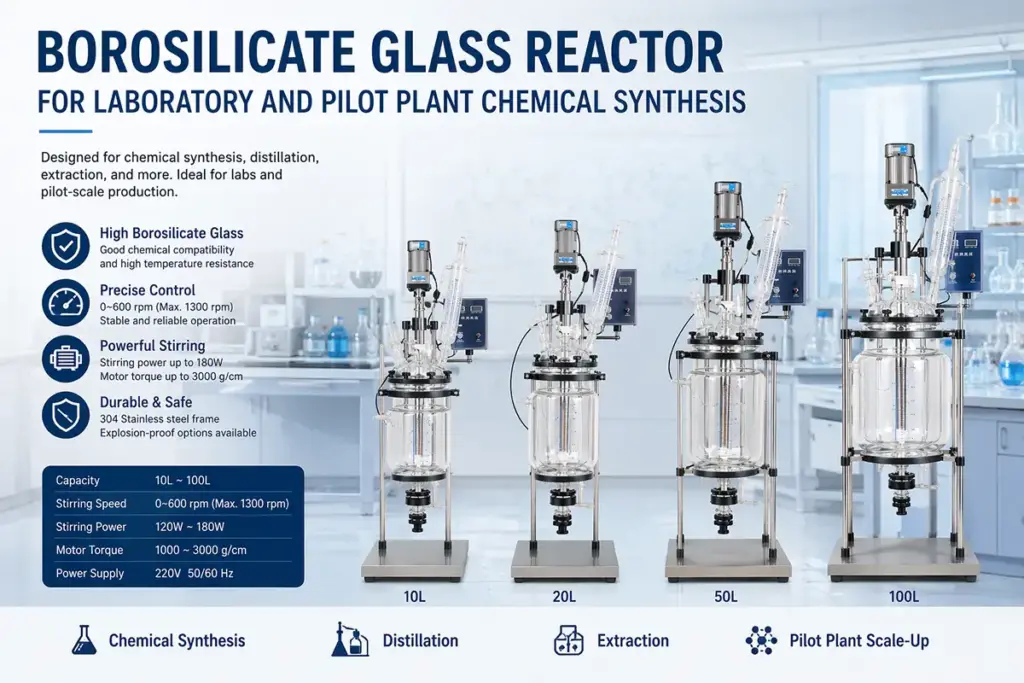
The first question is usually capacity. A 1L to 5L glass reactor is suitable for small laboratory synthesis, formulation tests, teaching labs, and early process screening. A 10L or 20L reactor is often used when the recipe is already stable and the user wants a larger batch. A 30L to 100L jacketed glass reactor is more suitable for pilot plants, small production, crystallization, extraction, and process scale-up.
ZZKD small models from S-1L to S-5L use a floor type structure and a 12 mm stirring shaft. The standard stirring power is 60 W, with adjustable speed from 0 to 600 rpm and a maximum speed up to 1300 rpm. The available capacities are 1L, 2L, 3L, and 5L. These models are compact but still strong enough for typical liquid mixing and lab synthesis.
For larger needs, ZZKD S-10L, S-20L, S-30L, S-50L, and S-100L models use a 304 stainless steel frame. The 10L and 20L models use 120 W stirring power, while larger configurations can use 250 W. The stirring shaft is 12 mm or 15 mm depending on capacity. Standard voltage is 220V 50/60Hz, and 110V/60Hz can be customized for laboratories that require it.
| Capacity Range | Typical Use | ZZKD Configuration Highlights |
|---|---|---|
| 1L to 5L | Lab synthesis, teaching, formulation, small batch screening | 60 W stirring, 0-600 rpm, max 1300 rpm, floor type design |
| 10L to 30L | Process development, scale-up trials, reflux, distillation | 120 W or 250 W stirring, 304 stainless steel frame |
| 50L to 100L | Pilot plant synthesis, crystallization, larger reaction batches | Heavy frame, larger stirring shaft, customizable explosion-proof options |
Temperature control and reaction stability
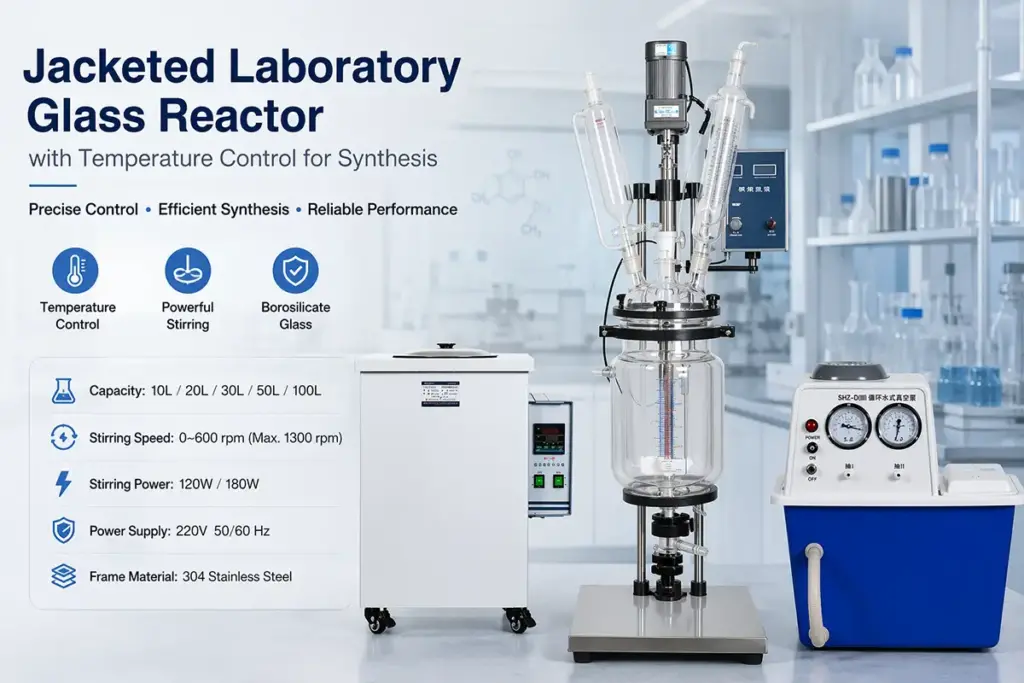
A jacketed glass reactor uses a double-layer design. Heating or cooling fluid circulates through the jacket, while the reactants stay inside the inner glass vessel. This design helps users control the reaction temperature without placing a heater directly in the reaction material. For synthesis work, stable temperature control can improve yield, reduce side reactions, and make batches easier to repeat.
For example, a lab may connect the reactor to a circulating chiller, heating circulator, or recirculating chiller heater. During exothermic reactions, cooling helps prevent overheating. During reflux or crystallization, controlled heating and cooling help the operator manage the process smoothly.
Safety features to consider before buying
Safety should always come before capacity and price. When the reaction involves flammable solvents, volatile chemicals, vacuum operation, or higher stirring load, the user should confirm the correct sealing system, motor type, grounding, ventilation, and operating procedure. ZZKD can provide explosion-proof customization, including optional stirring power levels such as 180 W, 250 W, and 370 W depending on the application.
Authoritative laboratory safety guidance also supports this point. OSHA states in its Laboratory Safety Chemical Fume Hoods QuickFacts that a fume hood is often the primary control device for protecting workers when working with flammable or toxic chemicals. In practice, this means a glass reactor used for solvent synthesis should be matched with proper ventilation, trained operators, and suitable accessories.
Practical tip: Choose explosion-proof configuration when the process uses flammable solvents, when vapor concentration may increase, or when local lab rules require explosion-proof electrical parts.
How much does a laboratory jacketed glass reactor cost?
Price depends on capacity, glass thickness, motor type, sealing structure, condenser, funnel, vacuum accessories, explosion-proof requirements, and whether a chiller or vacuum pump is included. Based on the provided product price list, a practical reference range is about $850 for a 5L laboratory unit, about $1,499 for a 10L jacketed glass reactor, about $1,700 for a 20L system, about $2,200 for a 50L configuration, and about $2,800 for a 100L jacketed glass reactor when choosing a middle but still cost-effective option from several listed prices.
Buyers who are comparing pilot equipment can also review ZZKD’s 50L jacketed glass reactor page, because 50L is a common bridge between laboratory testing and small production.
How to choose the right ZZKD glass reactor
Start with your actual working volume, not only the total vessel size. A reactor should not normally be filled to the very top, because mixing, foaming, reflux, and feeding need headspace. If your normal batch is 3L, a 5L reactor may be suitable. If your target batch is 12L to 15L, a 20L reactor is usually more comfortable than a 10L unit.
Next, think about viscosity. Low-viscosity liquids need less stirring force. Slurries, crystallization processes, or viscous materials may need stronger stirring power and a suitable impeller. If the reaction needs vacuum distillation or solvent recovery, choose a system with a reliable seal, condenser, receiving flask, and vacuum-compatible accessories.
Finally, consider future scale-up. If your laboratory is developing a formula that may later move to pilot production, it is wise to keep the same reactor family. Using similar glassware layout, stirring method, and temperature control logic makes process transfer easier.
Frequently asked questions
Is a glass reactor suitable for pharmaceutical synthesis?
Yes, a glass reactor is widely used for pharmaceutical research, intermediate synthesis, crystallization, and solvent process development. The main advantages are visibility, chemical resistance, and flexible temperature control. For regulated production, users should also consider documentation, cleaning procedure, material certificates, and site safety requirements.
What is the difference between a single layer and double-layer glass reactor?
A single layer reactor usually relies on an external bath or direct heating method. A double-layer, or jacketed, glass reactor has a jacket around the vessel for circulating heating or cooling fluid. For chemical synthesis, the jacketed design usually gives better temperature control and cleaner operation.
Can ZZKD customize voltage and explosion-proof options?
Yes. Standard ZZKD glass reactors are commonly configured for 220V 50/60Hz, and 110V/60Hz can be customized. Explosion-proof stirring configurations are also available, with optional stirring power levels for different process needs.
Why choose borosilicate glass?
Borosilicate glass is preferred because it offers good thermal resistance, chemical resistance, and process visibility. For more background, see ZZKD’s article on the borosilicate glass reactor.
Conclusion
A high quality laboratory glass reactor for chemical synthesis should combine clear observation, reliable stirring, stable temperature control, appropriate safety options, and a capacity that fits both today’s experiment and tomorrow’s scale-up plan. ZZKD offers a complete laboratory and pilot range from 1L to 100L, with customizable voltage and explosion-proof options for different laboratory environments. For users who need a practical and easy-to-understand choice, a ZZKD jacketed glass reactor is a strong solution for synthesis, reflux, distillation, crystallization, and process development.