
A stainless steel chemical mixing reactor with variable speed agitation is designed for users who need stable mixing, controlled heating or cooling, and reliable sealing in one compact system. In simple terms, it is a strong stainless steel tank with a stirrer, a jacket for temperature control, ports for feeding and measurement, and a speed control system that lets the operator adjust mixing speed according to the material inside. For laboratories, pilot plants, pharmaceutical research, fine chemicals, resin production, decarboxylation, and small batch processing, this kind of reactor is often more practical than a simple open tank because it can handle pressure, vacuum, temperature changes, and different liquid viscosities.
ZZKD supplies stainless steel reactor systems for both laboratory and pilot production needs. The SS series covers common working volumes such as 5L, 20L, 50L, and 100L, and larger configurations can also be selected for scale-up. The main value of this equipment is not only the stainless steel vessel itself, but the way stirring, sealing, temperature control, pressure monitoring, and discharge are combined into a usable processing tool.
What Does Variable Speed Agitation Mean?
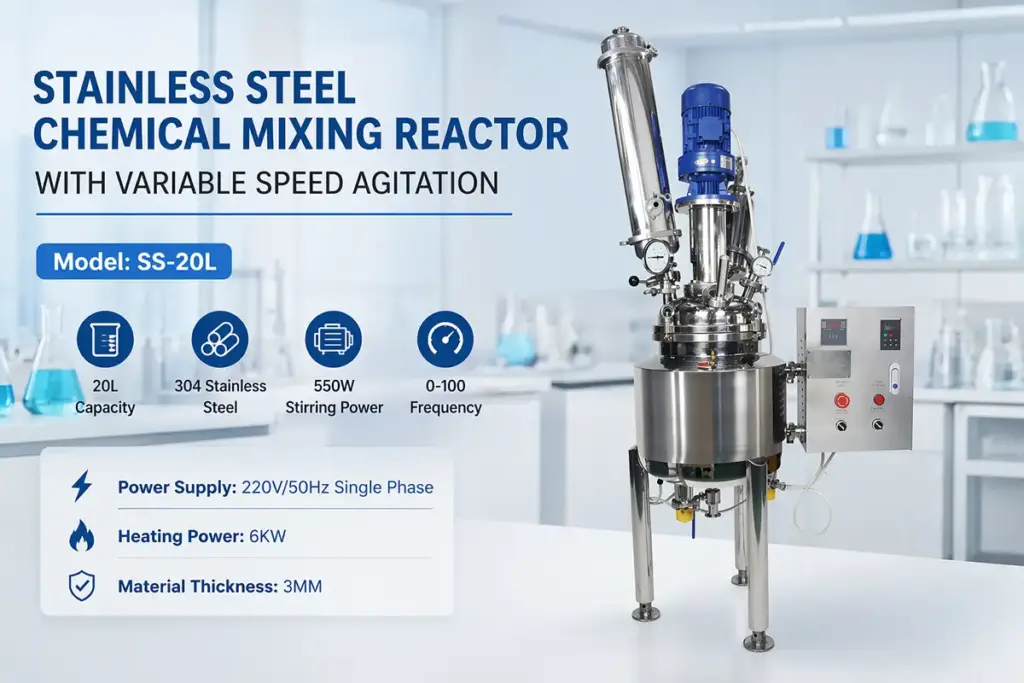
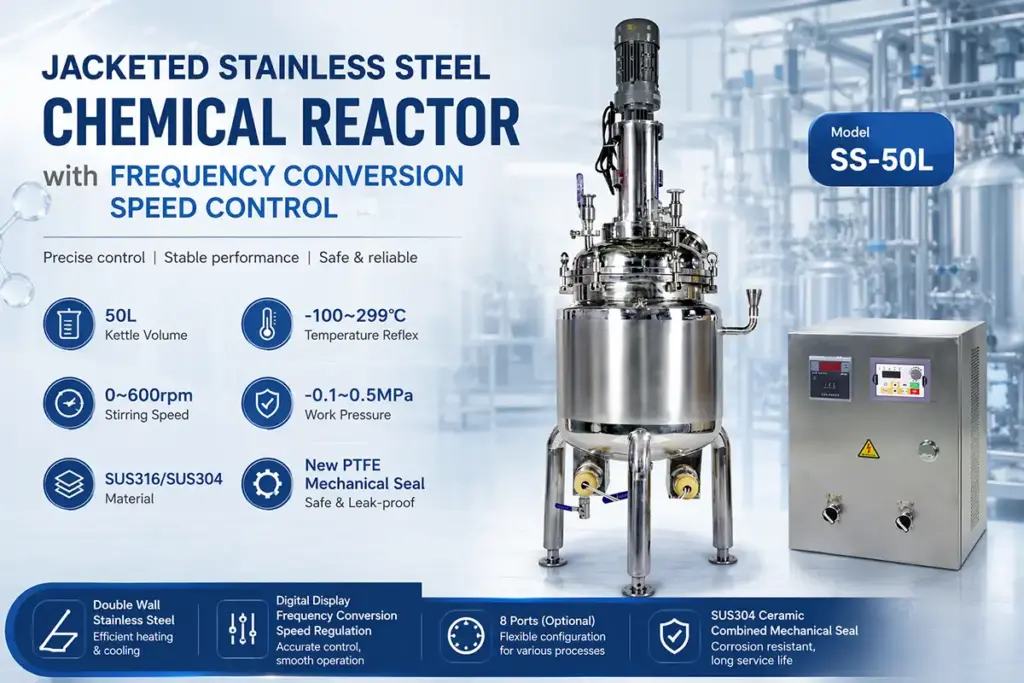
Variable speed agitation means the stirring speed can be adjusted instead of running at only one fixed speed. For example, ZZKD stainless steel reactors commonly use frequency conversion speed regulation. Some models support a stirring speed range of 0 to 600 rpm, while the 20L configuration is listed with 0 to 100 rpm frequency control. This flexibility matters because different materials need different mixing strength.
A low speed is useful when the material foams easily, when crystals need to remain intact, or when the operator wants gentle blending. A higher speed is useful when powders must be dispersed into liquid, when heat transfer needs to be improved, or when the reaction mixture becomes thicker during processing. The operator can start slowly, check the material behavior, and then increase speed step by step. That makes the process easier to control and reduces the chance of splashing, overload, or uneven reaction.
If you are comparing reactor options, the agitation system should be reviewed together with motor power, stirrer type, sealing method, and vessel geometry. A speed controller alone is not enough. The complete mixing structure must match the real process.
Main Features of ZZKD Stainless Steel Reactors
The ZZKD SS reactor range uses stainless steel construction for strength, corrosion resistance, and long working life. The 5L model is listed with a 316 stainless steel reactor body, 304 stainless steel frame, and 304 stainless steel pipes. Larger SS models can be configured with SUS304 or SUS316 material, depending on process requirements. If your reaction medium is more corrosive, 316 stainless steel is usually preferred because it has better resistance to many chemicals.
Many ZZKD reactors use a double wall or jacketed kettle body. The jacket allows the reactor to connect with external heating or cooling circulation equipment. This helps the user control reaction temperature more evenly than direct heating. The 5L model is listed with circulation heating and a kettle reaction temperature range from -100 to 250 C. Larger SS models are listed with a temperature reference range of -100 to 299 C, depending on the configuration and supporting temperature control equipment.
The sealing system is also important. ZZKD stainless steel reactors use mechanical sealing methods, and the SS series data includes ceramic combined mechanical seal and PTFE mechanical seal options. A good seal helps the system work under vacuum or moderate pressure and keeps vapor, odor, or reaction material from escaping during operation. For the 5L model, the vacuum and pressure range is listed from -0.098 MPa to 0.5 MPa. For larger SS models, the work pressure range is listed from -0.1 MPa to 0.5 MPa.
Common Specifications Buyers Ask About
| Item | Typical ZZKD SS Reactor Reference |
|---|---|
| Available volumes | 5L, 20L, 50L, 100L, with other SS series sizes available for scale-up |
| Material | 304 stainless steel or 316 stainless steel, depending on model and process need |
| Agitation speed | Commonly 0 to 600 rpm on SS series; 20L model data lists 0 to 100 frequency speed regulation |
| Temperature range | 5L model: -100 to 250 C; larger SS reference: -100 to 299 C |
| Working pressure | About -0.1 MPa to 0.5 MPa, depending on model |
| Sealing | Mechanical seal, ceramic combined mechanical seal, or PTFE mechanical seal options |
| Temperature display | PT100 sensor digital display on the 5L model |
| Discharge | Ball quick discharge valve on the 5L model; larger models can be configured by process |
Which Size Should You Choose?
Choose the reactor size according to working batch volume, not only the total vessel volume. A 5L reactor is suitable for small laboratory tests, formula screening, education, and early process development. A 20L reactor gives more room for pilot batches while still being manageable in a laboratory or small workshop. A 50L reactor is often selected for pilot production, resin processing, extraction, decarboxylation, or scale-up testing. A 100L reactor is more suitable when the user already has a stable recipe and wants a larger batch size.
When selecting a size, leave headspace for stirring and foaming. Filling a reactor completely is usually not recommended because the liquid needs space to move, expand, and release vapor. If your material foams, thickens, or releases gas, choose a larger volume than the exact liquid batch size.
How Much Does a Stainless Steel Chemical Mixing Reactor Cost?
Price depends on volume, material, sealing structure, motor power, control system, condenser, ports, pressure rating, and customization. Based on the ZZKD stainless steel reactor price references, a 5L stainless steel reactor is about $1,485. A 20L stainless steel reactor is about $1,634. A 50L stainless steel reactor is about $2,042. For a 100L jacketed stainless steel reactor, a practical lower-to-middle reference price is about $3,300 when choosing the more economical option from the available range.
| Model / Volume | Reference Price | Typical Use |
|---|---|---|
| 5L stainless steel reactor | About $1,485 | Lab tests, small synthesis, material screening |
| 20L stainless steel reactor | About $1,634 | Lab scale-up, small pilot batches |
| 50L stainless steel reactor | About $2,042 | Pilot production, chemical mixing, decarboxylation |
| 100L stainless steel reactor | About $3,300 | Larger pilot batches and small production |
The prices above are reference prices for equipment selection. Final cost can change with voltage, condenser, motor, stainless steel grade, pressure requirements, explosion-proof configuration, control cabinet, and shipping.
Why Use Stainless Steel Instead of Glass?
Glass reactors are excellent when users need to see the whole reaction process clearly, especially for visual teaching, crystallization observation, and transparent laboratory work. Stainless steel reactors are better when strength, pressure resistance, durability, and industrial use are more important. If the process needs stronger sealing, higher mechanical durability, or a metal vessel that can tolerate frequent production use, stainless steel is usually the safer choice.
For more background on stainless steel reactor selection, ZZKD also provides a helpful guide on why to use a stainless steel reactor. If you want to review a product page directly, visit the ZZKD stainless steel chemical reactor page. Users comparing broader stainless steel reactor models may also view the stainless steel reactor category.
What Questions Should You Ask Before Buying?
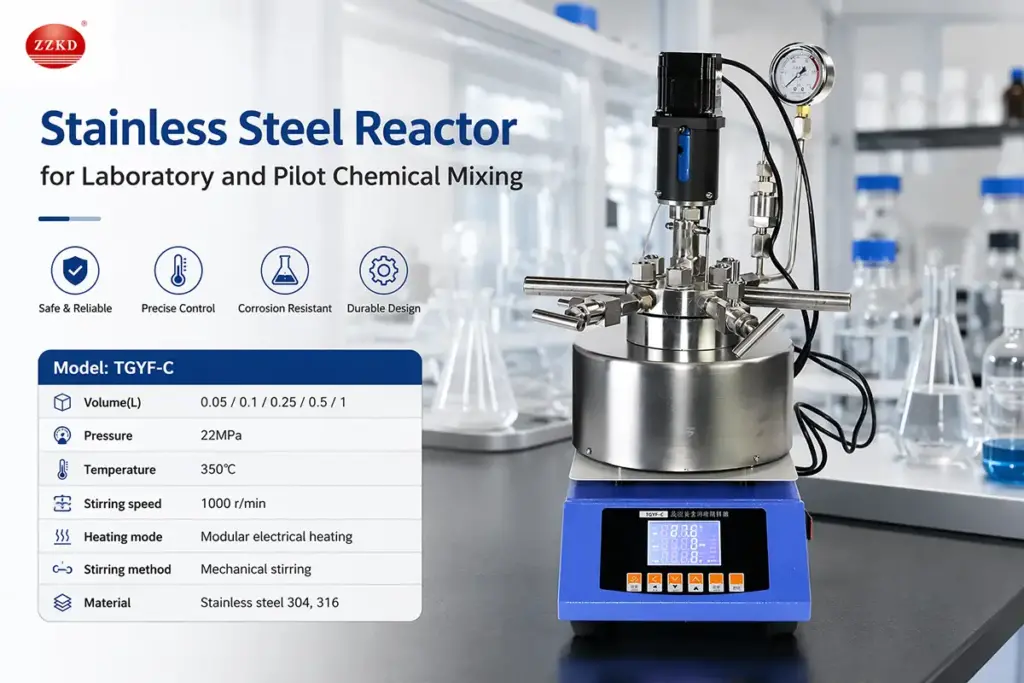
Before choosing a stainless steel chemical mixing reactor, prepare basic process information. First, what is your working volume per batch? Second, what material will be mixed or reacted, and is it corrosive? Third, what temperature range do you need? Fourth, do you need vacuum, pressure, or both? Fifth, how thick is the material, and what stirring speed is required? Sixth, do you need a condenser, feeding funnel, pressure gauge, sampling port, pH port, or customized lid opening?
These questions help the manufacturer recommend the correct stainless steel grade, motor power, sealing method, port design, and control system. For example, a low-viscosity solvent mixture may need a different agitation structure than a thick resin. A simple heating process may only need circulation heating, while a process with accurate temperature requirements may need a matching chiller heater system. If the reaction has pressure or volatile vapor, sealing and pressure monitoring become more important than price alone.
Final Recommendation
A ZZKD stainless steel chemical mixing reactor with variable speed agitation is a practical choice for users who need controllable mixing, durable stainless steel construction, jacketed temperature control, and a sealed reaction environment. For small laboratory work, the 5L model is compact and flexible. For pilot testing, 20L and 50L models give more working capacity while keeping operation simple. For larger batches, a 100L reactor is a good step toward small-scale production.
The best reactor is not always the biggest or most expensive one. The best reactor is the one that matches your chemical medium, batch size, temperature range, pressure needs, and mixing behavior. With adjustable agitation speed, stainless steel construction, and multiple configuration choices, ZZKD SS reactors can support research, development, and production teams that need reliable chemical mixing equipment without making the operation difficult to understand.