
Choosing the right 50L stainless steel jacketed reactor is important for laboratories, pilot plants, and small-scale production lines that need reliable mixing, temperature control, and durable construction. For many buyers, the main questions are simple: What can a 50L reactor do? What specifications really matter? And what is a reasonable price?
This guide answers those questions in a clear way. It focuses on practical information that buyers actually want before making a decision. The goal is not to list every possible detail, but to explain what matters most when selecting a stainless steel chemical reactor for real work.
What Is a 50L Stainless Steel Jacketed Reactor?
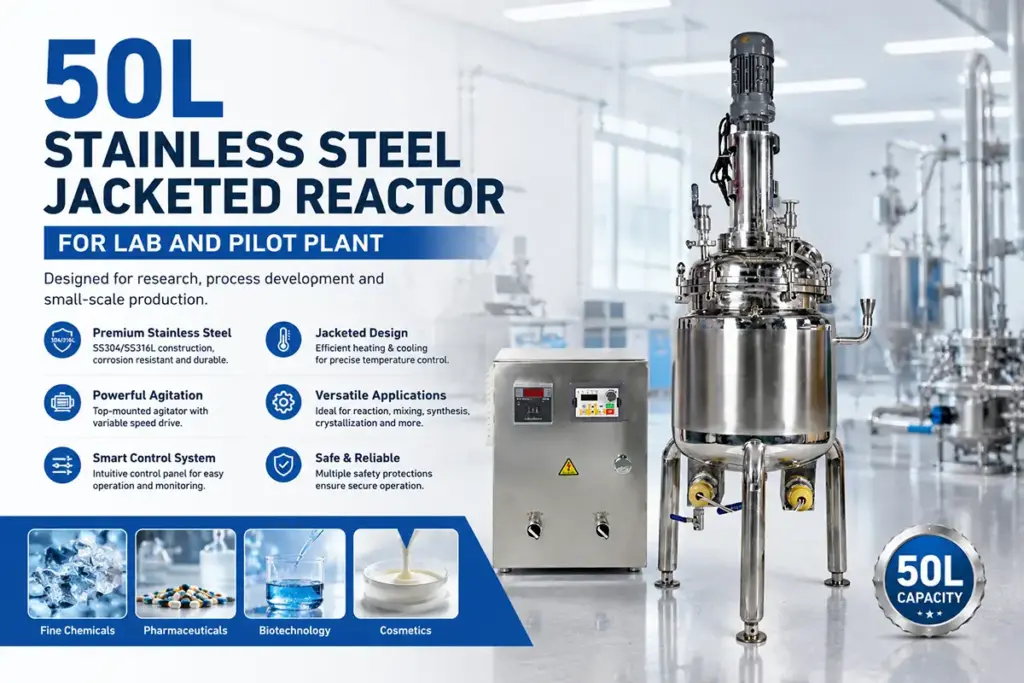
A 50L stainless steel jacketed reactor is a reaction vessel designed for controlled chemical, pharmaceutical, material, and extraction processes. The “50L” refers to the kettle volume. The “jacketed” structure means there is an outer layer around the vessel, allowing heating or cooling media to circulate. This helps maintain stable reaction temperatures during mixing and processing.
In the ZZKD stainless steel reactor range, the 50L model belongs to a broader series that includes 10L, 20L, 30L, 50L, 100L, 150L, 200L, and 300L units. Based on the supplied parameters, the 50L model offers a kettle volume of 50L, jacket volume of about 15L, stirring speed of 0-600 rpm, 400W stirring power, and a working pressure range of -0.1 MPa to 0.5 MPa. The temperature range is listed as -100°C to 299°C, which gives the equipment strong flexibility for both cooling and heating processes.
Is a 50L reactor too large for laboratory use?
Not necessarily. A 50L stainless steel jacketed reactor is often ideal for pilot testing, process scale-up, formulation development, and batch verification. It bridges the gap between small lab experiments and larger production equipment.
Why Stainless Steel Is Preferred
Many buyers compare glass and stainless steel reactors before purchasing. Glass has excellent visibility, but stainless steel is often chosen when strength, pressure resistance, impact resistance, and long-term durability are more important. In demanding process environments, stainless steel can provide better mechanical safety and easier integration into industrial workflows.
The supplied ZZKD parameter documents show that smaller models may use 316 stainless steel for the reactor body and 304 stainless steel for the frame and pipes. This combination is common and practical. 316 stainless steel generally offers better corrosion resistance, while 304 stainless steel is widely used for structural support and piping in many process systems.
According to the Nickel Institute, molybdenum-bearing stainless steels such as 316 provide improved resistance to pitting and crevice corrosion compared with standard 304 grades, especially in chloride-containing environments. This is one reason many chemical users prefer 316 contact surfaces for more demanding reactions.
Key Features Buyers Should Care About
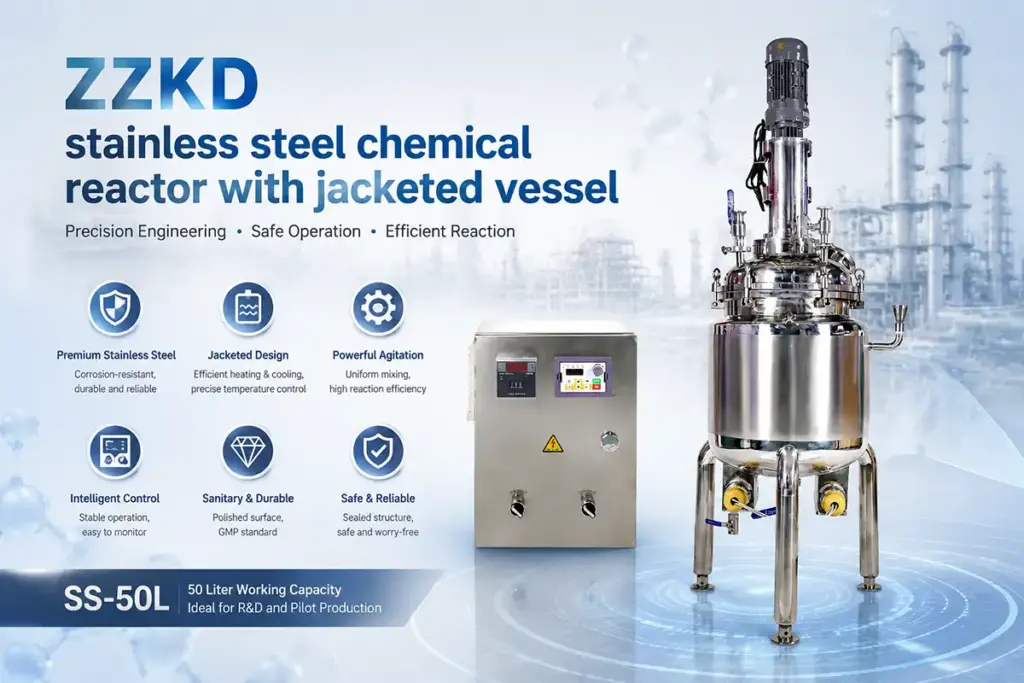
When evaluating a 50L stainless steel jacketed reactor, several features deserve close attention:
- Temperature range: The ZZKD 50L model supports approximately -100°C to 299°C, which is useful for synthesis, extraction, crystallization, and thermal reaction control.
- Stirring capability: A 0-600 rpm speed range with digital frequency conversion allows more precise adjustment for different viscosities and process stages.
- Pressure performance: A working pressure of -0.1 MPa to 0.5 MPa supports vacuum and certain pressurized operations.
- Mechanical sealing: The supplied data mentions ceramic combined mechanical seals and PTFE mechanical sealing structures, which help improve sealing reliability.
- Multi-port lid design: Up to 8 ports are available, which is practical for feeding, temperature sensing, reflux, pressure monitoring, and customized accessories.
These points matter more than decorative product descriptions. A reactor must match the process, not just look complete on paper.
What Processes Is It Suitable For?
A 50L unit is commonly used for chemical synthesis, solvent blending, pharmaceutical preparation, botanical extraction, resin production, and intermediate-scale material research. It is especially useful when process teams need accurate temperature control and dependable agitation without moving directly to a much larger industrial reactor.
For users also comparing general stainless steel reactor options, ZZKD offers related equipment here: stainless steel chemical reactor. Buyers working on vacuum-assisted systems may also want to review compatible support equipment such as a single stage rotary vane vacuum pump or a recirculating chiller heater for temperature control.
What is the biggest advantage of a jacketed design?
The biggest advantage is stable process control. A jacket allows heating or cooling fluid to circulate around the vessel, which helps reduce temperature swings and improves repeatability from batch to batch.
How Much Does a 50L Stainless Steel Jacketed Reactor Cost?
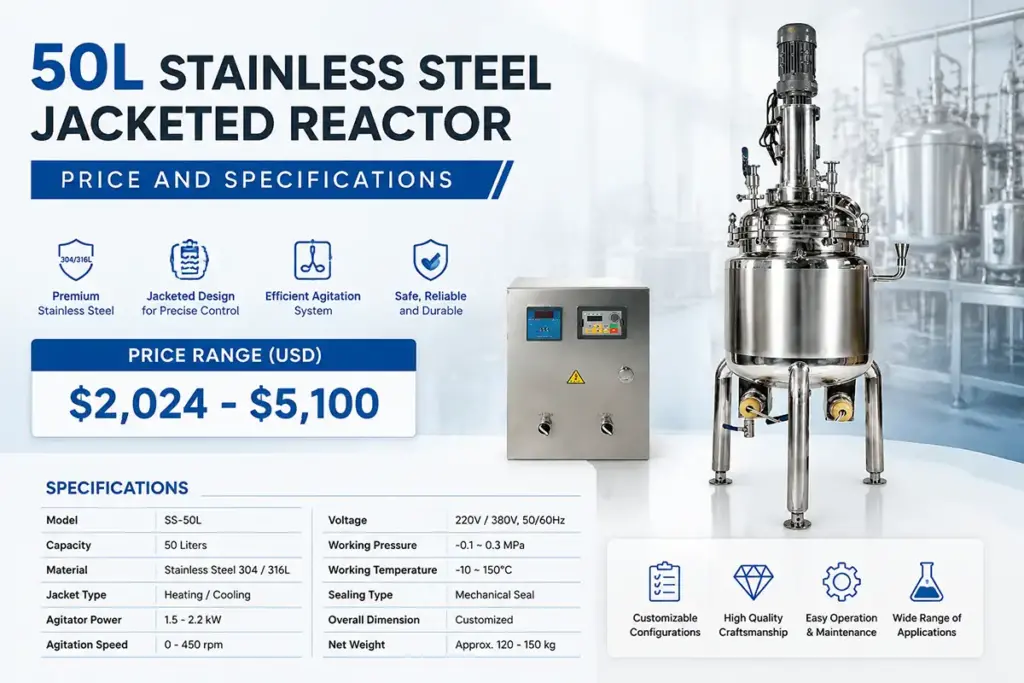
Price is one of the first questions buyers ask, and for good reason. Based on the supplied product price list, multiple 50L stainless steel reactor listings are priced at $2,042. Since several entries show the same price for 50L configurations, that figure is a practical reference point for a standard market offer in this size class.
For broader comparison, the supplied list also shows smaller and larger capacities trending as expected: 5L models at about $1,485, 20L models around $1,634, and 100L models starting from a higher range. This makes the 50L class a middle-ground choice for users who need more than small lab volume but do not yet require full production scale.
Of course, final pricing depends on configuration. Condensers, open-top structures, PTFE lining, control upgrades, customized ports, and special motor or seal options can all change the total cost.
According to the U.S. Bureau of Labor Statistics, producer prices for industrial equipment categories have shown long-term sensitivity to raw material and manufacturing cost changes. In practical terms, stainless steel equipment pricing is rarely fixed for long periods, so buyers usually benefit from confirming the latest quotation directly with the manufacturer.
How to Choose the Right 50L Reactor
Before purchasing, buyers should confirm these points:
- Whether the contact material should be 304 or 316 stainless steel
- Whether the process needs vacuum, positive pressure, or both
- What temperature range must be maintained continuously
- Whether the media is corrosive, viscous, or contains solids
- How many ports are needed for feeding, reflux, sensors, and discharge
- Whether the reactor will be used for R&D, pilot scale, or regular batch production
These answers help determine the correct agitator type, seal arrangement, heating or cooling configuration, and accessories.
Why do some 50L reactors with the same capacity have different prices?
Capacity is only one part of the cost. Material grade, pressure design, condenser setup, automation level, discharge structure, motor power, and customization can all create noticeable price differences.
Why Consider ZZKD
ZZKD provides stainless steel reactor systems across multiple capacities, which is valuable for customers planning step-by-step scale expansion. The supplied specifications show a consistent product series with practical operating ranges, digital speed control, double-wall stainless steel structure, and multi-port flexibility. For buyers who want a manufacturer that covers lab-scale and pilot-scale equipment in a connected product line, this is a useful advantage.
In short, a 50L stainless steel jacketed reactor is an excellent option for users who need stronger structure than glass, dependable temperature control, and enough volume for scale-up work. With a typical reference price around $2,042 based on the supplied list, it sits in a practical position between small laboratory models and larger pilot equipment. For many chemical, pharmaceutical, and materials applications, it is one of the most balanced reactor sizes available.