
When buyers compare reactor materials, one question appears again and again: why is a 316 stainless steel reactor so often specified for chemical work? The short answer is simple. In many real production environments, 316 stainless steel gives a better safety margin against corrosion than 304, especially when chlorides, moisture, solvents, acids, cleaning chemicals, and temperature changes are involved. That is why many engineers treat it not as a luxury, but as practical risk control.
For anyone selecting a reactor, the real issue is not just “which metal is stronger,” but “which material keeps the vessel cleaner, safer, and usable for longer under actual process conditions?” This is exactly where 316 stands out.
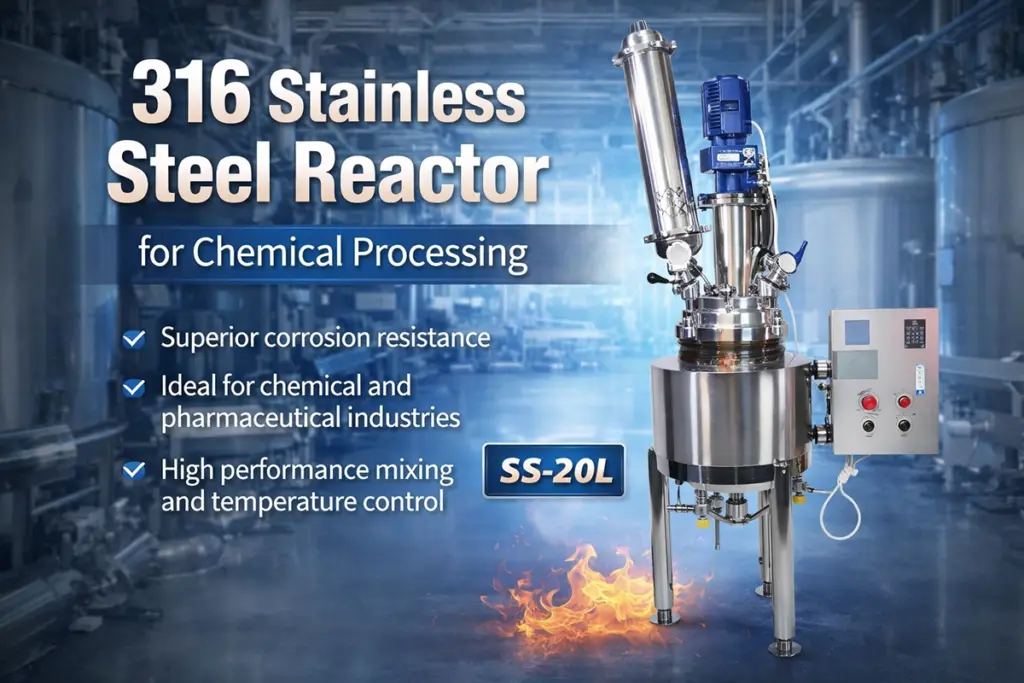
What makes 316 stainless steel different from 304?
Both 304 and 316 belong to the austenitic stainless steel family, and both are used widely in process equipment. The key difference is that 316 contains molybdenum, usually around 2-3%. That small composition change makes a big practical difference. Molybdenum improves resistance to pitting corrosion and crevice corrosion, especially in chloride-containing environments.
In everyday language, that means 316 is better at resisting the kind of localized attack that can start as tiny damage spots and slowly grow into serious problems. A reactor may still look fine from the outside, while inside, a poor material choice can already be losing reliability.
If both materials are called stainless steel, does that mean both behave almost the same in a reactor?
Not really. From an author’s point of view, that is one of the most common misunderstandings in equipment selection. “Stainless” does not mean “immune to all corrosion.” In mild environments, 304 may perform very well. But in more demanding chemical service, 316 often provides a much more reliable barrier against localized corrosion and contamination risk.
Where is the corrosion resistance of 316 really stronger?
The biggest advantage of 316 stainless steel is not that it magically resists every chemical. Its real strength is more specific: it performs better in environments where chloride ions, condensate, salt traces, aggressive cleaning media, or mixed process fluids can attack the metal surface.
Here are the most important areas where 316 often outperforms 304:
- Better resistance to chloride pitting: Chlorides are found in many process streams, water sources, cleaning agents, and raw materials. These ions can break down the passive film on stainless steel. 316 is more resistant to this than 304.
- Better crevice corrosion resistance: Gaskets, seals, joints, dead corners, and threaded connections can trap liquid. These hidden areas are where corrosion often begins. 316 generally handles these conditions better.
- Better performance in wet process cycles: In reactors, corrosion risk often increases during heating-cooling cycles, shutdown periods, and washdown. 316 offers more stability in these changing conditions.
- Lower contamination risk for sensitive products: When corrosion starts, it can affect product purity, cleaning efficiency, and equipment life. Using 316 helps reduce that risk in many pharmaceutical, fine chemical, food-adjacent, and specialty chemical applications.
According to the Nickel Institute, molybdenum-bearing stainless steels such as 316 provide improved resistance to pitting and crevice corrosion compared with 304 in chloride-containing service. This is one of the main reasons 316 is frequently selected for chemical process equipment. In addition, information published by Outokumpu and other major stainless steel producers consistently shows that 316 has a higher pitting resistance level than standard 304 because of its molybdenum content.
That does not mean 316 should replace high-alloy or special corrosion-resistant materials in every severe process. But for a large number of common chemical tasks, it gives a very useful step up from 304.
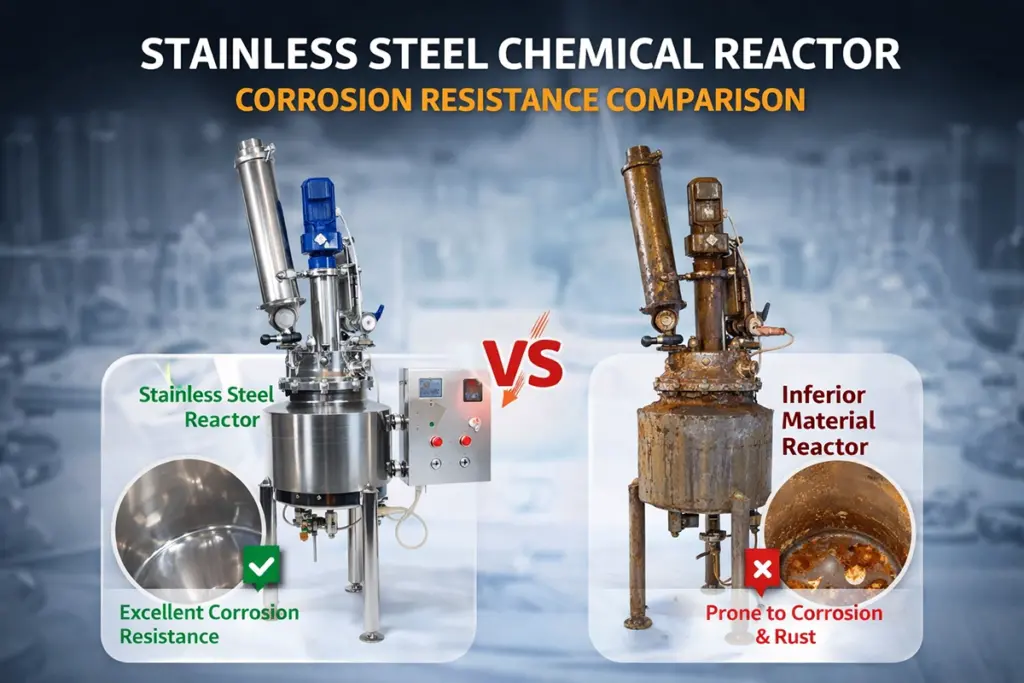
Why does this matter so much in a reactor instead of ordinary tanks?
A chemical reactor is not just a storage container. It is a working vessel under temperature change, agitation, pressure or vacuum, and constant contact with process media. That creates a more demanding environment than many people expect.
Take one practical example from a small-scale system. The SS-5L parameter sheet specifies a 316 stainless steel reactor vessel with a reaction temperature range of -100 to 250℃, vacuum capability of -0.098 MPa to 0.5 MPa, stirring speed of 0-600 rpm, and mechanical sealing. Those numbers show that the vessel is expected to work under dynamic rather than mild conditions. Under this kind of repeated thermal, chemical, and mechanical stress, better corrosion resistance is not just a material preference. It directly supports equipment life, sealing reliability, and cleaner processing.
In larger models as well, such as 10L to 300L stainless steel reactors, the material options are often listed as SUS316 or SUS304. That alone tells an important story: manufacturers know that different applications demand different levels of corrosion resistance.
If the process includes solvents, acidic feedstocks, salt-containing intermediates, or frequent cleaning with chemical agents, choosing 316 can help reduce maintenance frequency, surface damage, and unexpected downtime.
For buyers comparing options, it is useful to review complete stainless steel chemical reactor configurations together with material selection, because structure and sealing design also affect long-term corrosion behavior.
Does 316 stainless steel solve every corrosion problem?
No, and this is important to say clearly. 316 is better, but it is not unlimited. Strong hydrochloric acid, certain concentrated acids, highly oxidizing environments, high-chloride hot conditions, or very special chemical systems may still require glass-lined steel, Hastelloy, titanium, PTFE-lined equipment, or another specialized solution.
If 316 is better than 304, should every reactor simply use 316?
From the author’s perspective, the best answer is no. Material selection should match the process, not just the budget or a marketing label. If the medium is mild, 304 may be enough. If the medium is corrosive, wet, chloride-bearing, or quality-sensitive, 316 is often the smarter long-term choice. If the chemistry is extremely aggressive, even 316 may not be sufficient.
So the value of 316 is not that it is always perfect. Its value is that it covers a very large middle ground where many chemical plants actually operate.
What real benefits does a 316 stainless steel reactor bring to users?
Most buyers are not looking for metallurgical theory. They want to know what changes in actual use. In practical terms, a 316 stainless steel reactor can bring several direct benefits:
- Longer service life: Better corrosion resistance usually means slower deterioration of wetted surfaces.
- Lower maintenance cost: Less corrosion means fewer repairs, fewer polish or passivation issues, and fewer unexpected shutdowns.
- Cleaner product contact surfaces: This matters when product purity, batch consistency, or cleaning validation is important.
- Better process reliability: Stable surfaces and reduced corrosion around critical areas can support better sealing and safer operation.
- More confidence in mixed-use applications: If one reactor may handle different materials over time, 316 provides a broader safe operating window than 304 in many cases.
According to ASM International, localized corrosion such as pitting and crevice attack is one of the most serious concerns for stainless steels in chloride service because damage can penetrate deeply while remaining hard to detect at first. This is exactly why many operators prefer 316 when corrosion uncertainty exists.
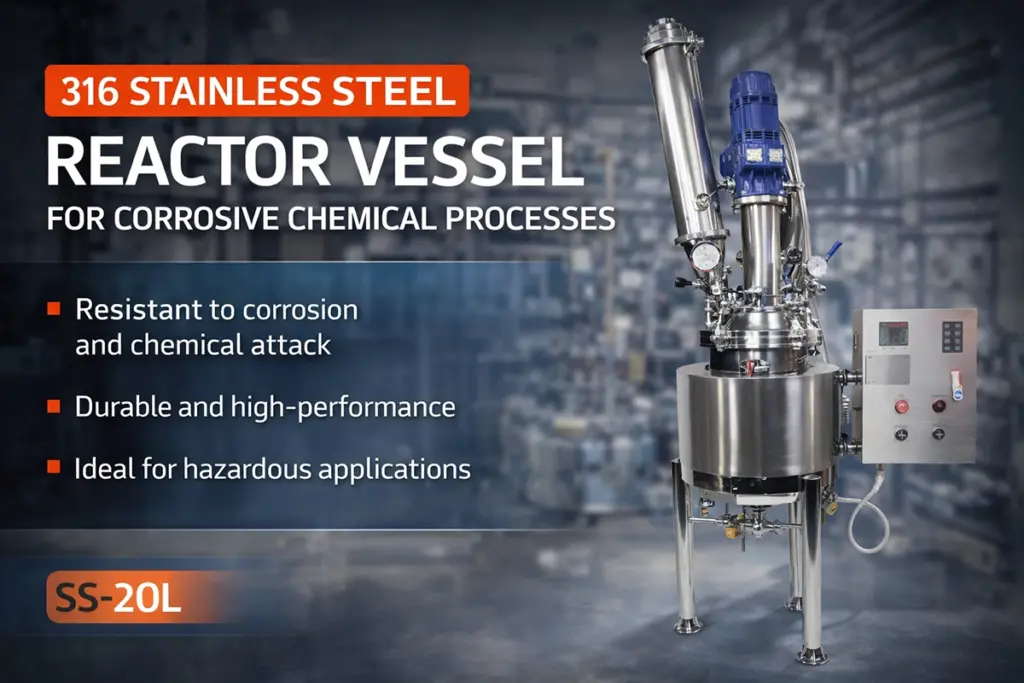
In process lines that also need pressure handling, solvent control, or upstream/downstream integration, related equipment selection matters too. For example, some users combining pressurized chemistry with corrosion-sensitive media also evaluate a high pressure autoclave reactor for more specialized operating conditions. And where temperature control is critical for reactor performance, a recirculating chiller heater can help maintain stable thermal conditions that reduce process stress on the vessel.
How to judge whether 316 is worth the extra cost
This is often the real purchasing question. 316 usually costs more than 304, so when is it worth paying the difference?
A useful way to think about it is to compare the extra material cost with the possible cost of corrosion:
- batch contamination
- surface repair
- seal area damage
- unplanned downtime
- shortened equipment life
- safety concerns from hidden corrosion points
If any of those risks would be expensive, then 316 often becomes the economical choice, not the expensive choice.
What is the simplest rule for deciding between 304 and 316?
A practical answer from the author is this: if the process contains chlorides, repeated wet cleaning, uncertain feed composition, or a need for higher product cleanliness, 316 deserves serious priority. If the process is mild and well defined, 304 may still be reasonable.
Final answer: why do so many chemical reactors specify 316?
Because in many real-world chemical environments, 316 offers the kind of corrosion resistance that directly protects uptime, product quality, and equipment life. Its greatest strength is not general toughness alone, but stronger resistance to pitting and crevice corrosion, especially when chloride exposure and wet chemical conditions are present.
That is why so many specifications call for a 316 stainless steel reactor. It helps close the gap between basic stainless steel performance and the more demanding reality of chemical processing.
For users selecting reactor equipment, the smartest approach is not to ask only which grade is cheaper. The better question is which material is more reliable for the real medium, real temperature range, real cleaning cycle, and real service life target. In many cases, that answer is 316.