
Why This Question Matters
In laboratories, pilot plants, and small-scale production lines, many reactions do not rely on just one function. A process may need heating for reaction speed, condensation for solvent recovery, vacuum for low-temperature operation, and a stable dropping system for controlled feeding. If one part is missing or poorly matched, the whole setup becomes inefficient or even unsafe.
According to the American Chemical Society, careful reaction control is one of the most important factors affecting yield, selectivity, and repeatability in chemical work. In practical terms, this means the reactor is not only a container—it is the center of process control. That is exactly why choosing a complete configuration is so important.
Question: Is a standard reactor vessel alone enough for reflux, vacuum, and continuous dropping?
Answer: No. From a practical equipment perspective, the vessel is only the base. A complete setup also needs a condenser, vacuum sealing structure, feeding assembly, stirring system, temperature control, and properly matched support components. Without these, the three functions cannot run reliably together.
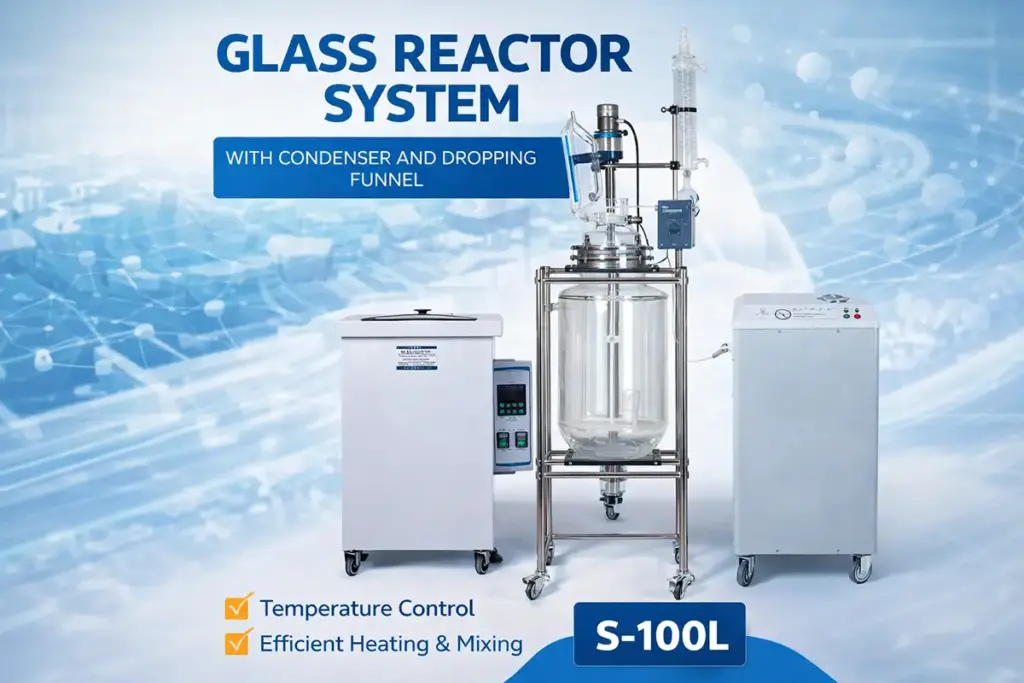
Typical glass reactor system layout with vessel, condenser, feeding port, and stirring assembly.
The Essential Configurations of a Complete Glass Reactor System
1. Jacketed Glass Reactor Vessel
The first required component is the reactor body itself, preferably a jacketed glass vessel. The jacket allows circulation of heating or cooling fluid, which is critical when reflux temperature or vacuum evaporation temperature must be controlled accurately. High-borosilicate glass is commonly used because it provides strong chemical resistance and good visibility during the process.
For small and medium applications, capacity can range from 1L to 100L. Based on the provided parameter data, models from 1L to 5L use a 12 mm stirring shaft and 60 W stirring power, while 10L to 100L models use 120 W or 250 W motors and larger shaft sizes on some models. This is important because viscosity, liquid volume, and feeding rate all affect mixing demand.
2. Stirring System with Adjustable Speed
If continuous dropping is involved, strong and stable stirring becomes essential. Freshly added liquid must be dispersed quickly to avoid local overheating, side reactions, or concentration layering. The supplied parameter sheet shows a stirring speed range of 0–600 rpm, with a maximum of 1300 rpm. That range is useful because different processes need different shear levels.
- Low speed helps reduce splashing and foaming.
- Medium speed supports general liquid-liquid or solid-liquid reactions.
- Higher speed improves mass transfer during feeding and vacuum distillation steps.
3. Condenser for Reflux Operation
To achieve reflux, a condenser is non-negotiable. Vapor from the reactor rises into the condenser, cools, and returns to the vessel. This allows heating without major solvent loss. For many organic reactions, reflux improves reaction rate and keeps the solvent composition more stable.
A vertical coil condenser or straight condenser is commonly selected. The key point is that cooling capacity must match vapor load. If the condenser is too small, solvent vapor may escape, vacuum stability may suffer, and process loss may increase.
Question: Can reflux and vacuum exist in the same glass reactor system?
Answer: Yes, but the design must be correct. In real use, the system needs a sealed condenser path, reliable vacuum connections, and controlled cooling. Under reduced pressure, boiling points drop, so condensation efficiency becomes even more important than in atmospheric reflux.
4. Vacuum System with Chemical-Resistant Sealing
A vacuum-capable setup requires more than a vacuum pump. It also needs a good sealing structure, vacuum valves, a receiving line if vapor is being collected, and a properly configured condenser. Many users overlook the seal and focus only on pump power. In reality, weak sealing is one of the most common reasons for unstable vacuum.
A complete vacuum section usually includes:
- Vacuum pump matched to solvent load
- Vacuum gauge or digital vacuum display
- Chemical-resistant tubing
- PTFE sealing parts and valves
- Cold trap or collection protection when needed
The U.S. National Institute for Occupational Safety and Health has long emphasized proper vapor control in laboratory chemical operations. This supports a simple conclusion: if the process uses volatile solvents, vacuum operation should always be planned together with condensation and vapor handling.
5. Continuous Dropping Device
For continuous feeding, a dropping funnel, constant-pressure dropping funnel, or metering pump inlet can be added. The right choice depends on how precise the feed rate must be. In many standard synthesis processes, a pressure-equalizing dropping funnel is enough. For more demanding work, a peristaltic pump or dosing pump gives better consistency.
The feed port should be positioned so that the liquid enters safely without interfering with stirring or causing backflow. For vacuum processes, a pressure-balanced feed structure is especially useful because it prevents sudden air intake.
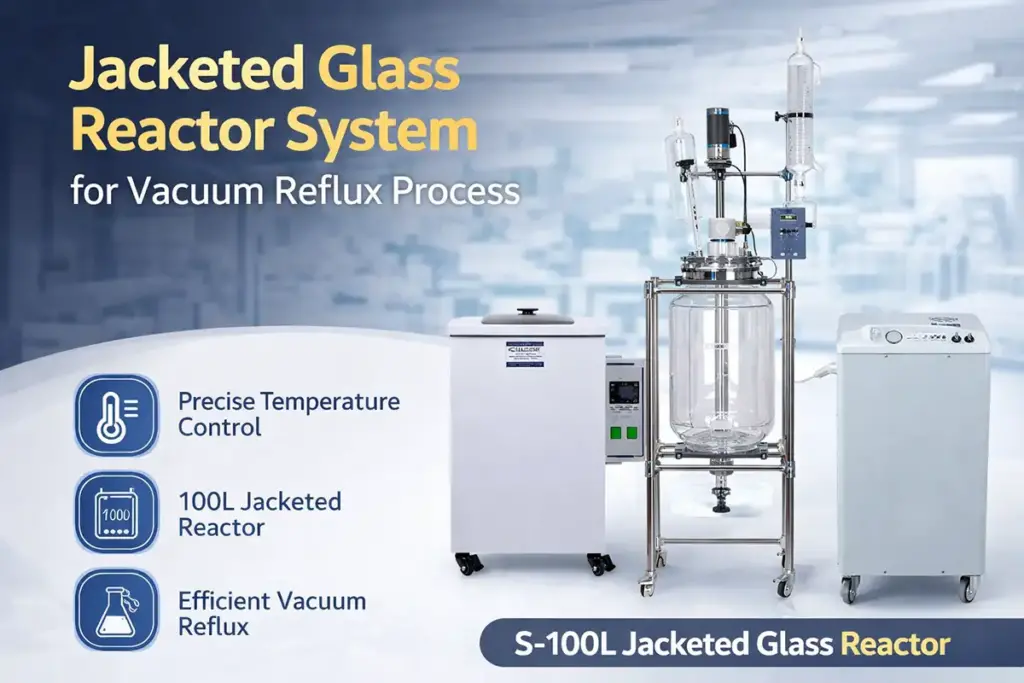
A jacketed glass reactor system helps combine temperature control, vacuum operation, and reflux in one process line.
Supporting Components That Make the System Truly Complete
Heating and Cooling Unit
Reflux and vacuum both depend on temperature control. A circulator or heating bath is needed for stable thermal management through the reactor jacket.
Support Frame
A floor-standing stainless steel frame gives better stability, especially for 10L to 100L models. The provided data notes a 304 stainless steel frame for larger units.
Explosion-Proof Option
Where flammable solvents are used, explosion-proof configuration is highly valuable. It is listed in the provided model notes and should be considered seriously.
For users comparing process equipment more broadly, related systems such as a rotary evaporator or a solvent recovery equipment setup may also be useful in post-reaction solvent handling. For applications involving higher pressure rather than vacuum glass operation, a high pressure autoclave reactor is a more suitable choice.
How to Match the Reactor Size and Motor Configuration
One common question is whether a smaller reactor can simply be used for every process. The answer is not always. Capacity affects condensation load, mixing strength, thermal response, and safe headspace. A reactor should not be selected only by the final product volume. It should be selected by actual working volume, reaction foaming, feed volume, and vapor generation.
| Model Range | Capacity | Stirring Power | Speed Range | Shaft Diameter | Power Supply | Key Notes |
|---|---|---|---|---|---|---|
| S-1L to S-5L | 1L / 2L / 3L / 5L | 60 W | 0–600 rpm (Max. 1300) | 12 mm | 220V 50/60Hz | Floor type, explosion-proof option, 110V/60Hz customizable |
| S-10L to S-100L | 10L / 20L / 30L / 50L / 100L | 120 W / 250 W | 0–600 rpm (Max. 1300) | 12 mm / 15 mm | 220V 50/60Hz | 304 stainless steel frame, explosion-proof option, 110V/60Hz customizable |
Question: What matters more when choosing capacity: total vessel volume or actual process demand?
Answer: Actual process demand matters more. In equipment selection, working volume, reflux intensity, vacuum evaporation load, and feed rate all decide the final reactor size. A vessel that is too full leaves little space for vapor circulation and safe dropping, which reduces operating stability.
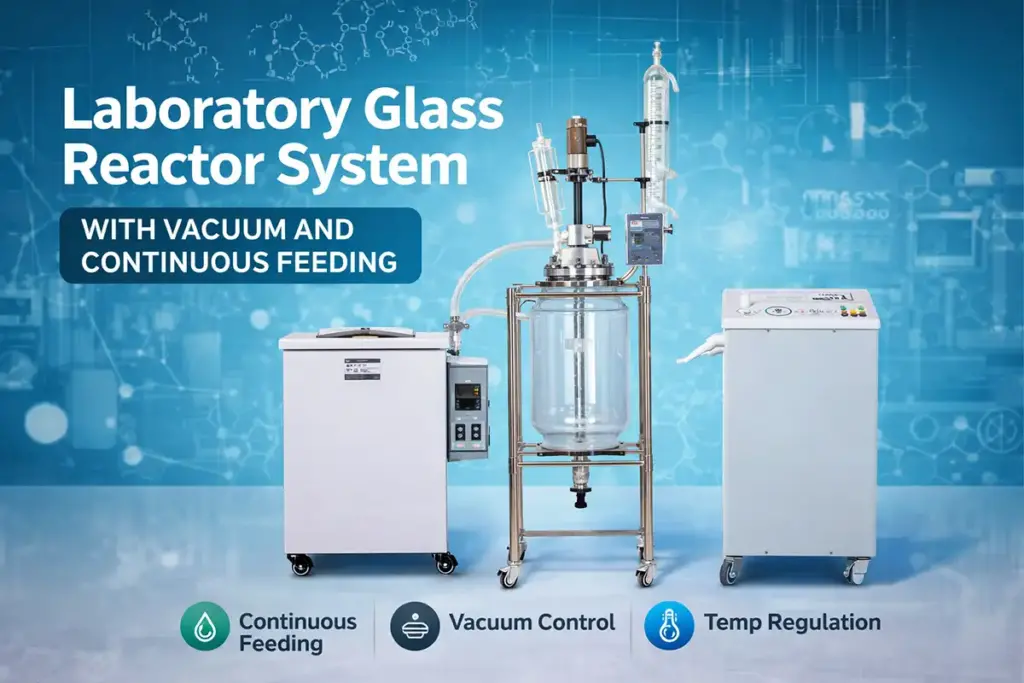
A complete laboratory glass reactor system should be configured for safe stirring, controlled addition, and efficient condensation.
The Best Practical Configuration for Running All Three Functions Together
If the goal is to perform reflux, vacuum, and continuous dropping at the same time, the recommended configuration is straightforward:
- Jacketed glass reactor vessel with enough working headspace
- Mechanical stirrer with adjustable speed and suitable torque
- Efficient condenser matched to solvent vapor load
- Vacuum pump with gauge, resistant tubing, and sealed connections
- Dropping funnel or metering feed device designed for controlled addition
- Heating/cooling circulator for stable jacket temperature
- Support frame with safe, rigid structure
- Optional explosion-proof configuration for solvent-heavy applications
In short, the answer is not complicated: a complete glass reactor system must be built as an integrated process unit, not as separate random accessories. Reflux depends on condensation, vacuum depends on sealing, and continuous dropping depends on controlled feeding plus strong mixing. These three functions are interconnected, so the configuration must be planned as one whole system.
Conclusion
A reactor that can truly handle reflux, vacuum, and continuous dropping at the same time needs the right vessel, the right condenser, the right stirring system, and the right auxiliary equipment. From the author’s perspective, the most common mistake is underestimating support components. Users often focus on reactor volume first, but real performance usually depends more on sealing, condensation, temperature control, and feeding design.
When these parts are selected correctly, the system becomes easier to operate, more stable during long runs, and more suitable for repeatable chemistry. That is what makes a complete glass reactor system valuable—not just the glass itself, but the way every component works together.
Note: Final configuration should always be matched to solvent type, reaction temperature, viscosity, corrosion conditions, and site power requirements.