
A laboratory high pressure reactor is used when a normal open beaker, glass flask, or atmospheric reactor cannot provide the pressure, temperature stability, sealing performance, or mixing strength required by the experiment. For many research teams, the most important question is simple: can the reactor hold the selected pressure safely while keeping the reaction temperature steady enough to produce repeatable results? A ZZKD stainless steel reactor is designed for this kind of work, especially in chemical synthesis, hydrogenation, catalyst screening, polymer research, material preparation, and small-batch process development.
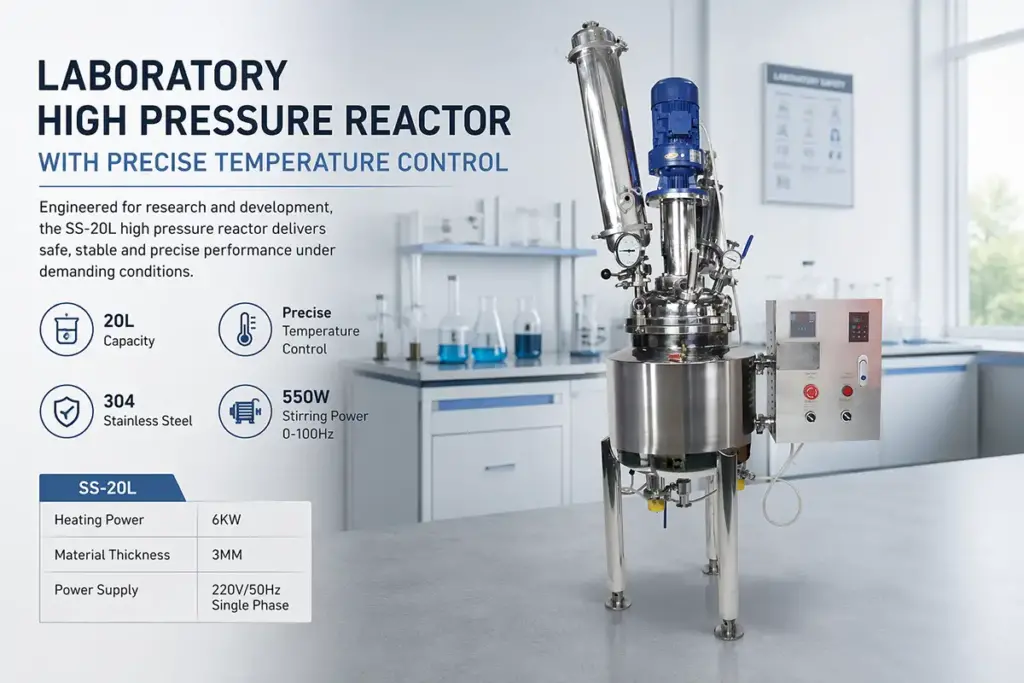
Why precise temperature control matters in a high pressure reactor
Pressure reactions are often sensitive to temperature. A few degrees of difference can change reaction speed, conversion rate, product purity, color, viscosity, or gas absorption. In hydrogenation, oxidation, esterification, catalytic synthesis, and high temperature extraction, stable temperature control helps the operator compare batches with confidence. It also helps reduce overheating, sudden boiling, excessive pressure rise, and unstable reaction behavior.
ZZKD laboratory reactors use a jacketed or double-wall structure for circulating heating or cooling media. The small SS-5L model supports circulation heating and uses a PT100 sensor with digital temperature display. Larger stainless steel models are designed for a temperature range around -100 to 299 degrees C, depending on the configuration and external circulation equipment. This means the same reactor platform can support low temperature research, moderate synthesis, and high temperature pressure experiments when matched with the right heater, chiller, or recirculating temperature controller.
What is inside a ZZKD stainless steel laboratory reactor?
A good stainless steel reactor should be easy to operate, easy to seal, and strong enough for repeated laboratory use. ZZKD models are commonly built with SUS304 or SUS316 stainless steel contact parts, depending on the model and customization needs. The SS-5L reactor uses 316 stainless steel for the reactor body, 304 stainless steel for the frame and piping, a mechanical seal, threaded union interfaces, and a ball quick discharge valve. These details matter because they affect corrosion resistance, cleaning convenience, service life, and pressure stability.
For mixing, the SS-5L model has a 0 to 600 rpm stirring range and a three-blade stainless steel stirring rod. Larger ZZKD stainless steel reactors also use digital display frequency conversion speed regulation, which allows smoother adjustment during different reaction stages. Slow mixing may be enough for homogeneous liquids, while higher speed mixing may be needed for gas-liquid reactions, slurry systems, catalysts, or viscous materials.
Main specifications buyers usually ask about
Before buying a laboratory high pressure reactor, most users want to know capacity, material, temperature range, pressure range, stirring speed, heating method, sealing method, and port configuration. ZZKD stainless steel reactors are available from small laboratory volume to pilot scale. The SS-5L model has a 5 L reactor volume and about 1.5 L mezzanine capacity. It supports -100 to 250 degrees C reaction temperature, -0.098 MPa to 0.5 MPa vacuum or pressure operation, 0 to 600 rpm stirring speed, 120 W stirring power, 220 V power supply, PT100 digital temperature display, and mechanical sealing.
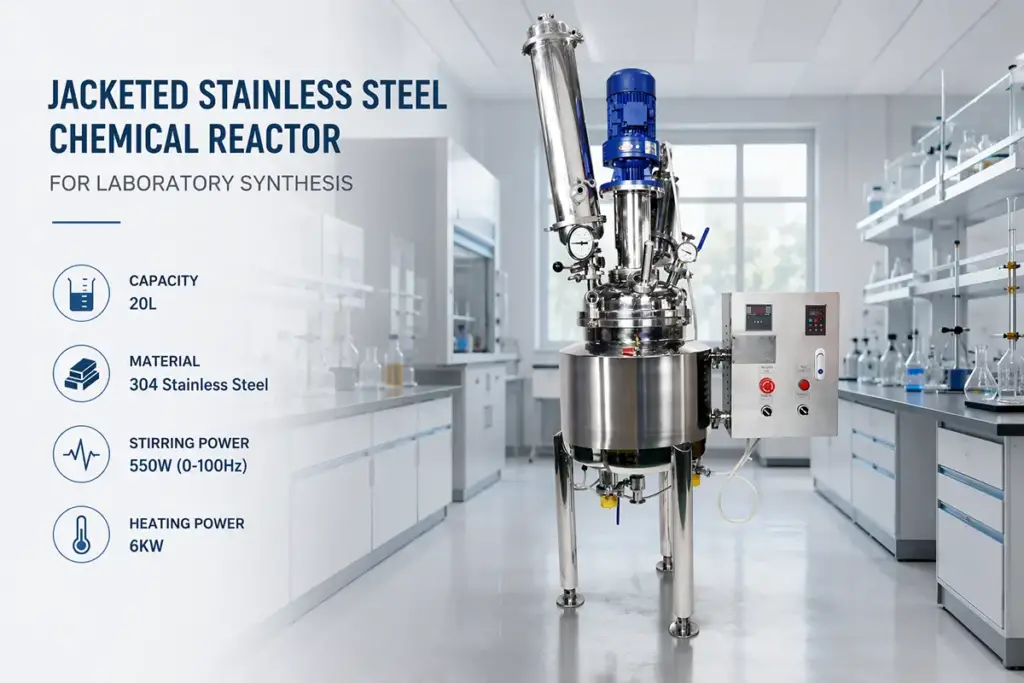
The SS-20L model is a practical step up for larger laboratory batches. It has 20 L capacity, 304 stainless steel construction, 550 W stirring power, 6 kW heating power, and 3 mm material thickness. For 10 L, 20 L, 30 L, 50 L, 100 L, 150 L, 200 L, and 300 L models, the common series specification includes a double-wall stainless steel kettle body, SUS316 or SUS304 material options, 0 to 600 rpm stirring, -0.1 MPa to 0.5 MPa working pressure, and multiple lid openings for feeding, observation, pressure measurement, temperature measurement, condensation, and other process needs.
If your application involves chemical synthesis under pressure, it may also be useful to compare your process with a dedicated stainless steel chemical reactor page, especially when you need corrosion resistance, stable agitation, and a stronger structure than a glass reactor can provide.
How much does a laboratory high pressure reactor cost?
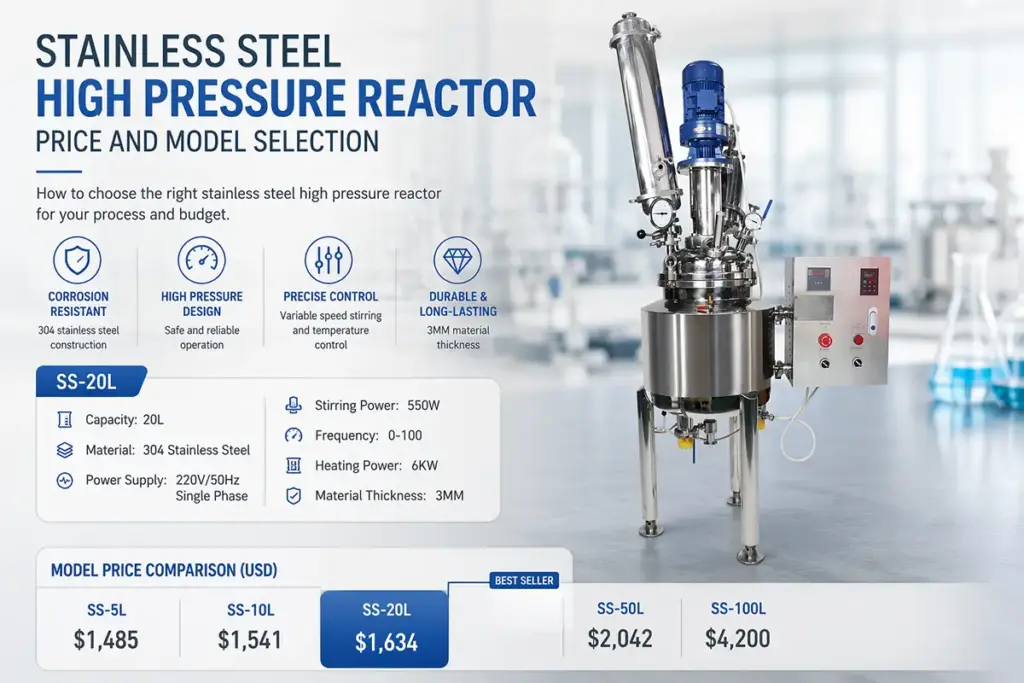
Price depends on volume, material grade, pressure design, heating method, controller type, sealing structure, ports, condenser, pH measurement, explosion-proof requirements, and whether the system includes a heater or chiller. Based on ZZKD product pricing, a 5 L jacketed stainless steel reactor is commonly listed around $1,485. A 20 L stainless steel reactor is around $1,634. A 50 L stainless steel reactor is around $2,042. A 100 L decarboxylation jacketed stainless steel reactor is commonly quoted from about $3,300 when choosing a cost-effective configuration from the available price range.
These prices are useful for budget planning, but the final quotation should match the actual process. For example, a simple 304 stainless steel reactor for general liquid-phase reactions will cost less than a customized SUS316 reactor with special ports, stronger sealing, condenser accessories, pH meter, or advanced temperature circulation system. If the process involves aggressive solvents, acids, bases, hydrogen, or long high temperature operation, it is better to confirm material compatibility and safety margin before choosing only by price.
Which size should a laboratory choose?
For early research and formula exploration, a 5 L reactor is usually easier to install, clean, and control. It is suitable for universities, research institutes, and small R&D labs that need reliable pressure and temperature control without occupying too much space. A 20 L reactor is better when the formula is more mature and the user needs enough material for downstream testing. A 50 L reactor is a common pilot scale choice because it gives more realistic mixing, heating, and discharge behavior. A 100 L reactor is suitable for pre-production trials, decarboxylation, larger synthesis batches, and process transfer before industrial production.
The working volume should not be selected only by the maximum vessel size. Operators should consider filling ratio, foam, gas space, heat transfer area, stirring efficiency, sample quantity, and cleaning method. For many pressure reactions, leaving enough headspace is important because gas expansion, vapor pressure, and foaming can increase total system pressure. If a reaction is new or not fully understood, starting with a smaller laboratory model is usually the safer and more economical path.
Typical applications
A ZZKD laboratory high pressure reactor can be used for catalyst testing, hydrogenation research, hydrothermal synthesis, polymerization, material modification, solvent reaction, decarboxylation, esterification, resin research, and small chemical production trials. It is also useful when users need to observe how temperature, pressure, stirring speed, and reaction time affect yield. For more general pressure reaction background, the ZZKD guide on a lab scale high pressure reactor provides additional context for laboratory users.
Compared with glass reactors, stainless steel reactors are stronger and more suitable for pressure operation. Compared with large industrial reactors, laboratory models are more flexible, easier to move, and better for repeated process trials. ZZKD stainless steel reactors can also be customized with different openings, condensers, pressure gauges, temperature sensors, feeding structures, and discharge valves to match different workflows.
Safety and operation tips
High pressure equipment should be operated by trained personnel. Before use, check the sealing surface, mechanical seal, pressure gauge, temperature sensor, discharge valve, stirring shaft, and all connections. Do not exceed the rated pressure or temperature of the vessel, gasket, seal, hose, or external circulation system. Heat slowly for unfamiliar reactions, keep a safe pressure relief plan, and record temperature and pressure changes during the run. After operation, allow the reactor to cool and depressurize safely before opening.
Cleaning is also part of safety. Residual material can corrode stainless steel, block valves, affect the next batch, or create unexpected reactions. For sticky, crystalline, or catalyst-containing systems, choose a structure that is easy to open and wash. If the material is corrosive, ask ZZKD whether SUS304, SUS316, PTFE lining, or another custom material is more suitable.
FAQ
Can one reactor control both heating and cooling?
Yes, a jacketed stainless steel reactor can work with external heating and cooling circulation equipment. The final temperature range depends on the reactor, jacket design, heat transfer fluid, and connected temperature controller.
Is 0.5 MPa enough for every high pressure reaction?
No. Some laboratory reactions need only mild pressure, while hydrogenation or special gas reactions may need a higher pressure design. Always match the pressure rating to the actual process and safety standard.
Should I choose SUS304 or SUS316?
SUS304 is suitable for many general laboratory processes. SUS316 offers better corrosion resistance for more demanding solvents or reaction media. The best choice depends on chemicals, temperature, pressure, and cleaning method.
Why choose ZZKD?
ZZKD offers multiple laboratory and pilot-scale stainless steel reactor models, practical temperature control options, stirring and sealing configurations, and customization support for different chemical research and production needs.