
Probiotic powder buyers usually want clear answers, not complicated theory. The real questions are simple: can spray drying probiotics work, what affects survival, what machine size is practical, and how much budget is needed? This guide focuses on those answers and explains how ZZKD spray dryers help turn heat-sensitive probiotic liquids into stable powder with better control, repeatability, and commercial value.
Can probiotics really be spray dried?
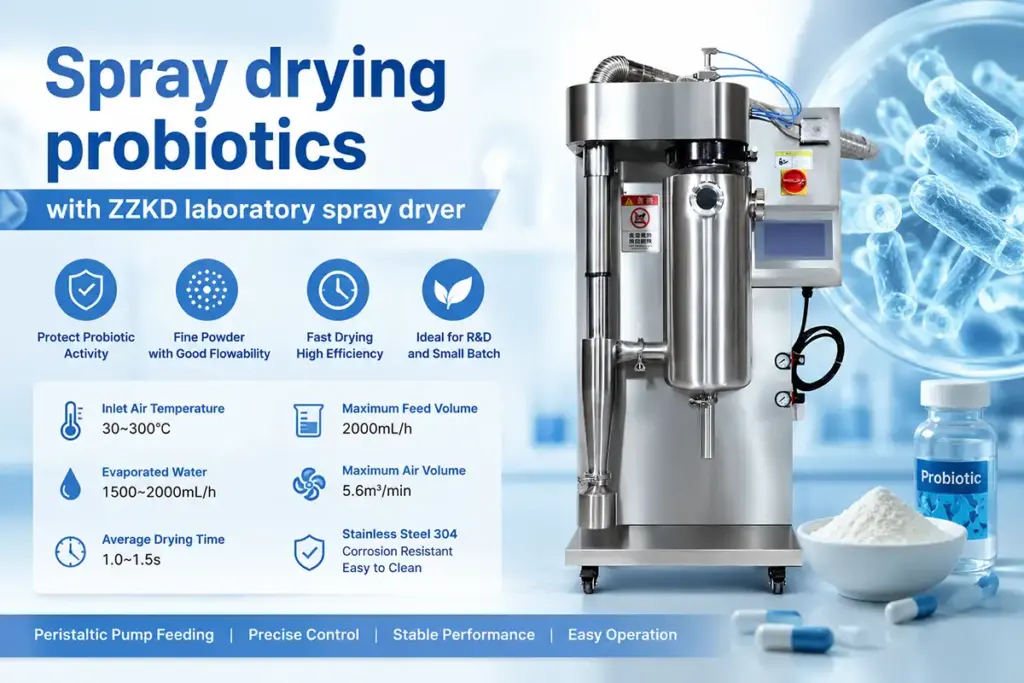
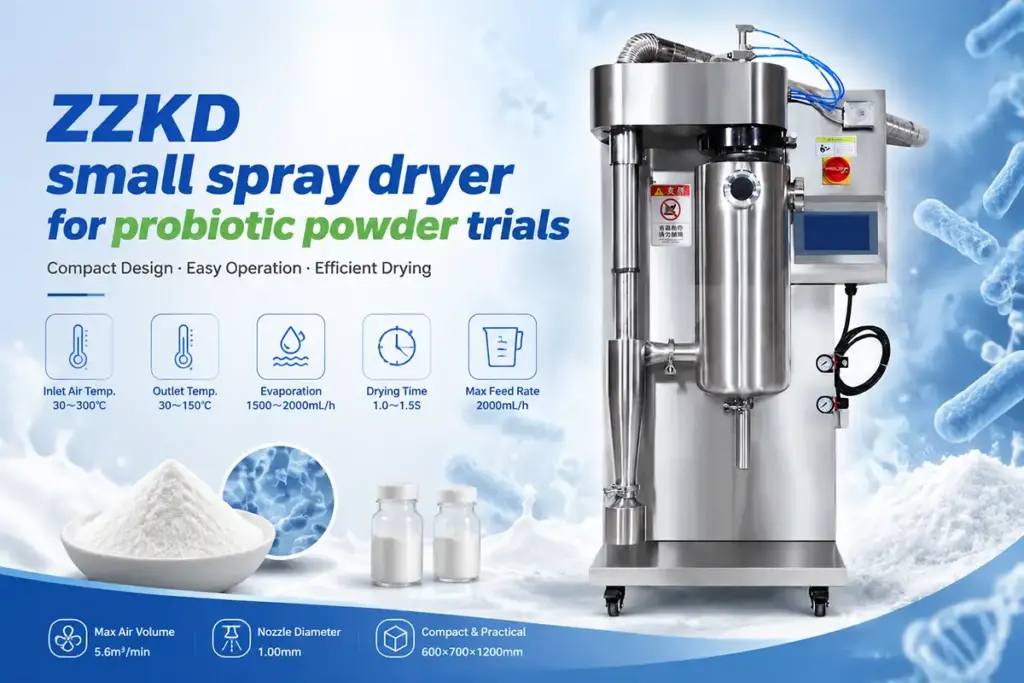
Yes, probiotics can be spray dried, but success depends on process control. Many buyers worry that hot air will simply kill the bacteria. In practice, the result depends on inlet temperature, outlet temperature, residence time, feed formulation, protective carriers, and atomization behavior. Spray drying is fast, and the droplet drying time is usually very short. For example, the ZZKD SD-2L and LPG-3L laboratory units work with an average drying time of about 1.0 to 1.5 seconds, which is important when handling sensitive bioactive materials.
Does high inlet temperature always mean poor probiotic survival?
Not always. The key point is that inlet temperature is only one part of the process. A properly designed formulation and a controlled outlet temperature can reduce thermal stress. Very short exposure time also matters. That is why a stable spray dryer is more valuable than simply choosing the lowest temperature setting.
According to a review published in Frontiers in Microbiology, drying technology and encapsulation strategy strongly influence probiotic survival during processing and storage. Research from the Journal of Food Engineering and related food science studies also shows that carrier systems such as maltodextrin, skim milk solids, gum arabic, or proteins can improve cell protection during spray drying. In short, the right machine must work together with the right formulation.
If a more basic overview of powder formation is useful before evaluating probiotic applications, this related article explains the spray drying process in a very clear way.
What matters most when spray drying probiotics?
When the goal is probiotic powder, buyers usually care about four things: survival rate, powder moisture, particle consistency, and scale-up confidence. These are the factors that deserve attention before choosing equipment.
1. Outlet temperature control
For probiotics, outlet temperature is often more useful than only watching inlet temperature. The ZZKD LPG-3L provides outlet temperature control from 30℃ to 140℃, while the SD-2L covers 30℃ to 150℃. This gives researchers room to optimize drying without blindly overheating the product.
2. Feed rate stability
Both the SD-2L and LPG-3L use peristaltic pump adjustment, which helps maintain a stable feed. For probiotic suspensions, stable feeding supports more uniform droplets and more repeatable powder behavior.
3. Small sample flexibility
Trials are often expensive when probiotic strains are valuable. The minimum feed amount on these models is 50 mL, which helps reduce material waste during formulation screening.
4. Fast development speed
Quick drying and adjustable temperature ranges let laboratories test different carriers, solids content, and atomization settings faster. That shortens the path from concept to pilot data.
Why is this important for a probiotic business?
Because the equipment does not just make powder. It affects product quality, shelf-life potential, validation workload, and the confidence to move from R&D into commercial production. A machine that is easy to control saves much more money than a machine that looks cheap on paper.
Buyers comparing general powder equipment may also want to read what is a spray dried powder, especially when building internal understanding across R&D and purchasing teams.
Which ZZKD spray dryer is suitable for probiotic work?
Choosing the right size depends on the real stage of the project. Not every probiotic developer needs a large unit at the beginning. A smart purchase starts with realistic throughput, available utilities, and trial objectives.
| Model | Best Use | Key Capacity / Range | Power / Notes | Reference Price |
|---|---|---|---|---|
| ZZKD SD-2L | Small-scale formulation screening | Evaporated water 1500-2000 mL/h; max feed 2000 mL/h; inlet 30-300℃ | 3.5 kW heater, AC220V, nozzle 1.00 mm | US$2,785 |
| ZZKD LPG-3L | Advanced lab optimization and pre-pilot trials | Evaporated water 1500-3000 mL/h; max feed 3000 mL/h; inlet 30-300℃ | 5 kW / 220V, ±1℃ control accuracy, optional nozzles | US$3,250 |
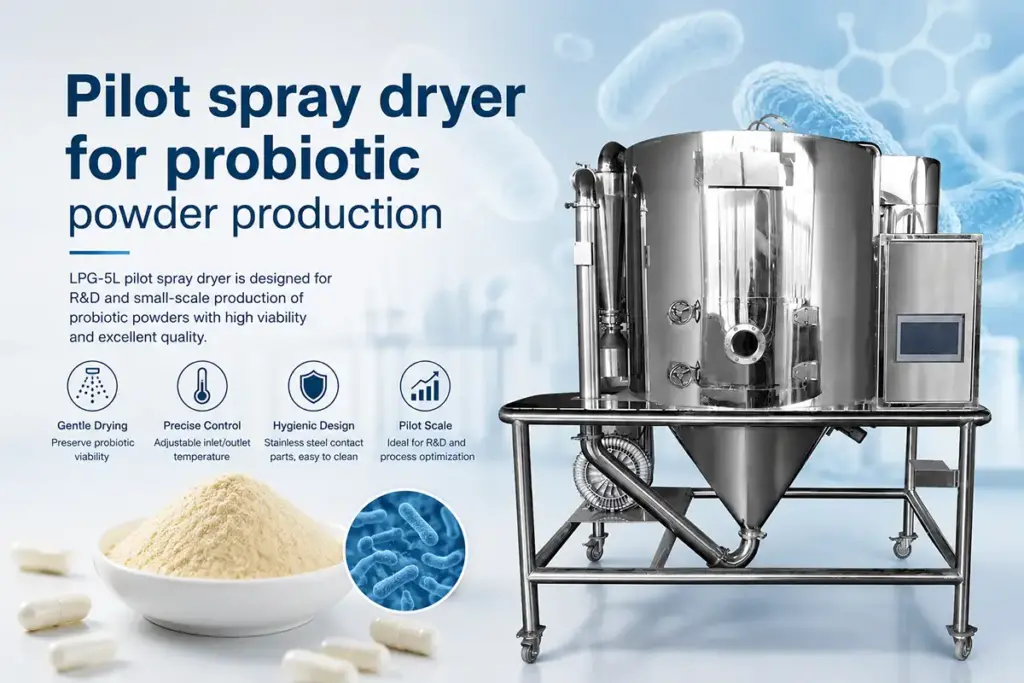
| ZZKD LPG-5L | Pilot scale and larger validation batches | Max water evaporation about 6 L/h; inlet up to 330℃; outlet up to 140℃ | 304 stainless steel, centrifugal atomization, 380V | US$7,428 |
| ZZKD LPG-10L | Pilot production and process scale-up | Moisture evaporation about 10 kg/h; inlet 140-350℃; outlet 80-90℃ | Compressed air transmission, high-speed rotary form | US$9,000 |
The prices above follow the provided pricing rule: when multiple prices exist, the selected number is the middle lower option. For example, the 5L market range often appears at US$7,000-9,400, so a practical reference is US$7,428. The 10L range often appears at US$9,000-12,000, so the lower-middle working figure is US$9,000.
Simple buying advice
If the project is still testing strain protection systems, start with SD-2L or LPG-3L. If the target is pilot validation, customer samples, or early scale-up, LPG-5L is usually the more efficient choice. If the business already knows the formulation and needs larger throughput, LPG-10L becomes more attractive.
How does spray drying compare with freeze drying for probiotics?
This is one of the most common buyer questions. Freeze drying is widely known for gentle treatment, but it is slower, usually more expensive, and often has lower throughput. Spray drying is continuous, faster, and easier to scale. For commercial probiotic products, that can be a major advantage.
If freeze drying is gentler, why do many companies still study spray drying probiotics?
Because industrial reality includes cost, speed, and production efficiency. Spray drying can offer a better balance between viability, output, and operating economics when the formulation and process are optimized correctly.
According to the U.S. Department of Energy, spray drying is one of the most widely used drying methods in industry because it combines continuous operation with efficient heat and mass transfer. In food and pharmaceutical development, that matters because a process must not only protect the ingredient, but also fit a real manufacturing budget.
If the team is comparing process principles in more detail, this article on the application of spray dryer helps connect technology choice with actual product categories.
Drying time: about 1.0-1.5 sMinimum sample: 50 mLLab to pilot scale optionsZZKD models from 2L to 10L+
What practical results should buyers expect?
A good probiotic spray dryer should deliver more than dry powder. Buyers should expect process visibility, repeatable settings, and enough flexibility to test carriers and operating windows. With ZZKD systems, the value is in practical control: adjustable feed, controlled air temperature, short drying time, and model options that match different development stages.
That means the expected benefits are usually:
- Faster screening of probiotic formulations
- Lower raw material waste during early R&D
- More consistent powder for downstream blending or filling
- Better confidence when moving from lab work to pilot scale
- More realistic cost control than using oversized equipment too early
Is the cheapest spray dryer the best choice for probiotics?
Usually no. For probiotics, unstable temperature control or poor feeding consistency can cost far more in failed tests, wasted cultures, and delayed scale-up. A better-value machine is the one that helps produce usable data and reliable powder.
Why choose ZZKD for spray drying probiotics?
ZZKD is a practical choice for buyers who need a clear path from laboratory trials to pilot production. The product line covers compact lab models and larger pilot units, which makes scale-up planning easier. For probiotic applications, that matters because a successful process is rarely built in one step.
From a sales and investment perspective, the strongest reasons are straightforward:
- Lower entry point: small models such as SD-2L and LPG-3L allow affordable process development.
- Usable technical ranges: broad inlet and outlet control windows support sensitive material testing.
- Scalable product line: the move from 2L or 3L to 5L and 10L is much easier when staying within one equipment family.
- Commercial logic: equipment cost remains reasonable compared with the value of saved development time and faster launch.
For companies looking at spray drying probiotics not just as a lab experiment but as a real product opportunity, ZZKD offers a balanced solution: controlled drying, flexible sizing, and pricing that makes sense for serious development work.
Final recommendation
If the goal is to evaluate probiotic viability, optimize carrier systems, and move toward reliable powder production, a ZZKD spray dryer is a strong fit. Start small for strain screening, move to 5L for pilot verification, and scale to 10L when throughput becomes the priority. That step-by-step approach reduces risk and makes investment easier to justify.
For probiotic powder development, the best machine is not simply the hottest, biggest, or cheapest one. It is the spray dryer that gives stable control, useful test data, and a smooth path to commercial production. That is exactly where ZZKD stands out.