
When researchers, pilot labs, and process development teams look for a compact pressure vessel, the 1 liter stainless steel reactor is often one of the most practical options. It is small enough for controlled screening work, yet large enough to produce meaningful data for scale-up. For many laboratories, this size sits in the sweet spot between a very small autoclave and a larger pilot reactor.
A 1 liter stainless steel reactor is commonly used when the reaction must be carried out under pressure, with heating, stirring, vacuum, or controlled feeding. Compared with glass systems, stainless steel is usually preferred for higher pressure work, solvent resistance, improved durability, and safer operation in demanding conditions. This is why it is often chosen for hydrogenation, polymerization, catalytic synthesis, solvothermal reactions, and other closed-system experiments.
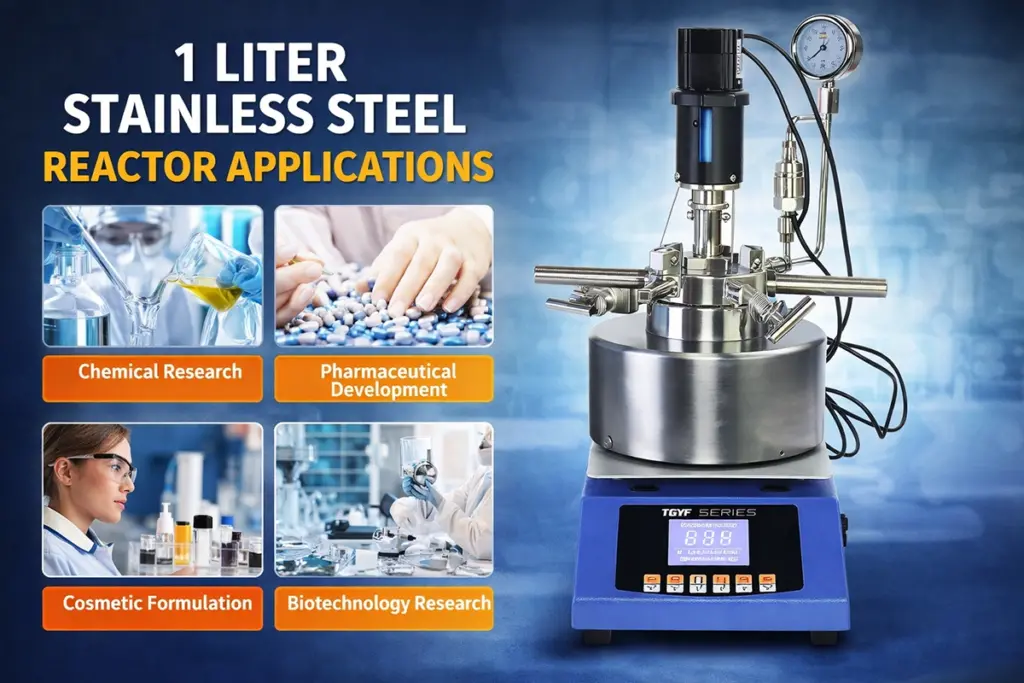
What small-scale high-pressure reactions is a 1 liter stainless steel reactor suitable for?
From the perspective of practical lab work, this reactor size is especially suitable for reaction screening, process optimization, catalyst evaluation, and small-batch synthesis. It is not mainly about producing large output. It is about obtaining reliable reaction data under controlled pressure and temperature.
The most common applications include:
- Hydrogenation reactions in pharmaceutical, fine chemical, and catalyst research.
- High-pressure synthesis where inert gas or reactive gas must be introduced.
- Solvothermal and hydrothermal reactions for new material development.
- Polymerization reactions that require sealed conditions and steady agitation.
- Liquid-phase catalytic reactions where temperature, pressure, and mixing all affect yield.
- Small-batch corrosive or solvent-based reactions that are not ideal for glass vessels.
In many labs, a 1 liter vessel is also used before moving to a lab scale high pressure reactor with a larger capacity. This step-by-step approach helps reduce development risk and improves repeatability.
Could a 1 liter reactor be too small for useful process development? In the author’s view, not at all. For early-stage route screening or parameter optimization, 1 liter is often large enough to observe heat transfer behavior, gas-liquid contact, agitation effects, and product isolation trends, while still keeping raw material consumption under control.
Why is stainless steel a strong choice for this reactor size?
The answer is simple: many small-scale high-pressure reactions are not just about volume. They are about safety margin, corrosion resistance, and process reliability. Stainless steel reactors are widely used because they can tolerate demanding reaction media better than many fragile alternatives.
For example, 316 stainless steel is widely recognized for strong corrosion resistance in chemical processing. According to the Nickel Institute, molybdenum-bearing stainless steels such as 316 provide better resistance to pitting and crevice corrosion than 304 in chloride-containing environments. That matters in a closed pressure system, because material failure is never a minor issue.
The parameter information provided for related stainless steel reactor models also shows what serious users usually pay attention to: reactor material, jacket structure, temperature range, vacuum range, stirring speed, seal design, discharge method, and interface configuration. Even though the listed models include 5L, 20L, 50L and above, the same selection logic directly applies to a 1 liter stainless steel reactor.
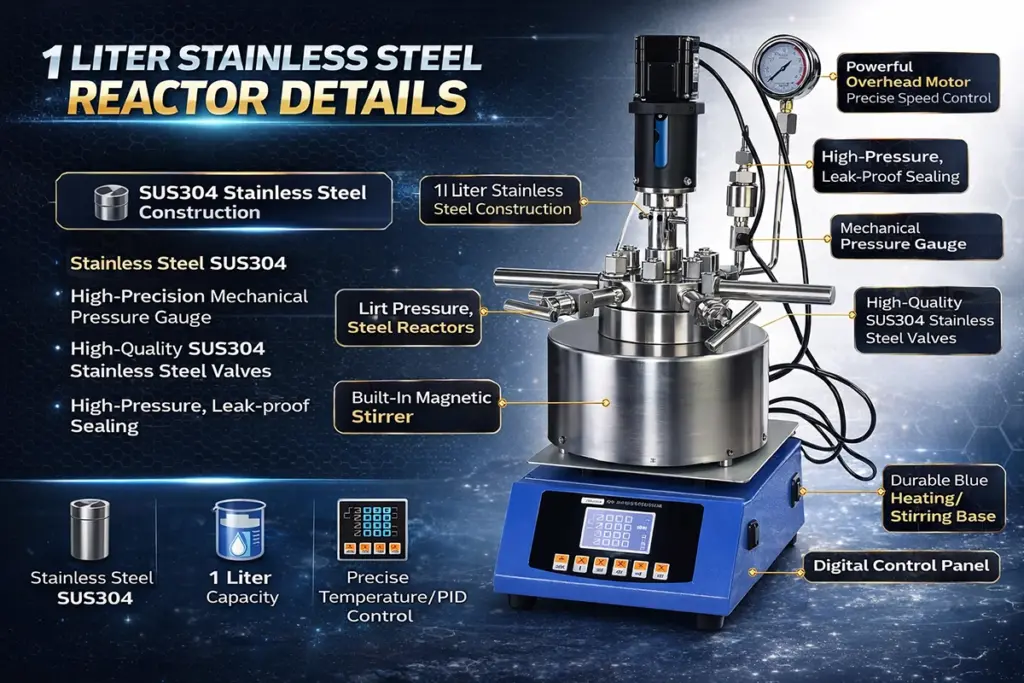
What should be checked first when selecting a 1 liter stainless steel reactor?
If only one thing had to be checked first, it would be this: the actual reaction conditions. A reactor should not be selected by volume alone. The most important question is whether the equipment matches the real temperature, pressure, solvent, and stirring requirements of the intended process.
The author recommends focusing on the following points in order:
1. Material of construction
For high-pressure chemical work, the vessel material is one of the first filters. If the process involves corrosive solvents, salt-containing systems, or stricter cleanliness requirements, 316 stainless steel is generally a safer choice than 304. The provided 5L specification uses 316 stainless steel for the reactor vessel, while some larger standard models offer SUS316/SUS304 options. That is a useful clue: material selection should always follow the chemistry, not just the budget.
2. Pressure and temperature range
A small reactor may still face demanding process conditions. The referenced stainless steel reactor specifications show working pressure ranges up to 0.5 MPa and temperature ranges from -100°C to 250°C or even -100°C to 299°C for some series. That is important because many lab users first ask about capacity, while the real pass-or-fail factor is often pressure-temperature compatibility.
According to the U.S. Department of Energy, reaction rate often increases significantly with temperature, which is one reason laboratory thermal control directly affects both productivity and safety. A reactor that cannot maintain stable thermal conditions may give misleading scale-up data.
3. Stirring performance
Mixing is often underestimated. Yet in gas-liquid, solid-liquid, or viscous systems, poor agitation can lead to uneven heat transfer, lower conversion, and inconsistent repeatability. The reference parameters show stirring speeds up to 0–600 rpm with digital frequency-conversion control in several stainless steel reactor models. For a 1 liter stainless steel reactor, variable-speed stirring is highly valuable because screening work may involve both low-viscosity and more demanding media.
Is high stirring speed always better? The answer from the author’s standpoint is no. What matters more is whether the stirrer design, torque, and speed range fit the specific reaction system. Some reactions need strong dispersion, while others need gentle mixing to avoid foaming or crystal breakage.
4. Sealing method
For pressure work, the sealing system is one of the most critical details. The supplied specifications mention mechanical seals, ceramic combined mechanical seals, and PTFE mechanical seals. These details are not minor accessories. They directly influence leak prevention, service life, and maintenance frequency. For flammable solvents or pressurized gas reactions, good sealing is essential.
5. Port configuration and feeding flexibility
A useful small reactor should not be a simple sealed pot. It should support real lab operation. The 5L parameter list includes ports for stirring, solids charging, temperature measurement, pressure gauge connection, constant-pressure funnel connection, and condensation reflux, with customization possible. This is exactly the kind of flexibility many users should expect when choosing a 1 liter stainless steel reactor for research use.
If solvent recovery or reflux is part of the workflow, combining the reactor with suitable downstream lab equipment can improve efficiency. In some cases, a rotary evaporator may be useful after reaction completion, especially for solvent removal and concentration steps.
Which users benefit most from a 1 liter stainless steel reactor?
This size is especially practical for:
- University research laboratories
- Pharmaceutical R&D teams
- Fine chemical development labs
- Catalyst screening groups
- New materials and nanomaterials researchers
- Companies doing small pilot verification before scale-up
According to the U.S. National Science Foundation, experimental reproducibility remains a major issue across research environments. In the author’s opinion, properly selected reaction equipment is one of the simplest ways to improve data consistency. A reactor that offers stable temperature reading, controllable stirring, and dependable sealing helps reduce unnecessary variables in every batch.
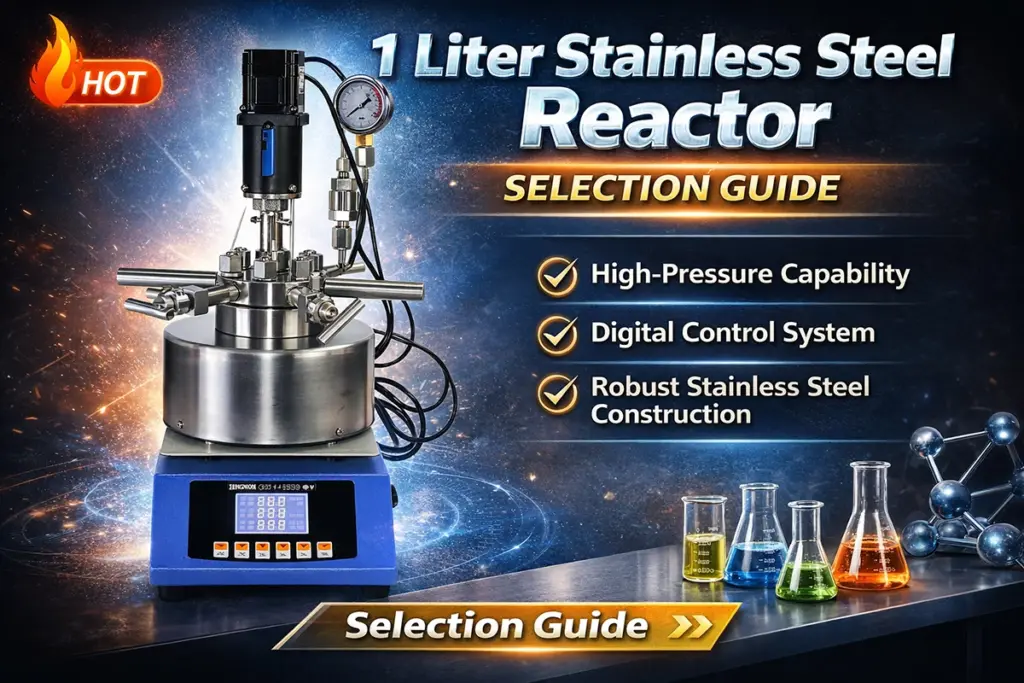
So, what matters most in the end?
If the question is reduced to one practical answer, it is this: choose the reactor based on process demands, not just nominal capacity. For a 1 liter stainless steel reactor, the most important factors are vessel material, pressure rating, temperature range, stirring quality, sealing reliability, and port design.
What is the biggest selection mistake seen in small high-pressure reactor purchases? From the author’s perspective, it is choosing by price and volume first, while leaving chemistry compatibility and operating conditions for later. That often leads to limited usability, difficult maintenance, or poor data quality.
A well-matched 1 liter stainless steel reactor can do much more than hold a reaction mixture. It can serve as a dependable platform for safe screening, accurate optimization, and smoother scale-up decisions. For labs working with pressure, temperature, and challenging solvents, that makes it a highly valuable investment.
For users comparing reactor types, it may also be helpful to review options such as a stainless steel chemical reactor when future scaling or broader process flexibility is part of the plan.