
A 20 liter rotary evaporator is a workhorse for medium‑scale solvent recovery and concentration. This article explains how it works, what to look for in the specifications, and how to decide if a 20L rotovap fits a specific process.
1. What Is a 20 Liter Rotary Evaporator?
A 20 liter rotary evaporator (20L rotovap) is a piece of equipment used to gently and efficiently remove solvents from liquid mixtures under reduced pressure. Compared with 1–5 L benchtop units, a 20L system is designed for pilot‑scale and small industrial production, where batches of several liters up to about 20 L need to be concentrated or solvent needs to be recovered.
In many laboratories and plants, evaporation and solvent recovery are among the most energy‑intensive steps. A study from the U.S. Department of Energy on chemical manufacturing showed that separation processes such as distillation and evaporation can account for up to 40% of total process energy. A properly sized rotary evaporator, including a 20L unit, can significantly reduce both time and energy consumption compared to open boiling or simple distillation.
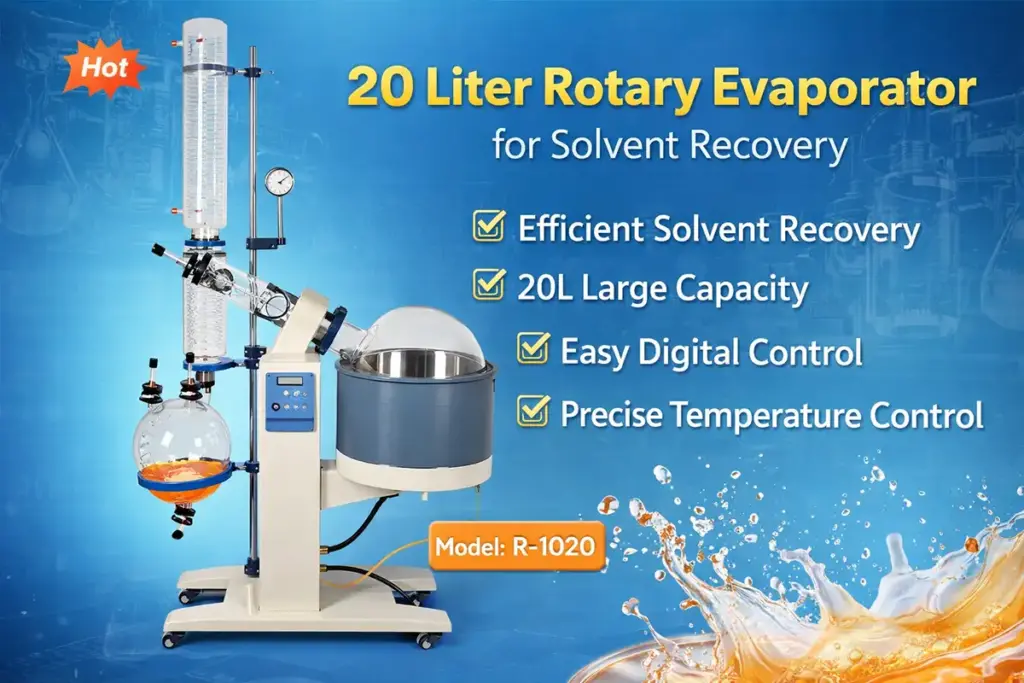
Typical layout of a 20 liter rotary evaporator with vertical condenser and water/oil bath.
Core Components of a 20L Rotovap
- Rotating evaporating flask (20 L) – holds the feed solution and provides a large surface area.
- Receiving flask (10 L typical) – collects the condensed solvent.
- Motor and drive – rotates the flask at a controlled speed.
- Heating bath – usually water or oil, heats the solution under vacuum.
- Condenser – vertical, double‑coil or double‑condenser design to efficiently condense vapor.
- Vacuum sealing system – PTFE and fluoro rubber seals to maintain low pressure.
- Lifting mechanism – raises/lowers the flask and bath, manual or electric.
Question: When is a 20 liter rotary evaporator more suitable than a 5L benchtop unit?
Answer (author’s view): It becomes a better choice when typical batch volumes exceed 2–3 L and when the same solvent needs to be evaporated repeatedly. At that point, the higher evaporation rate (for example >5 L/h water on a 20L unit) and larger flask drastically reduce total processing time and labor cost.
2. How Does a 20L Rotary Evaporator Work?
The working principle is the same as smaller rotary evaporators but implemented on a larger scale:
- Vacuum is applied to the system, lowering the boiling point of the solvent.
- The 20L flask rotates, forming a thin liquid film on the inner wall.
- A heated water or oil bath (typically RT–99 °C, optionally up to 250 °C) provides the energy needed to vaporize the solvent.
- The solvent vapor travels up into the vertical double condenser, where chilled coolant removes heat and condenses the vapor.
- The liquid solvent drips into the receiving flask, ready for reuse or safe disposal.
Compared with static distillation, thin‑film evaporation and vacuum allow much lower temperatures and shorter residence times. This is especially important for heat‑sensitive compounds in pharmaceuticals, fine chemicals and natural extracts.
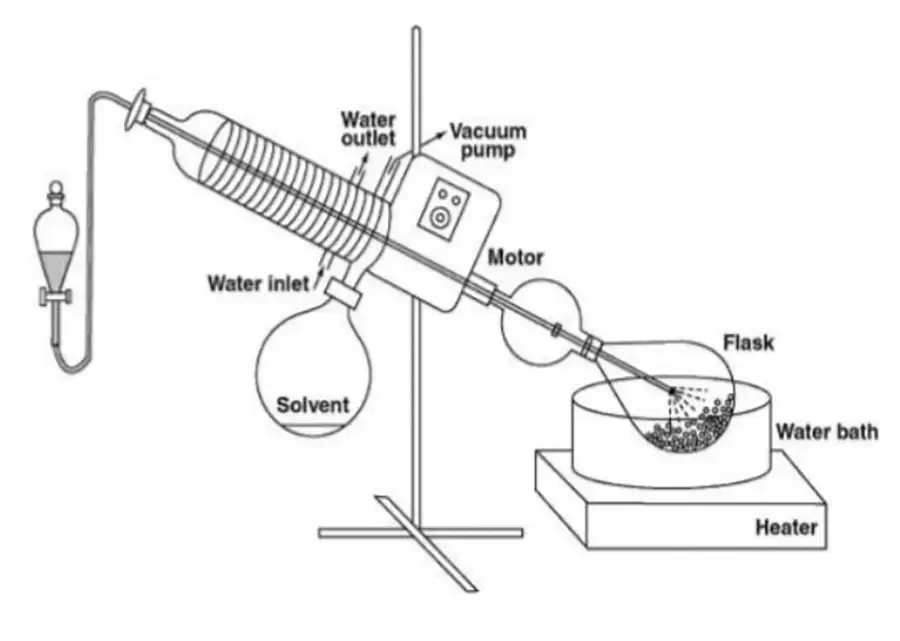
Under vacuum, the solvent boils at a lower temperature, protecting heat‑sensitive products.
3. Key Technical Parameters of 20L Rotary Evaporators
Below is a simplified comparison using typical data from medium‑scale models (10–50 L) based on the RE‑1002 / RE‑2002 / RE‑5002 and R‑series rotary evaporators. The 20L rotary evaporator falls in the middle of this range.
Selected Technical Parameters (10L – 50L Models)Focus: 20 liter rotary evaporator
| Model | Evaporating Flask | Receiving Flask | Motor Power | Rotating Speed | Bath Power | Evaporation Rate (H₂O) |
|---|---|---|---|---|---|---|
| RE‑1002 | 10 L | 5 L | 180 W | 0–120 rpm | 3000 W | >3 L/h |
| RE‑2002 (20L) | 20 L | 10 L | 250 W | 0–90 rpm | 5000 W | >5 L/h |
| RE‑5002 | 50 L | 20 L | 250 W | 0–90 rpm | 7000/9000 W | >9 L/h |
For comparison, smaller models like the RE‑201D, RE‑301 or RE‑501 (2–5 L flasks) typically have 40 W motors and 1200–1500 W baths with evaporation rates around >1–1.5 L/h of water. The 20 liter rotary evaporator thus offers several times the throughput while still operating on standard laboratory utilities (e.g., 220 V/50 Hz or three‑phase 220–240 V/380 V/60 Hz depending on the series).
Question: Does a higher evaporation rate always mean that the process will be proportionally faster?
Answer (author’s view): Not always. Evaporation rate is measured under specific conditions (usually water at a defined temperature and vacuum). Actual throughput depends on the solvent type, boiling range, viscosity, and how close the operating vacuum and temperature are to these ideal conditions. However, for the same solvent and similar conditions, a 20L rotovap with >5 L/h capacity will usually finish a batch significantly faster than a 5L unit.
4. Typical Applications of a 20L Rotovap
The 20 liter rotary evaporator is designed for scenarios where lab‑scale equipment is too small but full production systems are not yet justified. Common applications include:
- Solvent recovery from reaction mixtures or cleaning solutions in fine chemical and specialty manufacturing.
- Concentration of plant extracts (herbal, nutraceutical, CBD and essential oils) under mild conditions.
- Crystallization preparation by concentrating solutions prior to cooling or antisolvent addition.
- Process development – scaling from 1–5 L trial batches to 10–20 L pilot batches.
- Cleaning solvent recycling before feeding to a larger solvent recovery machine or central recycling unit.
A survey among European pharmaceutical process development groups published in an industry journal showed that over 60% of pilot‑scale solvent removal steps (for heat‑sensitive compounds) were conducted using rotary evaporators or thin‑film evaporators rather than conventional batch distillation, mainly because of better temperature control and product quality.
5. How to Read the Specifications When Choosing a 20L Rotary Evaporator
When comparing different 20 liter rotary evaporator models, the datasheet can look overwhelming. Focusing on a few key lines usually answers most practical questions.
5.1 Evaporating and Receiving Flask Volume
A nominal 20L model such as RE‑2002 uses a 20 L rotating flask and a 10 L receiving flask. In practice, it is advisable to fill the evaporating flask to about 50–70% of its volume to avoid bumping and splashing, especially when foaming solutions are used. This means that per batch, 10–14 L of liquid can be safely processed.
5.2 Motor Power and Rotation Speed
Motor power for 20L units (e.g., 250 W brushless motor in some R‑series models) should be enough to keep the flask rotating steadily even with viscous or partially crystallized solutions. Typical speed ranges are:
- RE‑series: 0–90 rpm for 20–50 L units.
- R‑series: 20–120 rpm or 10–140 rpm depending on the model.
Higher speeds create a thinner film, which increases the effective surface area and helps evaporation, but excessive speed can cause splashing. Most real‑world operations fall around 50–80 rpm for 20L flasks.
5.3 Heating Bath Range and Power
For a 20 liter rotary evaporator, a 5000 W water/oil bath is common. The specified control range is typically RT–99 °C for water and up to 250 °C when suitable heat transfer oils are used. Temperature fluctuation is usually around ±1 °C, as in the RE‑2002 data.
This power and control precision are important when dealing with higher boiling solvents (such as toluene or xylene) or when solvent mixtures need to be evaporated at carefully controlled temperatures to protect sensitive components.
5.4 Vacuum Performance and Sealing
Although the ultimate vacuum is often defined by the external pump, the rotary evaporator itself must maintain tight sealing. For smaller models (RE‑201D/301/501), the maximum vacuum degree is specified as <133 Pa (1.33 mbar, 1 Torr). The same sealing technology is applied to larger units:
- PTFE and fluoro rubber seals provide chemical resistance.
- Properly designed joints and gaskets minimize leakage and air ingress.
Stable vacuum is not just about speed. According to studies published in the Journal of Chemical & Engineering Data, even a 10–20 mbar variation in operating pressure can affect boiling points and concentration profiles in multicomponent mixtures, which may lower product reproducibility. A good 20L rotovap with reliable sealing helps keep these parameters stable.
5.5 Lifting Mode and Ergonomics
For 20L flasks that can weigh tens of kilograms when filled, electric or assisted lifting greatly improves safety and ergonomics. In the R‑series, 20L units (R1020) typically provide electric + manual lift with movement ranges around 0–190 mm, allowing the flask to be easily raised out of the bath when changing batches or responding to foaming.
6. Practical Selection Tips for a 20 Liter Rotary Evaporator
To decide whether a 20 liter rotary evaporator is the right choice, and which model to select, these practical points are usually more important than the full specification sheet.
6.1 Match Batch Size and Evaporation Rate
For typical batches of 5–10 L, a 10L unit might be enough. For 10–15 L batches or when multiple runs are scheduled every day, a 20L unit becomes much more efficient.
Assume a 20L rotovap with an evaporation rate of >5 L/h for water. If 10 L of solvent need to be removed, theoretical evaporation time is about 2 hours under ideal conditions. Even if real‑world performance is 20–30% lower, this still compares favorably with several runs on a smaller 5L unit, especially when considering operator time and handling.
Question: Is it advisable to buy a bigger (50L) rotary evaporator instead of a 20L model to “future‑proof” capacity?
Answer (author’s view): Not necessarily. A 50L system requires more space, stronger lifting mechanisms, larger chillers, and often higher‑capacity vacuum pumps. If regular batch sizes are below 15 L, a 20 liter rotary evaporator usually provides a better balance of cost, footprint and ease of use, with enough reserve capacity for moderate growth.
6.2 Consider the Solvent Portfolio
The boiling points and chemical compatibility of solvents should drive some choices:
- For low‑boiling solvents (e.g., hexane, acetone), focus more on condenser capacity and vacuum control.
- For higher‑boiling or viscous mixtures, prioritize a powerful bath and robust motor.
- Check the sealing materials (PTFE, fluoro rubber) against planned solvents to avoid swelling or degradation.
6.3 Integration with Vacuum and Chiller Systems
A 20L rotovap rarely works alone. It should be integrated with:
- Vacuum pump – chemically resistant, sized to handle vapor loads without excessive pressure fluctuations.
- Recirculating chiller – capable of maintaining low coolant temperatures at sufficient flow; capacity must match the evaporation rate.
- Solvent recovery or storage tanks – if the solvent is reused or treated further.
From an energy‑efficiency perspective, research in chemical engineering (for example, analyses published by the American Institute of Chemical Engineers) shows that combined optimization of vacuum, heating and cooling can reduce separation energy consumption by 10–30%. When selecting a 20L system, it is worth considering the entire setup, not just the rotary evaporator itself.
7. Safety and Good Operating Practices
Scaling from 2–5 L to a 20 liter rotary evaporator increases not only throughput but also stored energy and potential risk. Good practices include:
- Gradual vacuum ramping to prevent bumping and loss of product.
- Filling the flask below 70% of volume, especially for foaming solutions.
- Using appropriate glassware supports and handling tools to avoid mechanical shock.
- Regular inspection of seals and joints for signs of wear or chemical attack.
- Monitoring bath level and temperature to avoid dry heating or overheating.
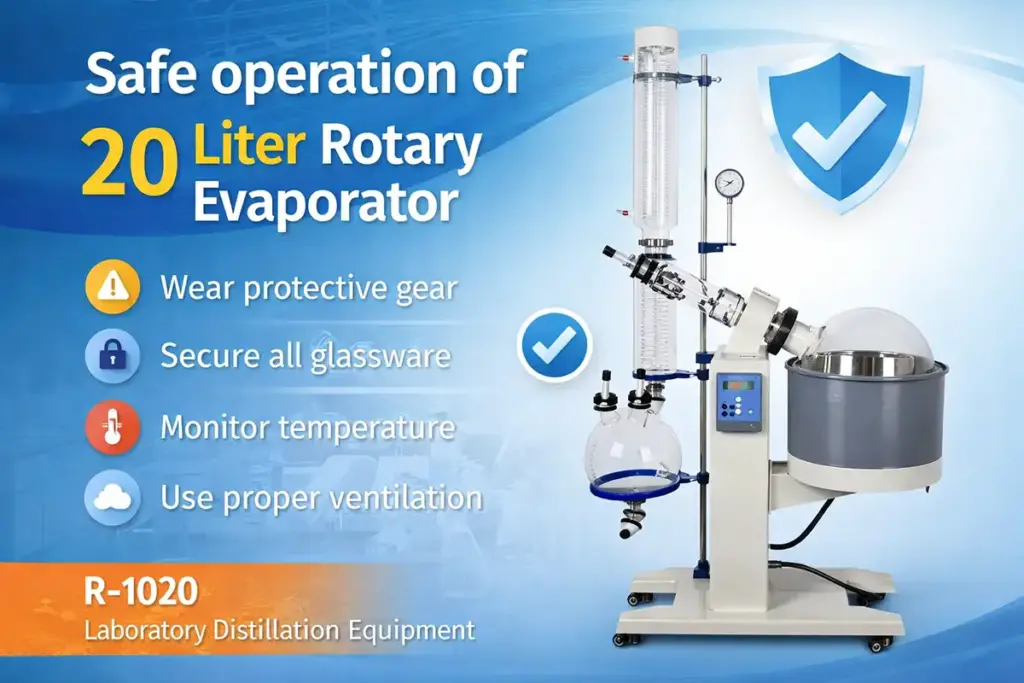
Proper filling, vacuum ramping and seal inspection are key to safe operation of a 20L rotovap.
8. Summary: When Does a 20 Liter Rotary Evaporator Make Sense?
A 20 liter rotary evaporator is an ideal solution in the following scenarios:
- Routine batches of 8–15 L that are too large for benchtop units.
- Need for efficient solvent recovery with evaporation rates of >5 L/h (water equivalent).
- Processes requiring precise temperature control and gentle vacuum for sensitive products.
- Pilot‑scale work that should be representative of later production while still fitting into a lab environment.
By focusing on a few key parameters—flask volume, evaporation rate, motor and bath power, vacuum sealing, and lifting design—it becomes straightforward to assess whether a specific 20 liter rotary evaporator matches the requirements of a particular process. When integrated with a correctly sized vacuum pump and chiller, a 20L rotovap can significantly reduce process time, energy consumption and solvent cost, while maintaining or improving product quality.
For users planning a complete solvent management strategy, combining a 20L rotary evaporator with dedicated solvent recovery units and appropriate downstream equipment provides a scalable and sustainable solution for laboratories and small‑scale production lines.
Note on data sources: Technical parameters quoted in this article are based on typical specifications of RE‑series (RE‑201D/301/501, RE‑1002/2002/5002) and R‑series (R1005/1010/1020/1050) rotary evaporators. Energy and separation process statistics reference published reports and articles from organizations such as the U.S. Department of Energy, the American Institute of Chemical Engineers, and peer‑reviewed chemical engineering journals.