
Understanding how a chemical glass reactor works, which parameters actually matter, and how to select the right volume and stirring power for laboratory and pilot‑scale work.
Updated for 2025 · Suitable for R&D labs, universities, and pilot plants
1. What Is a Chemical Glass Reactor?
A chemical glass reactor is a reaction vessel made mainly of high‑borosilicate glass, combined with a frame, motor, and control system. It allows chemists and engineers to carry out controlled reactions such as synthesis, crystallization, mixing, and solvent distillation under atmospheric or vacuum conditions.
Because the vessel is transparent, it is easy to observe phase changes, crystallization, emulsions, or foaming in real time. This is one of the main reasons glass reactors are widely used in organic synthesis, pharmaceuticals, fine chemicals, and teaching labs.
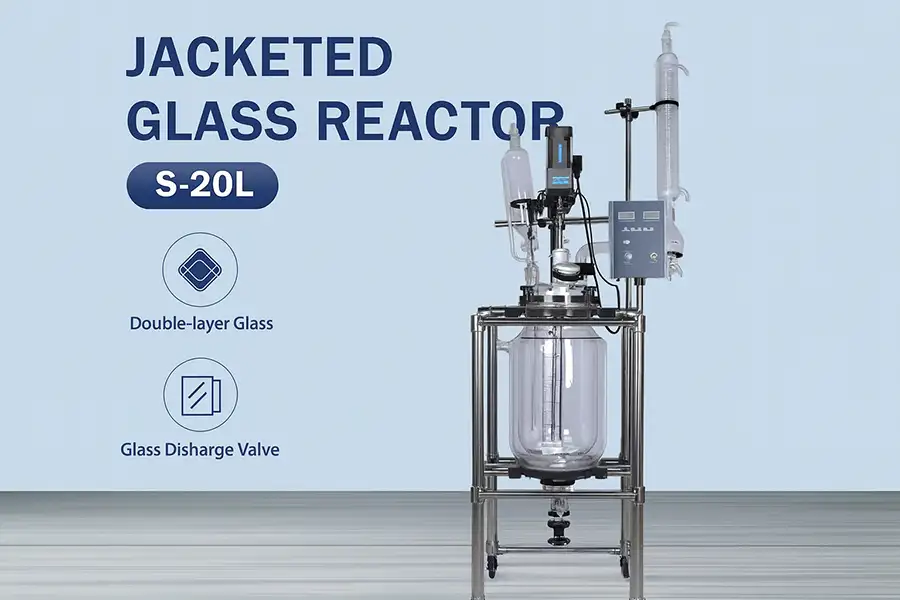
Typical laboratory‑scale chemical glass reactor with overhead stirring and glass vessel.
According to a 2023 survey by a European process‑chemistry association, over 65% of small‑molecule pharma development labs still prefer glass reactors over metal systems in the early R&D stage, mainly because of visual observation and easier cleaning.
In practice, a chemical glass reactor is often combined with a chiller or circulator for temperature control and with a vacuum pump if reduced pressure operation is needed. This creates a compact, flexible reaction platform that can be scaled from 1 L benchtop systems up to 100 L pilot reactors.
Question: Is a chemical glass reactor only suitable for low‑temperature reactions?
Answer: No. High‑borosilicate glass typically tolerates a wide temperature range (for example, from about −80 °C with proper fluid up to around +200 °C, depending on design). What matters is avoiding sudden thermal shock and following the manufacturer’s specified temperature and pressure limits.
2. Key Components and Why They Matter
Although designs vary, most chemical glass reactors share a few core components:
- Glass reaction kettle (vessel) – the main volume where the reaction takes place.
- Stirring system – motor, shaft, and impeller to mix reactants homogeneously.
- Support frame – often 304 stainless steel or coated steel to hold the glass safely.
- Sealing and accessories – PTFE or mechanical seals, addition funnels, condensers, etc.
- Control panel – for adjusting stirring speed, monitoring parameters, and safety functions.
Overhead stirring and stainless‑steel frame are critical for stable, long‑term operation.
For many users, the most confusing part is how to interpret parameters such as stirring power, torque, and stirring shaft diameter. These values directly influence viscosity handling, scalability, and safety.
3. Understanding Core Parameters of Glass Reactors
Below are typical parameters for double‑kettle glass reactors in the 1–100 L range, distilled into practical terms.
| Model | Reaction Kettle Capacity (L) | Stirring Power (W) | Stirring Speed (rpm) | Stirring Shaft Diameter (mm) | Motor Torque (g/cm) | Power Supply | Notes |
|---|---|---|---|---|---|---|---|
| S‑1L | 1 | 60 | 0–600 (Max. 1300) | 12 | 2000 | 220 V 50/60 Hz | Floor type; explosion‑proof versions available |
| S‑2L | 2 | 60 | 0–600 (Max. 1300) | 12 | 2400 | 220 V 50/60 Hz | |
| S‑3L | 3 | 60 | 0–600 (Max. 1300) | 12 | 4800 | 220 V 50/60 Hz | |
| S‑5L | 5 | 60 | 0–600 (Max. 1300) | 12 | 4800 | 220 V 50/60 Hz |
Optional configurations: stirring power 180 W, 250 W, or 370 W; power supply can be customized to 110 V / 60 Hz if required.
| Model | Reaction Kettle Capacity (L) | Stirring Power (W) | Stirring Speed (rpm) | Stirring Shaft Diameter (mm) | Motor Torque (g/cm) | Power Supply | Frame & Notes |
|---|---|---|---|---|---|---|---|
| S‑10L | 10 | 120 | 0–600 (Max. 1300) | 12 | 1000 | 220 V 50/60 Hz | 304 stainless‑steel frame; explosion‑proof versions available |
| S‑20L | 20 | 120 | 0–600 (Max. 1300) | 12 | 1200 | 220 V 50/60 Hz | |
| S‑30L | 30 | 250 | 0–600 (Max. 1300) | 15 | 1500 | 220 V 50/60 Hz | |
| S‑50L | 50 | 250 | 0–600 (Max. 1300) | 15 | 3000 | 220 V 50/60 Hz | |
| S‑100L | 100 | 250 | 0–600 (Max. 1300) | 15 | 3000 | 220 V 50/60 Hz |
Optional stirring power: 180 W, 250 W, 370 W; 110 V / 60 Hz supply can be customized for regions using that standard.
3.1 Stirring Power and Torque
Stirring power (W) and motor torque (g/cm) determine how viscous a fluid can be mixed effectively. For low‑viscosity solvents, 60–120 W may be enough. For more viscous slurries or crystallization slurries, higher power or torque (250–370 W and up) is safer.
Question: How much safety margin is reasonable when choosing stirring power?
Answer: A common engineering practice is to choose a motor with around 20–30% extra torque beyond what is calculated for the expected viscosity and solid content. This helps avoid stalling and reduces mechanical stress during start‑up or when crystals form.
3.2 Stirring Speed and Shaft Diameter
All the listed models offer a wide stirring speed range of 0–600 rpm, with a maximum of 1300 rpm. This allows gentle agitation for delicate crystallization, as well as faster mixing for emulsification or dispersion.
Shaft diameter (12 mm vs 15 mm) becomes more important at larger volumes. A thicker shaft provides more rigidity, reducing vibration and bending at 30–100 L scale, especially when a heavy impeller and viscous media are used.
3.3 Power Supply and Explosion‑Proof Options
The standard power supply is 220 V, 50/60 Hz, which covers most laboratories and pilot plants globally. For North American or Japanese sites, 110 V, 60 Hz configurations are often required and are available on request.
Explosion‑proof designs are recommended when working with flammable organic solvents, particularly under reflux or vacuum. This usually means an explosion‑proof motor, electrical box, and switches that comply with regional safety standards.
4. How to Choose the Right Chemical Glass Reactor Size
When selecting a chemical glass reactor, three questions should be clarified first:
- Required working volume per batch.
- Viscosity and solid content of the reaction mixture.
- Operating conditions: temperature, vacuum, and solvent flammability.
4.1 Typical Use Cases by Volume
- 1–5 L (S‑1L to S‑5L) – ideal for laboratory screening, method development, teaching experiments, and small‑scale synthesis.
- 10–20 L (S‑10L, S‑20L) – suitable for kilo lab, process optimization, and scale‑up studies.
- 30–50 L (S‑30L, S‑50L) – used in pilot‑scale runs, small production batches, or intermediate storage.
- 100 L (S‑100L) – often used in pilot plants or as a main reactor for high‑value fine‑chemical production.
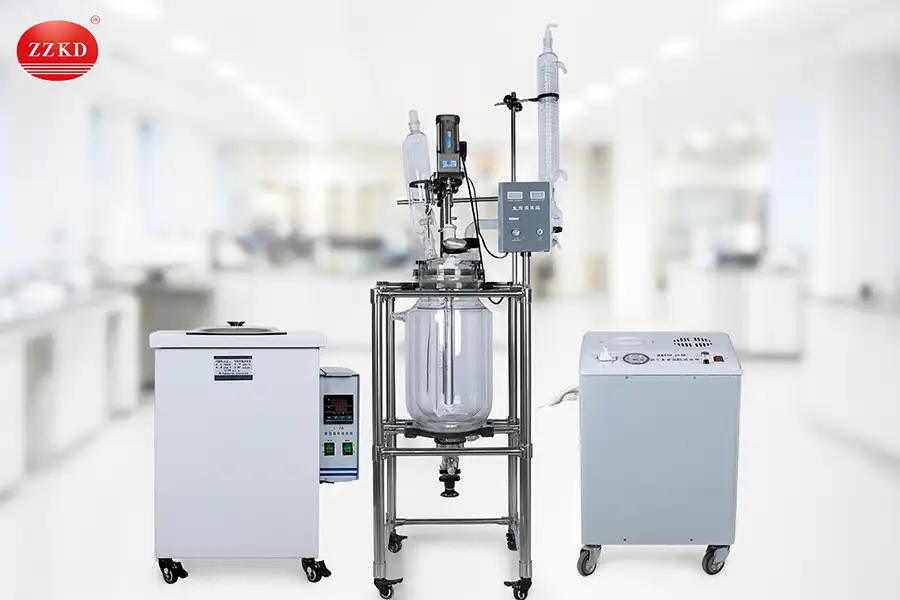
Larger volume chemical glass reactor for pilot‑scale synthesis and crystallization.
Practical Selection Tip
Working volume is usually 60–80% of nominal volume. For example, a 10 L reactor is typically comfortable at 6–8 L working volume, leaving headspace for foaming and vapor.
According to a 2022 survey in a major international pharma company’s process‑development division, moving from 5 L to 20 L glass reactors reduced the number of scale‑up steps by about 30%, saving several months in early development timelines.
Question: Is it better to buy a larger reactor “just in case”?
Answer: Oversizing by one step (for example using 10 L instead of 5 L) can be useful, but too large a reactor causes poor mixing at low fill levels, harder cleaning, and higher running costs. Matching the typical batch size to 60–80% of the vessel volume is usually a good balance.
5. Where Chemical Glass Reactors Fit in a Complete Lab Setup
A modern laboratory or pilot plant often combines a chemical glass reactor with other equipment to build a complete process line. For example:
- Reaction and crystallization: Chemical glass reactor with controlled stirring and jacketed heating/cooling.
- Solvent removal and concentration: Rotary evaporator or other distillation systems after the reaction step.
- Drying and solid isolation: Freeze dryer, spray dryer, or agitated nutsche filter dryer, depending on the product.
For instance, after using a 20 L chemical glass reactor for crystallization, the mother liquor might be concentrated using a rotary evaporator and then dried using a mini spray dryer or small freeze dryer. This integrated approach shortens development time from lab idea to small‑scale production.
Explore complementary equipment to build a complete process line:
· Stainless steel chemical reactor for higher‑pressure or higher‑temperature work.
· Solvent recovery distillation units for efficient solvent recycling after reactions.
6. Common Questions About Chemical Glass Reactors
6.1 Can a Chemical Glass Reactor Be Used Under Vacuum?
In most cases, yes, but only within the limits specified by the manufacturer. High‑borosilicate glass is suitable for moderate vacuum when the wall thickness and design are appropriate. For deep vacuum and high pressure combined, a stainless‑steel reactor may be more suitable.
6.2 How Difficult Is Cleaning and Changeover?
One practical advantage of glass is smooth surfaces, which simplify cleaning and minimize product adherence. Many users report significantly reduced cross‑contamination risks compared with porous or scratched metal surfaces. Detachable glass components also make visual inspection easier.
Question: How often should the seals and stirring components be checked?
Answer: For typical R&D and pilot use, a visual inspection after each campaign and a more thorough check every 3–6 months is common. Any sign of wear, cracking, or leakage around PTFE or mechanical seals should be addressed immediately to maintain vacuum and safety performance.
7. Summary: Choosing the Right Chemical Glass Reactor with Confidence
Selecting a suitable chemical glass reactor does not have to be complicated. Focusing on a few practical points is usually enough:
- Volume: match typical batch size to 60–80% of reactor capacity (1–5 L for lab screening, 10–20 L for kilo lab, 30–100 L for pilot scale).
- Stirring power and torque: ensure enough margin for viscosity and solid content, typically 20–30% above expected demand.
- Shaft and frame: 12 mm vs 15 mm shaft and 304 stainless frame improve stability at larger volumes.
- Safety: choose explosion‑proof configurations and the correct power supply standard for flammable solvents and regional regulations.
With a well‑chosen chemical glass reactor, it becomes much easier to design robust experiments, scale them up, and integrate downstream operations such as solvent recovery, spray‑drying, or freeze‑drying. This combination turns a single reactor into a central, reliable tool for both research and early‑stage production.Disclaimer: Technical specifications such as power, torque, and volume are indicative and may be adjusted in actual product configurations. For critical process design, always confirm the latest datasheets and safety ratings with the manufacturer or supplier.